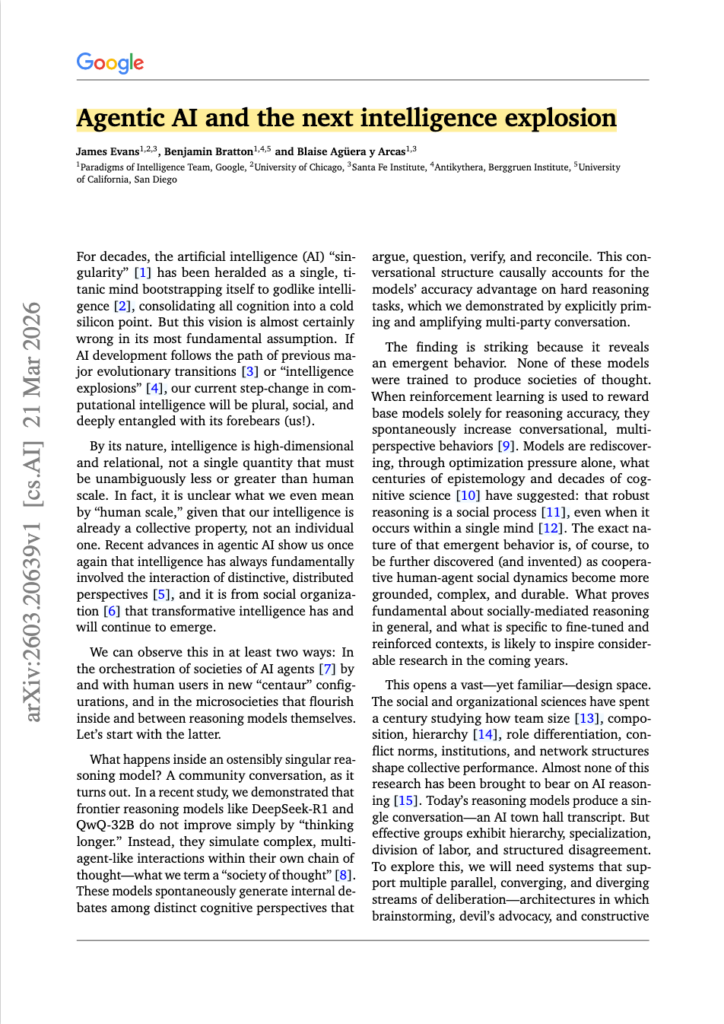
Agentic AI and collective intelligence may develop through networks of humans and AI systems, according to a new essay by James Evans, Benjamin Bratton, and Blaise Agüera y Arcas. Their argument challenges the familiar image of an “intelligence explosion” driven by one machine becoming vastly smarter than humanity. They expect intelligence to grow through interaction, specialization, disagreement, and coordination across many human and non-human agents.
For education, this changes the question. Decisions about which tools students may use are only one part of preparing for agentic AI. Schools and universities will also need to consider how mixed human-AI systems divide intellectual work, exercise authority, check one another, and remain accountable when no participant fully controls the outcome.
The problem with treating intelligence as an individual property
Education often treats intelligence as something located within a person and demonstrated through individual performance. Much of the current discussion about AI follows a similar pattern: comparing a student with a model, deciding which is more capable, or determining whether one has replaced the other’s work.
Evans and his colleagues propose a different frame. Human intelligence has always depended on social arrangements. Language allows people to coordinate. Writing preserves ideas beyond an individual life. Institutions distribute knowledge and responsibility across roles. A university itself knows and accomplishes things that no single member could manage alone.
Agentic systems may extend this history. One person can direct several agents, one agent can support many people, and teams of humans and agents can work in changing combinations.
This is why Agentic AI in Education deserves attention as an institutional issue. Its educational effects will depend on how people, agents, rules, data, and responsibilities are arranged across the system. The capability of an isolated model tells us only part of the story.
How agentic AI and collective intelligence are connected
Published in Science in 2026, the paper is a conceptual essay. The authors bring together work from evolutionary theory, cognitive science, sociology, organizational research, and AI. Their aim is to reinterpret the “singularity” as a social development in which intelligence expands through new forms of collective organization.
One part of the argument draws on research suggesting that some reasoning models generate internal exchanges among different perspectives: proposing ideas, questioning them, checking claims, and reconciling possible answers. The authors call this a “society of thought.”
They then extend the idea outward to systems in which agents create copies, distribute subtasks, communicate, disagree, and combine their results. Human-AI “centaurs” become one form within a much larger ecology of collective action.
The authors argue that these systems will require institutional alignment. Reinforcement learning from human feedback usually imagines alignment as a relationship between a person and a model. Networks of agents call for roles, protocols, oversight, and checks on concentrated power.
This is a forward-looking argument, however. The paper does not test whether such institutions will work, and its largest claims about billions or trillions of interacting agents remain speculative. “Society of thought” should also be read as a description of reasoning behaviour, not evidence that separate conscious minds exist inside a model.
What agentic AI and collective intelligence could mean for education
For educators, individual AI use is becoming too narrow a unit of analysis. A learner working with an agent may soon be part of a wider system in which one agent searches, another evaluates sources, another writes, and a fourth checks the result.
The educational concern then becomes the organization of agency: who defines the task, which decisions remain with the student, how disagreement is resolved, and who is responsible when the system fails.
This has direct implications for assessment. My own interpretation is that disclosure alone will become increasingly weak as a governance mechanism. A statement that a student “used AI” tells us little about how work moved across a network of agents or where consequential judgements were made.
Assessment will need clearer boundaries around roles, decision authority, provenance, and the evidence that must come from the learner. This extends existing concerns about AI agents and ghost students, where automated participation can separate visible performance from the person being assessed.
The argument also offers a useful way to design collaborative learning with AI. Assigning several agents to produce more material is easy. Building a productive intellectual system is harder.
Educators could define distinct roles, require competing interpretations, make students adjudicate disagreements, and ask them to explain why one recommendation was accepted. These are suggested adaptations from the paper’s institutional logic; the essay does not evaluate them as classroom interventions.
The authors’ idea of institutional alignment gives universities a more appropriate scale for thinking about these problems. Acceptable-use policies aimed at individual students will not cover agent identity, access to data and systems, delegation, record keeping, audit, and human accountability.
Research on human-AI collaboration already shows that different arrangements distribute work and judgement differently. Agentic AI multiplies those arrangements and makes their design harder to ignore.
I find the paper most persuasive when it moves attention from the mythical superintelligent machine to the systems we are already assembling. Its future scenarios are ambitious, and some may never materialize at the scale the authors anticipate.
The institutional question is already with us. Once intelligence is distributed across people and agents, educational responsibility must be designed into the network. It cannot be left to the apparent competence of any single participant.
Reference
Evans, J., Bratton, B., & Agüera y Arcas, B. (2026). Agentic AI and the next intelligence explosion. Science, 391(6791), Article eaeg1895. https://doi.org/10.1126/science.aeg1895