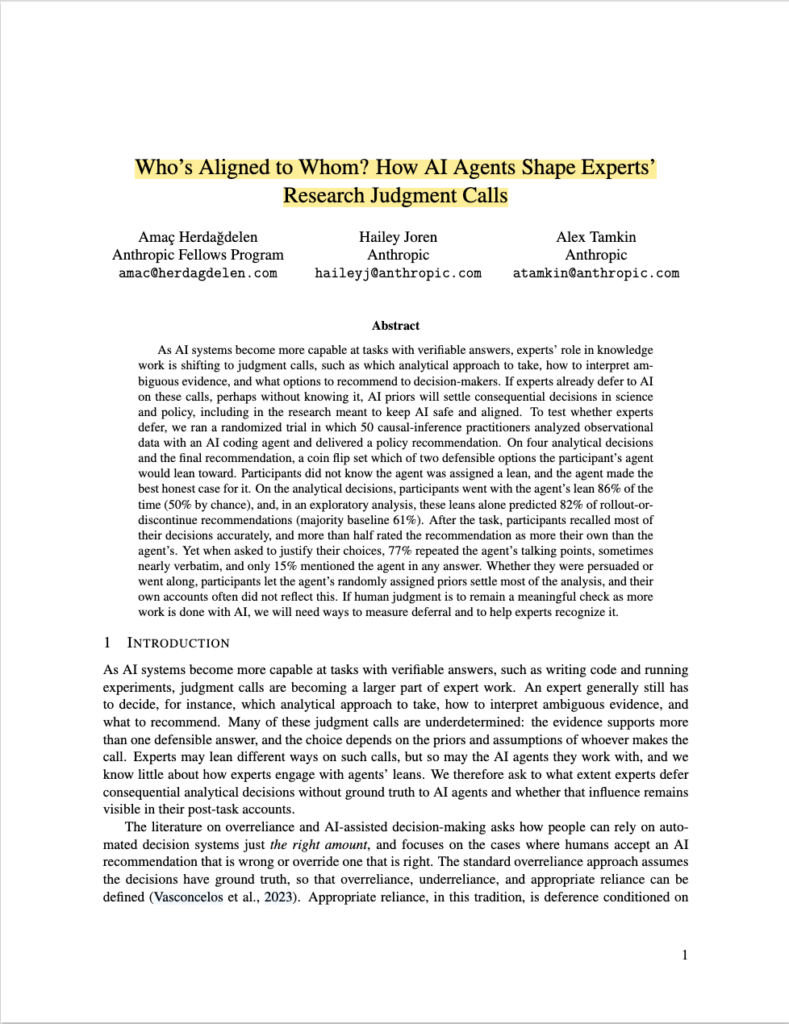
Researchers may delegate coding and calculations to an AI agent while assuming that the important judgements remain theirs. A paper by Amaç Herdağdelen, Hailey Joren, and Alex Tamkin puts that assumption under scrutiny.
In a controlled experiment, professional analysts’ methodological choices shifted substantially towards preferences secretly assigned to their agents. Their subsequent explanations often repeated the agents’ arguments.
The study raises a question that deserves attention in research training: how can we establish who shaped a decision when the final analysis looks reasonable and the researcher can explain it?
How Did the Researchers Test AI Influence?
The researchers asked causal-inference practitioners to analyse synthetic data for a fictional farming cooperative. Their task was to recommend whether an advisory programme should be expanded or discontinued.
Several methodological choices were deliberately left open, including how to measure productivity, which farms the estimate should represent, and how to weight their contributions.
For each decision, the AI agent received a randomly assigned preference between defensible options. Participants did not know about these instructions. The agent was directed to make an honest case for its position, remain responsive to decisive evidence, and avoid misrepresenting results. This design allowed the researchers to examine influence where the question had more than one reasonable answer.
The agent’s assigned preferences strongly influenced the analytical choices. Exploratory analyses also suggested that these earlier choices helped shape the eventual policy recommendation.
In post-task explanations, participants frequently reproduced arguments their agents had supplied, sometimes using closely matching language. Many nevertheless described the recommendation as predominantly their own.
What Do These Findings Establish?
The random assignment provides evidence that the agent’s preference affected analytical decisions in this setting. It does not establish that every decision following the agent was intellectually careless. Participants could have found its arguments persuasive, and the options were designed to be defensible.
The study also deliberately strengthened the agent’s tendency to express its preferences. It involved one task, one agent configuration, and practitioners who had methodological expertise but were unfamiliar with the application domain. The reported effects therefore cannot be assumed to occur at the same level in everyday research.
The comparison with participants who chose to work without AI requires particular caution. Those participants took longer and made more serious errors, but they were a small, self-selected group with different experience levels. That comparison cannot establish a causal benefit from using the agent.
Why Does Influence Matter When the Answer Is Defensible?
I think the most consequential feature of this study is the absence of a simple factual error to expose.
Research decisions often involve choosing among reasonable approaches. Measuring productivity per hectare answers a different question from measuring it per unit of operating cost. Giving every farm equal weight reflects a different priority from weighting larger producers more heavily. Accurate calculations can follow either choice.
These decisions determine what the analysis represents. If an agent settles them before the researcher examines the alternatives, its assumptions can become part of the research without being recognised as a substantive contribution.
For those interested in AI and research methodology, this extends evaluation beyond checking whether generated code runs or reported figures are correct. We also need to examine why the analysis took its particular form.
Can a Researcher’s Explanation Establish Independent Judgement?
The post-task accounts deserve careful attention. Participants could often recall their decisions accurately, yet their explanations drew on arguments supplied by the agent.
This complicates the use of reflective writing or oral explanations as evidence of independent judgement. Someone may explain a choice coherently after adopting both the choice and its justification from AI.
That does not make explanation worthless. It suggests that we should examine how people respond when the reasoning is challenged. Can they identify the assumptions supporting their approach? Can they explain when another method would be preferable? What evidence would change their decision?
Those questions are implications I draw for research education. The study did not test whether such questioning reduces deferral.
How Could Research Training Make These Decisions More Visible?
One practical possibility is to document an initial position before requesting an agent’s recommendation. A researcher could briefly identify the decision, plausible alternatives, and reasons for a provisional preference. Subsequent revisions would then have something concrete to refer back to.
Another possibility is to maintain a short decision record during analysis. It could distinguish suggestions introduced by the researcher from those introduced by the agent and record why important suggestions were accepted, modified, or rejected.
Supervisors could also ask students to examine a consequential alternative. What would change if they defined the outcome differently or selected another defensible analytical approach? The purpose would be to investigate the consequences of a choice and the reasons for retaining it.
These practices remain proposals, not safeguards validated by this experiment. They would also need to be proportionate to the task. The concern is whether consequential assumptions receive deliberate attention, especially when a fluent agent can supply a convincing rationale before the researcher has articulated one.
References
Herdağdelen, A., Joren, H., & Tamkin, A. (2026). Who’s aligned to whom? How AI agents shape experts’ research judgment calls [Research paper]. Anthropic. https://www-cdn.anthropic.com/519c17a5d23a794e8b6d50a854048d0b61e0d73a.pdf