
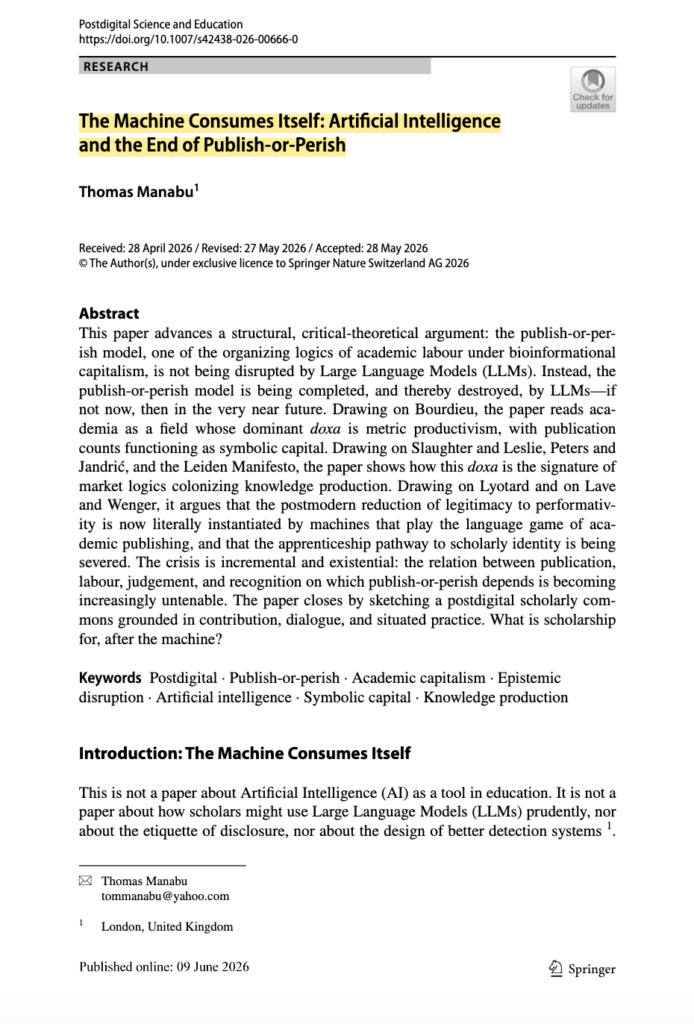
The conversation about AI and academic publishing fixates on who used a chatbot, who disclosed it, and whose detector caught what. Thomas Manabu (2026) thinks we’ve been staring at the wrong problem. In a new paper for Postdigital Science and Education, he argues that AI isn’t breaking the publish-or-perish system at all. It’s finishing it.
Manabu’s frame comes from Bourdieu. The academic field runs on symbolic capital, the recognition peers grant each other, and for forty years that capital has been counted in one currency: peer-reviewed articles, ranked by journal prestige and citation totals. He calls this logic metric productivism, and his sharpest claim is that universities deliberately built a machine to convert scholarly labor into countable units. GenAI is that machine reaching its conclusion.
Why AI and Academic Publishing Were Always Headed Here
This is where Manabu breaks from the usual story. Most accounts treat large language models as an external shock hitting an otherwise healthy enterprise. He treats them as endogenous, grown from inside the field itself. His reasoning is hard to dismiss. The peer-reviewed article was standardized long ago into a parsable object, with its fixed abstract, keywords, methods, results, and machine-readable identifiers, all built for indexing and retrieval. The field didn’t need AI to invade it. We trained ourselves to write for databases, and now the databases can write back.
When the Currency Stops Meaning Anything
The strongest section is on what Manabu calls the collapse of symbolic capital, and his logic is simple. Symbolic capital depends on scarcity. A publication count means something only because producing publications used to cost real human effort. Take out that cost and the whole chain from publication to reward starts to break.
He doesn’t hedge: “Currencies, when their backing fails, do not depreciate gradually. They lose function. A publication count, in 2026, does not mean what it meant in 2016.” He grounds the claim in real evidence, citing excess-vocabulary studies that estimate large shares of AI-mediated text in biomedical abstracts and analyses finding sizeable portions of AI-generated peer reviews at major venues.
This tracks with arguments I’ve followed elsewhere. Hartzog and Silbey made the case that AI corrodes institutions from the inside by hollowing out the trust they run on, and Manabu is describing that exact mechanism inside the publishing system. The verdict he lands on is bleak.
Peer review, the ritual that certifies a manuscript as serious, is now itself partly machine-generated, so the thing that legitimizes scholarship has been handed to the same engines producing it. He calls the likely end state “not the death of academic publishing but its zombification: the body continues to move, but its animating function has departed.”
How Scholars Get Made
The argument I’ll carry furthest isn’t about publishing metrics. It’s about formation. Manabu draws on Lave and Wenger’s idea of legitimate peripheral participation to show that scholars are made through slow, unglamorous tasks: reading closely, summarizing, drafting, revising, learning how a discipline forms its judgments. Every one of those tasks can now be handed to a model.
A doctoral student can ask AI to summarize the paper she hasn’t read, draft the literature review she hasn’t thought through, and generate the argument she hasn’t formed. None of it announces itself as a loss. It arrives as convenience. That, Manabu warns, is how the apprenticeship pathway gets severed, one small delegation at a time.
Where I’d Slow Him Down
I find the diagnosis bracing and mostly right. I’d still slow the funeral march. Manabu’s claim is deliberately total. The collapse is complete, detection can’t help, disclosure can’t help, better metrics can’t help, and he concedes the paper is immodest by design. The danger in that totality is fatalism, the feeling that nothing any of us does at the desk counts anymore. I don’t buy that. A polemic this absolute can talk itself out of the very agency it wants scholars to use.
There’s also an irony Manabu is candid about in his acknowledgements. He drafted parts of this paper with AI help. The machine that consumes the system wrote some of the indictment against it. That doesn’t weaken his case, but it shows how deep the dependence already runs, which is the territory Cleland and colleagues mapped in their work on AI disclosure in academic publishing. His worry about homogenization, that AI pulls scholarship toward the statistically likely and the already-said, lines up with what Sourati and colleagues found on the homogenizing effect of language models on thought.
Manabu ends by trying to build, not just mourn. He sketches a scholarly commons grounded in things that resist automation: recognition for datasets and code and public teaching, open and traceable peer review, and the embodied work of seminars, mentorship, and fieldwork that can’t be mass-produced because a person has to be in the room.
References
- Cleland, J., Driessen, E., Masters, K., Lingard, L., & Maggio, L. A. (2025). When and how to disclose AI use in academic publishing: AMEE Guide No. 192. Medical Teacher. https://doi.org/10.1080/0142159X.2025.2607513
- Hartzog, W., & Silbey, J. (2025). How AI destroys institutions [Draft]. Boston University School of Law. : https://scholarship.law.bu.edu/faculty_scholarship/4179
- Manabu, T. (2026). The machine consumes itself: Artificial intelligence and the end of publish-or-perish. Postdigital Science and Education. https://doi.org/10.1007/s42438-026-00666-0
- Sourati, Z., Ziabari, A. S., & Dehghani, M. (2026). The homogenizing effect of large language models on human expression and thought. Trends in Cognitive Sciences. Advance online publication. https://doi.org/10.1016/j.tics.2026.01.003