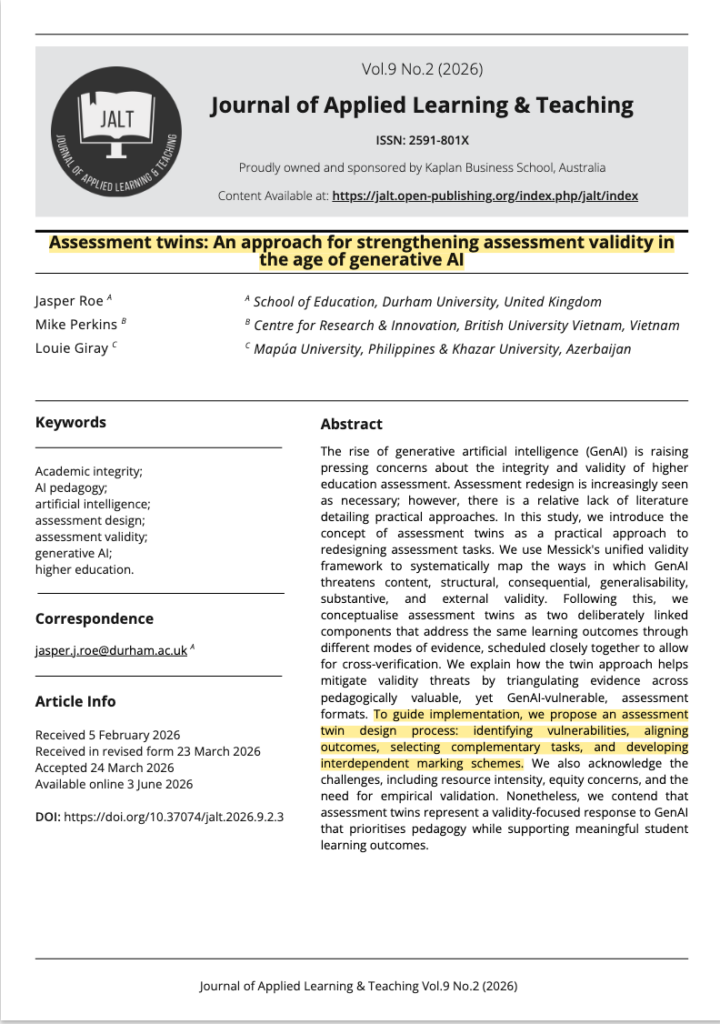
For two years now I’ve argued that cheating was the wrong thing to panic about. The real casualty of generative AI is assessment validity, whether a grade still tells you what a student actually knows. A new paper from Roe, Perkins, and Giray (2026) takes that view and builds something practical on top of it, which is why it held my attention.
Their starting point names the damage in a straightforward way. When a student can generate a polished take-home essay, report, or presentation script with little real effort, the grade stops working as evidence of learning. Roe et al. treat this first as a validity problem and only second as an integrity one.
That ordering matters to me, because it’s the same move Dawson and colleagues (2024) made in arguing that validity, not misconduct, is the real issue. Detection won’t rescue the situation. The authors accept the now-familiar finding that catching AI use in submitted work has become close to impossible, which lines up with Bassett and colleagues’ (2026) evidence that AI detectors don’t deliver, and they warn that surveillance corrodes the trust real reform depends on.
So what do you do? Guidance alone, ethics statements, AI literacy lessons, reflection tasks, banning tools, all lean on student compliance. Roe et al. argue that structural redesign is the more durable answer, echoing the case Corbin, Dawson, and Liu (2025) made that talk is cheap and the assessment itself has to change.
The Assessment Twin
Their proposal is the assessment twin. Two deliberately linked tasks measure the same learning outcomes through different kinds of evidence, scheduled close enough that one performance can be checked against the other. A take-home essay stays open to AI completion, so you pair it with a task that’s harder to fake: a short oral on the essay’s arguments, a timed in-class write, a live discussion, a physical artefact. The second task earns the name twin because it’s designed from the start as a validity response to a specific AI weakness, well beyond a generic oral bolted on at the end.
The point isn’t to scrap essays. Roe et al. are clear that writing an essay builds self-regulation and metacognitive awareness whatever happens to the final product, so the vulnerable task keeps its place for what students gain by doing it. One task supports learning, and the other confirms it.
What gives the framework its spine is its grounding in validity theory. The authors lean on Messick’s unified account and on Shaw and Crisp’s six strands, then map each way AI threatens validity to a tailored twin. If AI lets a student skip the learning, an in-person discussion of key concepts confirms genuine understanding. If AI shortcuts the cognitive work, asking the student to document their own thinking surfaces real engagement. The threat is diagnosed strand by strand, and the twin answers that specific threat.
Where It Gets Real: The Marking
The marking is where the idea grows teeth. A simple 50/50 split won’t do, because the two tasks have to depend on each other. Roe et al. offer two models. Under a threshold model, the student has to clear a minimum bar on the twin, say explaining two of the essay’s arguments aloud, for the essay grade to count at all. Under a confirmatory weighting model, the oral earns a small score and the essay mark is scaled by how far the oral backs it up. An essay scored 80 with a weak oral can land at 40, and a complete failure on the oral can wipe the essay grade out.
The framework also flexes by class size, which I found refreshingly grounded. Small cohorts allow individual orals and viva voces. Mid-sized classes lean on group presentations and poster events. Large lectures may need transparent random sampling for the twin, paired with a secured in-person exam as one data point among several.
The Cautions Worth Naming
I’m persuaded by the logic, and I’d still hold back from selling this as settled. The authors are upfront that there’s no empirical evidence yet. The whole approach rests on the assumption that a gap between a student’s two performances signals a problem, and they admit a gap could just as easily come from anxiety, uneven skills, or the simple fact that different formats measure different things. That caveat should carry real weight before anyone caps a grade on the strength of a shaky oral.
Equity is the other place I’d move carefully. Oral and group formats can disadvantage students with social anxiety, disabilities, or English as an additional language, and an extra task falls hardest on students juggling work and family. Roe et al. point to Universal Design for Learning (UDL) as a way to build inclusivity in from the start, which is the right instinct, and it connects to the broader case Tai and colleagues (2023) make for building inclusion into assessment from the start. The authors also warn that if twins become a way to catch cheaters, the method poisons the trust assessment depends on.
That last point is the one I’d underline. The assessment twin works as a validity tool, a way to make a credible claim about what a student learned that neither task could support alone. Treated as a trap, it becomes one more surveillance scheme dressed up as pedagogy. Two tasks pointing at the same outcome can hand us back something AI took: a grade we can believe. It still has to be tested, and it’s the most concrete proposal I’ve read for getting there.
References
- Bassett, M. A., Bradshaw, W., Bornsztejn, H., Hogg, A., Murdoch, K., Pearce, B., & Webber, C. (2026). Heads we win, tails you lose: AI detectors in education. Journal of Higher Education Policy and Management. https://doi.org/10.1080/1360080X.2026.2622146
- Corbin, T., Dawson, P., & Liu, D. (2025). Talk is cheap: Why structural assessment changes are needed for a time of GenAI. Assessment & Evaluation in Higher Education, 50(7), 1087–1097. https://doi.org/10.1080/02602938.2025.2503964
- Roe, J., Perkins, M., & Giray, L. (2026). Assessment twins: An approach for strengthening assessment validity in the age of generative AI. Journal of Applied Learning & Teaching, 9(2). https://doi.org/10.37074/jalt.2026.9.2.3
- Tai, J., Ajjawi, R., Bearman, M., Boud, D., Dawson, P., & Jorre de St Jorre, T. (2023). Assessment for inclusion: Rethinking contemporary strategies in assessment design. Higher Education Research & Development, 42(2), 483-497. https://doi.org/10.1080/07294360.2022.2057451