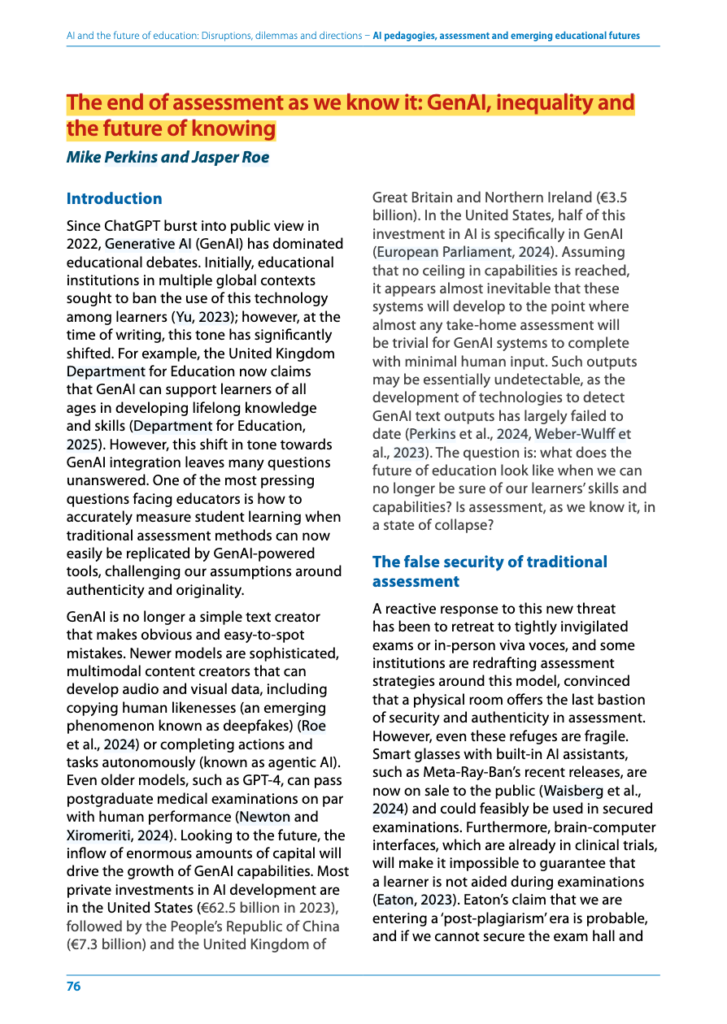
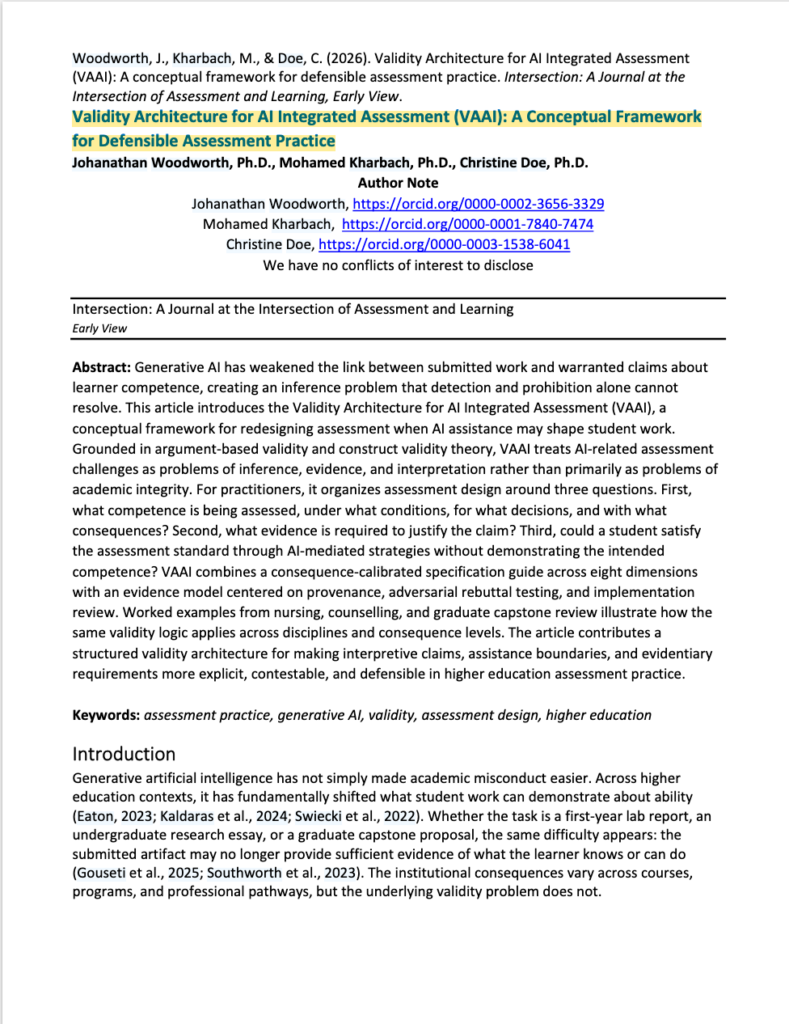
A student submits a thoughtful essay, a convincing care plan, or a polished research proposal. What can we reasonably conclude about that student’s competence? This question sits at the centre of an article I co-authored with Johanathan Woodworth and Christine Doe: Validity Architecture for AI Integrated Assessment (VAAI): A Conceptual Framework for Defensible Assessment Practice.
We introduce VAAI as a way to examine whether assessment evidence supports the conclusions educators intend to draw when AI may shape student work. The starting point is the learning claim: what the student should be able to demonstrate, under which conditions, and for what purpose.
What Does VAAI Propose?
VAAI is a conceptual framework grounded in argument-based validity, construct validity, and established assessment design traditions. It focuses on the reasoning that connects observed performance to a conclusion about competence.
Our argument is that detecting AI use cannot, by itself, establish what a submission demonstrates. Even permitted assistance can change what educators can infer from the work. This builds on the wider discussion of why validity matters in AI-era assessment.
The framework connects explicit learning claims, evidence requirements, assistance boundaries, scoring, fairness, feedback, and ongoing review. A specification guide helps educators decide how much detail and scrutiny different assessment decisions warrant.
Worked examples in nursing, counselling, and graduate capstone review illustrate the logic. These are design illustrations, not empirical findings. VAAI’s effectiveness, usability, and proposed specification scale require direct investigation. Woodworth – Validity Architectu…
How Can Educators Use VAAI in Assessment Design?
For readers working on AI and assessment, the practical starting point is an existing task. Before adding documentation or changing AI rules, ask what conclusion that task is meant to support.
State the Claim About the Student
“Students will submit a literature review” describes a product. It does not specify the competence the product should demonstrate.
The claim might concern evaluating sources, comparing competing explanations, or justifying inclusion decisions. These distinctions matter because AI can contribute differently to each activity. VAAI asks educators to identify the intellectual work students must perform for the assessment result to support its intended interpretation.
This also leaves room for different performance conditions. An assessment of independent reasoning and an assessment of professional work with tools need different evidence. Their results cannot simply be assumed to mean the same thing.
Decide What Evidence Would Justify That Claim
A finished artifact may provide some evidence while leaving important decisions hidden. VAAI uses provenance to mean proportionate evidence of how work was produced and what the learner contributed.
That could include a short rationale, an annotated outline, a decision trail, or a sampled explanation. The aim is to collect enough relevant evidence to support the claim. More documentation is not automatically better.
In the paper’s nursing example, a care plan could be supplemented by an explanation of priorities or a response to a change in the patient’s condition. The additional evidence targets clinical reasoning that a polished plan might leave uncertain.
Derive AI Boundaries From the Intended Competence
A useful assistance boundary explains which work can be supported and which must remain with the learner.
Our feedback example makes this concrete. If students are being assessed on diagnosing weaknesses in their arguments, AI feedback that supplies the diagnosis and revision may take over the assessed work. The resulting draft could improve without demonstrating the student’s evaluative judgement.
This connects with student feedback literacy: receiving a correction and deciding what needs correction provide different evidence. The boundary needs to follow that distinction.
Test Whether the Assessment Can Be Passed Without the Competence
VAAI includes adversarial rebuttal testing. The question is whether a plausible AI-supported strategy could satisfy the rubric without the student demonstrating the intended competence.
This is a test of the assessment design. If AI can produce work that meets the criteria while bypassing the target reasoning, educators need to reconsider the task, rubric, evidence requirements, or claim.
The framework also proposes stop rules: conditions identified in advance under which the original interpretation would need additional evidence, redesign, or reduced consequential weight. Insufficient evidence for a competence claim does not establish misconduct.
Match the Evidence Burden to the Consequences
A formative activity and a professional certification decision should not require identical documentation. VAAI therefore treats proportionality, accessibility, and workload as part of defensible design.
A short written explanation might be appropriate in one context; a sampled oral discussion might work in another. Each option needs consideration of what it measures and what additional burdens it creates. Provenance requirements also need safeguards against being repurposed for surveillance.
Plan to Review the Assessment
Tasks, tools, and permitted assistance change. An evidence model that once supported a conclusion may become inadequate.
VAAI asks educators to identify review responsibilities and triggers in advance. Its value will ultimately depend on whether it helps practitioners make clearer claims, recognise weaknesses, and design feasible evidence requirements. Those are questions for research as well as professional judgement. Completing a framework cannot substitute for examining whether the assessment result still means what we intend.
References
Woodworth, J., Kharbach, M., & Doe, C. (2026). Validity Architecture for AI Integrated Assessment (VAAI): A conceptual framework for defensible assessment practice. Intersection: A Journal at the Intersection of Assessment and Learning. Advance online publication.