
Questions about AI and cognitive offloading have appeared repeatedly in the research I have reviewed over the past year. Students can now ask AI to explain a concept, generate an argument, solve a problem, summarize a reading, or complete an entire assignment. The educational outcome depends partly on what the tool does and what remains for the student to do.
This is the focus of my AI Research Brief, When AI Supports Learning and When It Replaces Thinking. I brought together nine studies examining performance, persistence, knowledge retention, transfer, critical thinking, feedback literacy, and cognitive effort.
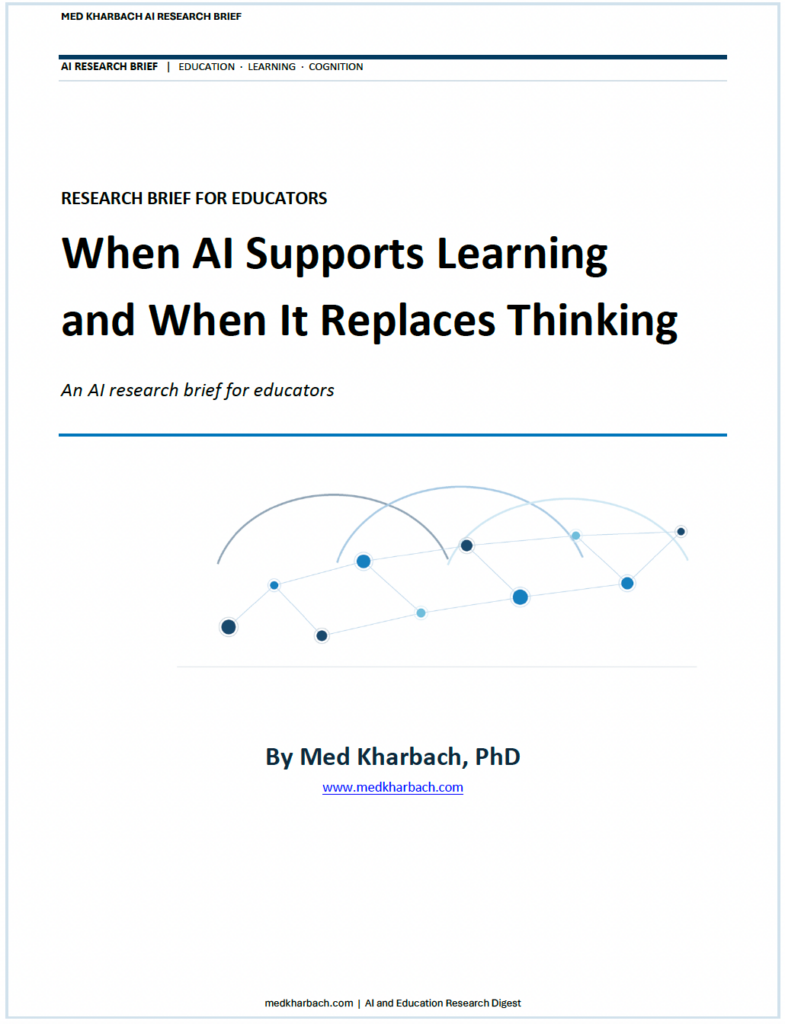
Download the complete research brief: When AI Supports Learning and When It Replaces Thinking
A Better Product Can Conceal Weaker Learning
One of the clearest findings comes from Bastani and colleagues’ study of nearly 1,000 high school students in Türkiye. Students using AI performed much better during assisted mathematics practice. Those using a standard GPT interface later scored 17% lower on an unassisted examination than students who had practised without AI.
The result was different when the AI tutor included educational safeguards. These safeguards largely removed the negative examination effect, although students did not significantly outperform the control group. As I discussed in my earlier review of AI tutoring and mathematics learning, access to AI was only part of the story. The way the assistance was designed changed the outcome.
Liu and colleagues found a similar pattern across three randomized experiments involving 1,222 participants. AI improved performance while it was available. Once it was removed, participants generally performed worse and were more likely to skip questions. An exploratory analysis also found that participants who requested direct answers later performed worse than those who used AI for hints or clarification. Because this comparison was observational, it cannot show that requesting answers caused the lower performance.
The studies by Barcaui and Fan and colleagues add another layer. Barcaui found stronger retention approximately 45 days later among students who studied with conventional resources, although nearly 30% of the original participants did not complete the delayed test. Fan and colleagues found that ChatGPT helped students improve their essays, yet the groups did not differ significantly in knowledge gain, transfer, or intrinsic motivation.
Across these studies, improved work during AI use did not consistently carry into independent learning.
AI Changes Where Critical Thinking Happens
Some of the research suggests that AI changes the work involved in critical thinking. In a survey of 319 knowledge workers, Lee and colleagues found that higher confidence in AI was associated with less reported critical-thinking effort. Participants described moving from gathering information to verifying it, from solving problems to integrating AI responses, and from completing tasks to supervising outputs.
This was a self-report study, so it cannot establish that AI caused people to think less. It does show that critical thinking may shift to different parts of the task.
Hawkins, Taylor-Griffiths, and Lodge reached a related conclusion in their exploratory study of 32 psychology students. Students used AI to generate ideas, clarify instructions, request feedback, paraphrase, evaluate suggestions, and refine prompts. Some also decided to stop using it. Feedback literacy was the only significant positive predictor of essay grade, although the overall statistical model was not significant and the sample was small. I explored this study more fully in my discussion of feedback literacy and AI-assisted writing.
Other evidence needs even greater caution. Kosmyna and colleagues reported lower brain-network connectivity, weaker ownership, and more difficulty quoting recently written essays among participants using an LLM. This was a preliminary study involving 54 participants, with only 18 completing the fourth session. Gerlich found associations among reported AI use, cognitive offloading, and critical-thinking scores in a survey of 666 participants. Neither study supports a universal claim that AI damages the brain or causes critical thinking to decline.
A Practical Boundary for Educators
Cognitive offloading is part of ordinary intellectual life. We use calculators, notes, diagrams, reference books, calendars, and search engines. The concern begins when students offload the mental activity through which the intended learning develops.
This distinction also appears in Lodge and Loble’s work on the cognitive risks of AI in education. Offloading can free attention for other work. It becomes detrimental when the tool removes the retrieval, interpretation, reasoning, evaluation, or judgement that students need to practise.
I developed the THINK–USE–CHECK–RETURN framework to help educators apply this distinction:
- Think: Students begin from a cognitive starting point of their own.
- Use: AI has a defined form of assistance connected to the learning goal.
- Check: Students evaluate, verify, reject, or revise the output.
- Return: Students reconstruct, explain, apply, or transfer the learning independently.
The brief also includes an educator checklist, a ready-to-use classroom activity, a professional-learning activity, reflection questions, and a presentation-ready summary.
The question I want the brief to help educators answer is simple: If the AI disappeared tomorrow, what would students still know, understand, and be able to do?
Research Brief Reference
Kharbach, M. (2026). When AI supports learning and when it replaces thinking: An AI research brief for educators. https://medkharbach.com/wp-content/uploads/2026/09/Med-Kharbach-AI-Research-Brief-When-AI-Supports-Learning.pdf



