
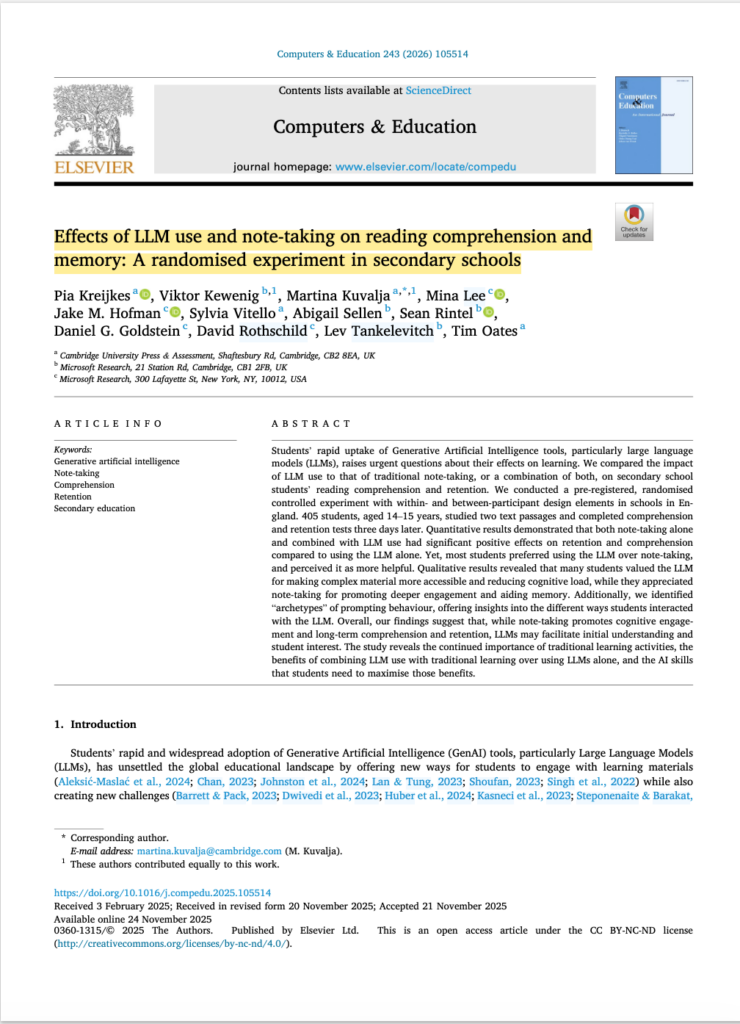
Students may find an AI explanation helpful and still remember less of what they read. In a randomised experiment in English secondary schools, Pia Kreijkes and colleagues (2026) found that note-taking, both alone and alongside an AI chatbot, supported better delayed comprehension and factual retention than chatbot use alone.
The findings give teachers a reason to preserve students’ own processing of a text when introducing AI assistance. I find the study useful because it examines what students could demonstrate several days later, alongside how helpful and enjoyable they found the learning activity at the time.
What Did Students Do, and What Did They Learn?
Students aged 14–15 studied passages about apartheid in South Africa and the Cuban Missile Crisis. The preregistered experiment compared chatbot use, digital note-taking, and using both together. Each student experienced two conditions, with chatbot use serving as the shared comparison. Researchers provided instructions and a demonstration, then allowed students to use the activities without prescribing every step. Three days later, students completed comprehension, factual-retention, and free-recall tasks.
Note-taking alone outperformed chatbot use alone across all three outcomes. Combining the chatbot with notes improved comprehension and factual retention compared with chatbot use alone, but showed no significant advantage for free recall.
Students nevertheless tended to prefer the chatbot over note-taking and rated it as more helpful. Those comparing the combined activity with chatbot use alone generally preferred the combination.
The boundaries matter. The study used GPT-3.5 Turbo, short history passages, and a brief learning activity. Students had no substantial practice period, and there was no reading-only condition.
Notes alone and chatbot-plus-notes were compared indirectly, so the study cannot provide a straightforward head-to-head verdict between them. Its tests assessed learning from the assigned passages, leaving broader knowledge gained through students’ AI-supported explorations unmeasured.
Why Might Feeling Helped Differ From Learning?
The chatbot made the activity feel easier. Students asked for explanations, definitions, summaries, and additional background. These are understandable ways to seek help, and the prompt analysis showed considerable engagement with relevant content.
The important question is what happened after an answer appeared. Asking for clarification does not reveal how carefully a student processes the explanation or connects it with the original text. The researchers could identify the kinds of prompts students submitted, but their analysis could not establish which forms of interaction caused better learning.
One explanation they consider is that students underestimated the value of effortful processing. Selecting important ideas and putting them into notes requires decisions that an automatically generated summary may remove.
This connects with the questions raised in my earlier review of metacognitive laziness and AI: how much of the learning activity does the student continue to carry out?
I would be careful about turning that explanation into a claim that all AI assistance weakens engagement. The experiment identifies differences between these conditions. The mechanisms behind those differences still require investigation.
What Should Teachers Do With the Note-Taking Finding?
The combined condition is especially relevant to classroom planning. Students had access to a digital notepad while using the chatbot, and the researchers found substantial copying from AI output among some students. Having notes on the screen therefore did not necessarily mean students had generated those notes themselves.
The authors suggest separating AI consultation from independent note-taking. Students could first use the chatbot to clarify or explore a text, then take notes without directly copying its output. They present this as a design possibility for future testing, so it should not be described as a proven intervention.
I think it is a sensible possibility to examine in teaching. The question is whether students can select, organise, and explain the material themselves after receiving assistance. A completed page of notes provides limited information unless we also understand how it was produced.
What Does This Mean for Evaluating AI Reading Activities?
Within broader discussions of AI & Cognition, this study makes a useful distinction between an activity’s immediate appeal and its later learning outcomes. Both matter, but they answer different questions.
The chatbot also prompted students to explore ideas beyond the passages. That may have educational value even though the tests did not capture it. Teachers therefore need to decide what an activity is intended to accomplish: understanding the assigned material, remembering it later, or opening a wider inquiry. A tool may support one purpose more effectively than another.
My practical takeaway is to retain opportunities for students to work through ideas themselves and to check understanding after the assistance has ended. Students’ preferences can inform that design, while delayed explanations and recall provide evidence of what has stayed with them.
References
Kreijkes, P., Kewenig, V., Kuvalja, M., Lee, M., Hofman, J. M., Vitello, S., Sellen, A., Rintel, S., Goldstein, D. G., Rothschild, D., Tankelevitch, L., & Oates, T. (2026). Effects of LLM use and note-taking on reading comprehension and memory: A randomised experiment in secondary schools. Computers & Education, 243, Article 105514. https://doi.org/10.1016/j.compedu.2025.105514



