
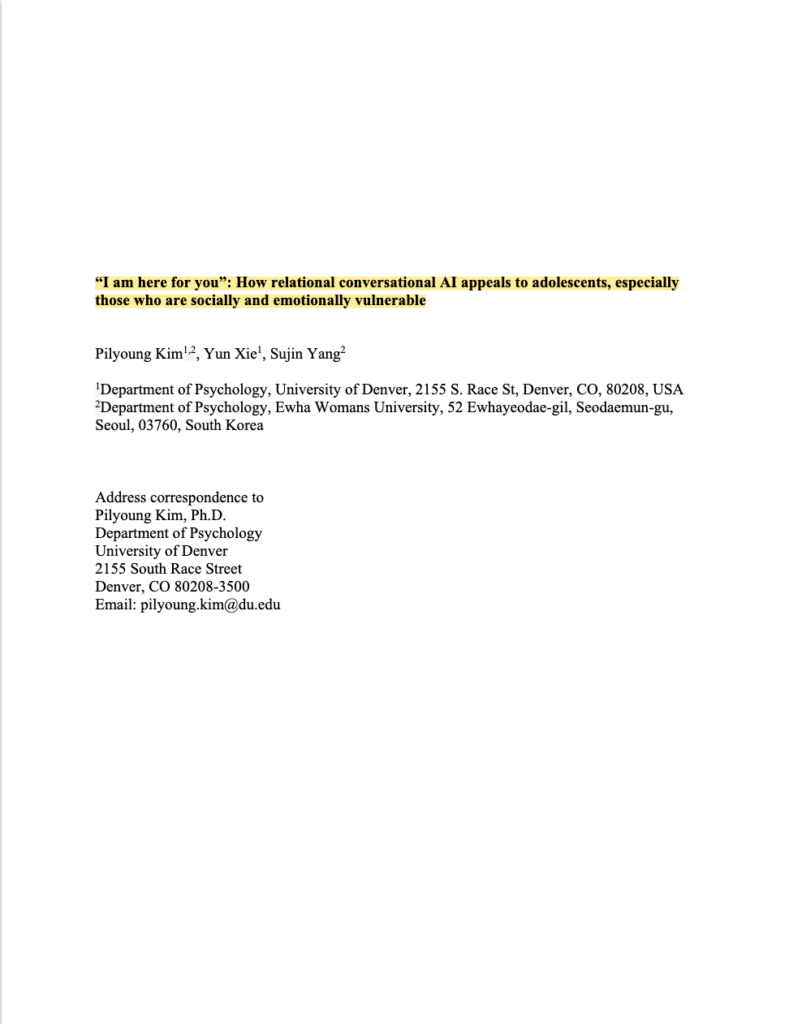
AI chatbots and adolescents can form a powerful combination because a few seemingly ordinary language choices can make a system feel more human, trustworthy, and emotionally close. In a preregistered study, Pilyoung Kim, Yun Xie, and Sujin Yang found that adolescents preferred a warm, relationship-oriented chatbot over one that clearly stated its nonhuman limits.
Both versions, however, were judged similarly helpful. The study measured responses to short transcripts, so it tells us about immediate perceptions and preferences, not whether chatbot use causes emotional dependence over time.
When Supportive Language Starts to Feel Like a Relationship
Teachers may encounter student use of chatbots as a study issue, but adolescents also use these systems for reassurance, advice, and conversations about personal problems. This matters because conversational AI can simulate patience and emotional availability with unusual consistency.
Phrases such as “I am here for you” may read as kindness, yet they can also invite a young person to interpret generated language as evidence of care, feeling, or commitment.
That distinction belongs within AI and wellbeing education. Students need more than warnings about inaccurate answers. They need ways to notice how interface and language choices shape their trust. Earlier research reviewed on this site found that AI voice can increase perceived accuracy and anthropomorphism. Kim and colleagues examine a related question in a younger population: what happens when the content stays similar but the social tone changes?
How Relational and Transparent Chatbots Were Compared
Kim, Xie, and Yang (2025) recruited 284 adolescent-parent dyads in the United States. The adolescents were 11 to 15 years old. Both adolescents and parents read two matched transcripts about a middle-school student whose ideas had been ignored during a group project.
One chatbot used first-person statements, emotional validation, affiliative language, and commitment cues. The other remained supportive but stated that AI does not have feelings and used a more informational tone. The order was randomized, and the two responses offered similar problem-focused advice.
Adolescents were more likely than parents to choose the relational version: about two thirds of adolescents preferred it, compared with just over half of parents. Adolescents rated it as more human-like, likable, trustworthy, and emotionally close. Yet they did not rate it as more helpful.
Those who preferred the relational style also reported more stress and anxiety, while parent reports indicated lower-quality family and peer relationships in parts of this group. These are associations. The study cannot tell us whether distress drew adolescents toward relational language, whether chatbot use affected their wellbeing, or whether another factor shaped both.
The controlled transcripts let the researchers compare styles while holding much of the advice constant, but reading a brief scenario is different from having a private, repeated conversation with a chatbot. Some outcomes were measured with single questions, and the online US sample limits generalization. The authors therefore call for longitudinal and live-interaction research that can track attachment, use patterns, and social outcomes over time.
What Teachers Can Do With This Insight
The finding I would carry into practice is simple: warmth and helpfulness are not the same property. Students in this study found the transparent chatbot similarly helpful even though it felt less human and emotionally close. Schools do not have to choose between a cold tool and a system that speaks as if it were a devoted friend.
Teachers could make relational language part of AI literacy instruction. Present two short responses to the same student problem, one using phrases such as “I understand how you feel” and “I am always here for you,” and another explaining its limits while offering the same practical options.
Ask students to mark which words make each response feel caring, credible, or human. Then ask a harder question: did the advice improve, or did only the feeling around the advice change? This is my suggested classroom adaptation, not an intervention tested by Kim and colleagues.
The paper also gives educators a useful set of questions for reviewing school-facing chatbots:
- Does the system clearly identify itself as AI and explain that it does not have feelings?
- Does it use commitment language that implies a continuing personal bond?
- Can it support a student without presenting itself as a substitute for friends, family, teachers, or counsellors?
- What happens when a student discloses distress, self-harm, abuse, or another serious concern?
- Are caregivers and staff given enough information to understand the system’s conversational design?
These questions deserve particular care when a student appears socially isolated or distressed. The study does not provide a method for identifying which individual students will become overreliant, and preference for a warm chatbot should never be treated as a diagnosis. It does suggest that the young people most attracted to simulated closeness may include those already experiencing weaker relationships or greater anxiety. That is a reason for attentive human follow-up, not surveillance or punishment.
This paper also adds a useful layer to discussions of AI chatbots and loneliness. Time spent with a chatbot matters, but so does the language through which the relationship is presented. Educators should help students examine both: how long they are using the system and what its words are encouraging them to believe about the relationship.
Full Reference
Kim, P., Xie, Y., & Yang, S. (2025). “I am here for you”: How relational conversational AI appeals to adolescents, especially those who are socially and emotionally vulnerable [Preprint]. arXiv. https://doi.org/10.48550/arXiv.2512.15117