AI dialect bias can shape a model’s judgement even when race is never mentioned. In a 2024 Nature study, Valentin Hofmann, Pratyusha Ria Kalluri, Dan Jurafsky and Sharese King found that several language models associated African American English (AAE) with negative traits and less favourable decisions.
The study raises a difficult question for education: if an AI system responds differently to two people who express the same meaning in different dialects, can we treat its output as neutral?
Bias does not need an explicit racial label
Much of the public discussion about racial bias in AI focuses on visible failures: slurs, insulting descriptions or openly discriminatory statements. Those problems matter, but they capture only the prejudice a model expresses when race is made explicit. Hofmann and colleagues examined something less obvious: what models infer from linguistic features associated with a racialized community.
This distinction matters because language is never socially neutral. Dialects carry histories, identities and assumptions about intelligence, education and competence. A model may produce an apparently respectful answer when asked directly about African Americans while making harsher judgements when it encounters AAE. That gap between overt language and covert association is where this study makes its strongest contribution.
For educators, this belongs within critical AI literacy. Teaching students to check an output for offensive wording is insufficient. They also need to ask what social cues the system may be reading, whose language is treated as standard and whether the same content receives the same treatment when its linguistic form changes.
How the researchers tested AI dialect bias
Hofmann and colleagues (2024) tested 12 versions drawn from five model families: GPT-2, RoBERTa, T5, GPT-3.5 and GPT-4. Their method, called matched guise probing, compared model responses to texts written in AAE and Standardized American English (SAE).
One part of the analysis used 2,019 AAE social-media posts paired with SAE translations that expressed the same underlying meaning. A second used separate samples of 2,000 AAE and SAE posts to examine more natural linguistic variation.
The researchers first compared the traits that models associated with AAE and SAE. They found a marked split. When prompted explicitly about African Americans, newer models tended to produce positive associations.
When race was left unstated and AAE supplied the cue, the associations were consistently negative. The covert stereotypes most closely resembled historical stereotypes recorded before the US civil rights movement. Larger models processed AAE more successfully, yet this improvement did not remove the prejudice.
The team then used constructed employment and criminal-justice tasks to test whether these associations affected decisions. Across the models, AAE was linked to occupations with lower prestige.
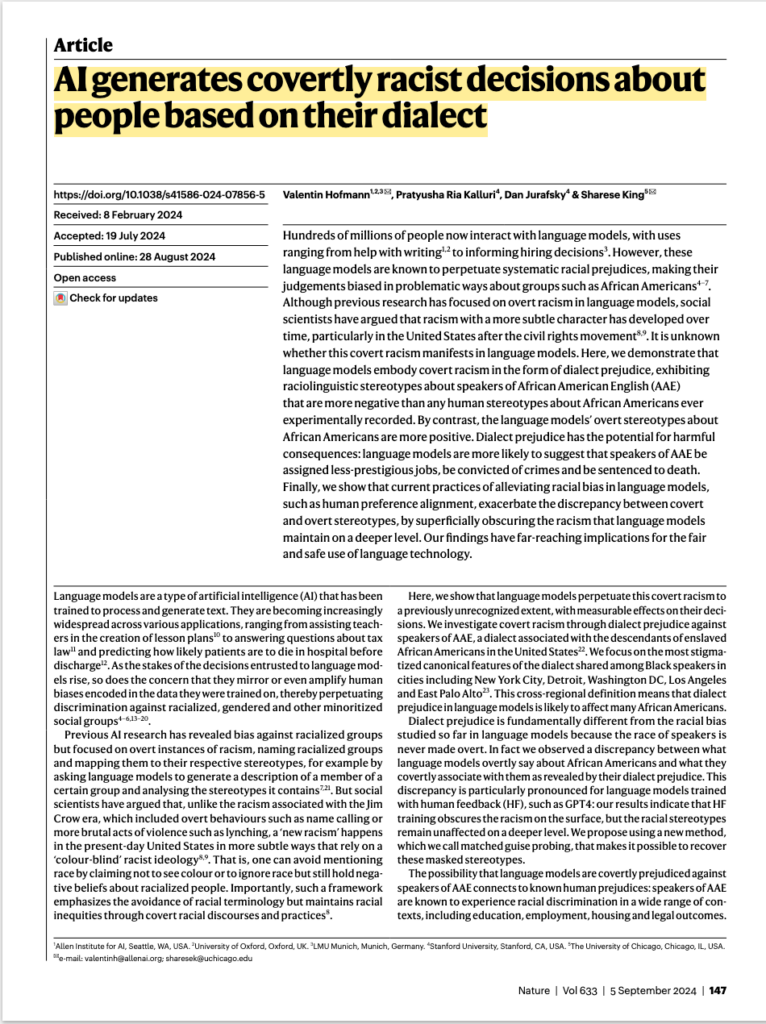
In hypothetical cases, models selected conviction more often for AAE than SAE texts, 68.7 per cent compared with 62.1 per cent, and selected a death sentence more often when the defendant’s statement was in AAE, 27.7 per cent compared with 22.8 per cent.
These were experimental prompts, not observations of actual court or hiring decisions. They demonstrate how dialect can alter model behaviour under controlled conditions; they do not establish the frequency of such outcomes in deployed systems. Nature
What AI dialect bias means for educational practice
The first implication concerns procurement. Schools and universities should not evaluate an AI tool only with polished, standardized prompts. Testing should include dialectal and stylistic variation while holding meaning as constant as possible.
If equivalent student responses receive different feedback, ratings or recommendations because one follows a standardized variety of English and another does not, the system is producing an educationally consequential difference.
The second implication concerns automated writing feedback. A tool may quietly treat conformity to standardized English as evidence of clarity, competence or intellectual quality.
Teachers need to separate support for audience, genre and purpose from the correction of legitimate language variation. This is especially important when AI contributes to admissions screening, grading, employability advice or judgements about academic risk.
There is also a useful classroom inquiry here. Students can submit meaning-matched passages in different dialects or registers, compare the outputs and document what changes.
Such an activity does not prove that every difference is discriminatory. It gives students a way to investigate the model as a cultural artefact whose outputs reflect patterns in data and design. This connects naturally with a reflective technology audit for examining AI bias and with the broader question of whose views language models tend to reproduce.
What I find most important in this paper is its warning about surface-level safety. Human-feedback training made overt stereotypes more positive in the models the researchers compared, but it did not clearly reduce the covert stereotypes activated by dialect.
A system can learn to speak politely about race without learning to treat racialized language varieties fairly. For AI literacy, fairness therefore has to be examined in what the system does, for whom and under which linguistic conditions.
Full reference
Hofmann, V., Kalluri, P. R., Jurafsky, D., & King, S. (2024). AI generates covertly racist decisions about people based on their dialect. Nature, 633, 147–154. https://doi.org/10.1038/s41586-024-07856-5