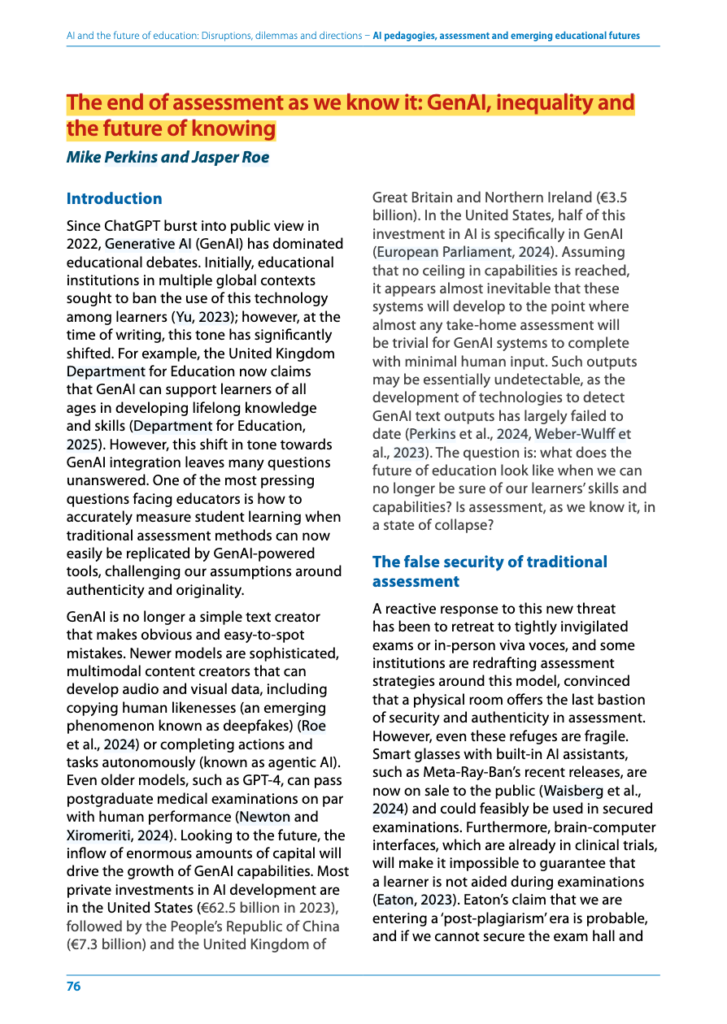
I’ve argued for a while that the “can a machine grade as well as a teacher?” debate is aimed at the wrong target. It treats feedback as a product you either buy from a human or from a machine, when the thing that actually moves student learning is the structure around the comment, not the hand that wrote it.
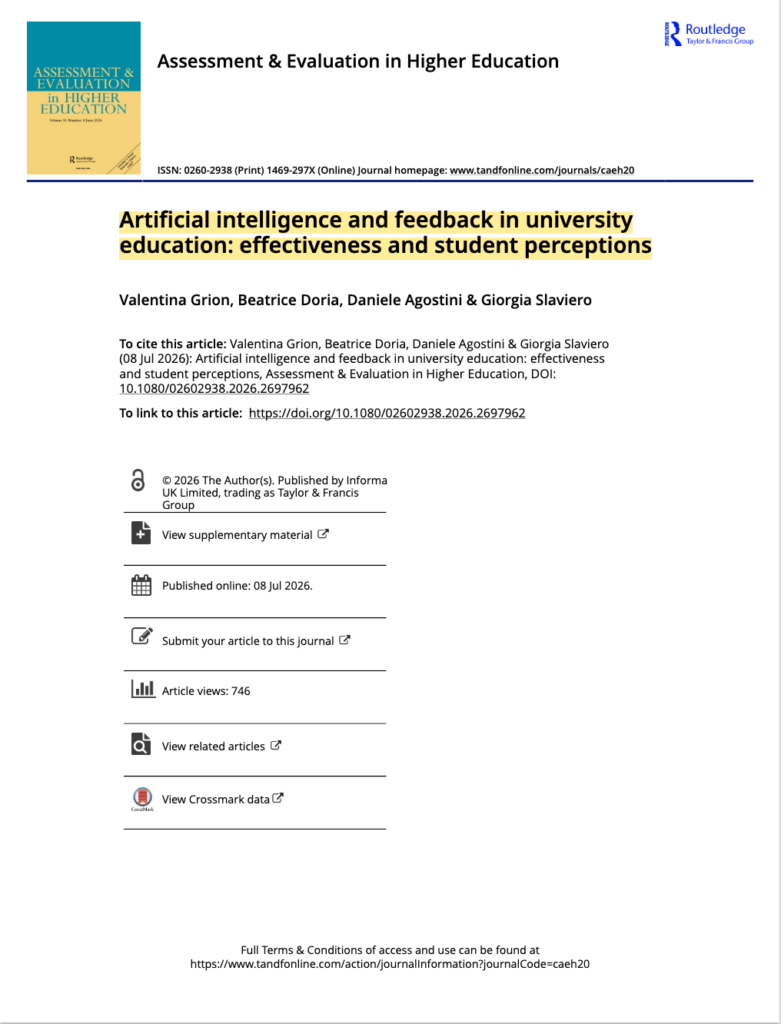
A new open-access study by Grion, Doria, Agostini, and Slaviero (2026) in Assessment & Evaluation in Higher Education gives me fresh reason to hold that line. Their answer is yes, AI-generated feedback can perform on par with an expert teacher. Their sharper point is that the match had almost nothing to do with the AI itself.
The Study That Pits AI-Generated Feedback Against a Teacher
Grion and her colleagues ran a quasi-experiment inside a real course, not a lab task. Third-year student teachers at the University of Padua, 238 of them across 47 working groups, designed a Unit of Learning, received formative feedback, then revised. Each group was randomly assigned to one of three sources:
GPT-o4-mini, DeepSeek R1, or two expert teachers working together. The grading was blind to both the feedback condition and the draft stage, a detail worth respecting, because it strips away the halo that “this came from a human” usually carries.
The results are clean. Every condition improved significantly from first draft to revision, with a large effect (a rank-biserial correlation of 0.77) and an average gain of roughly 3.9 points on a 30-point rubric.
When the authors compared the three sources head to head, no significant differences showed up. They didn’t stop at “no difference,” which is the right call, since a null result never proves sameness. Their equivalence and non-inferiority tests found GPT-o4-mini statistically equivalent to the teacher, and DeepSeek R1 non-inferior.
Students, kept blind to which source they’d received, reported similar levels of perceived mastery, positive emotion, and satisfaction across the board. Satisfaction landed near 98 percent regardless of source.
Grion et al. also checked whether attendance mattered, comparing students who came to class with those who didn’t. Attendance made no difference to the gains and didn’t interact with feedback source, which strengthens the read that the structure, and not the population or the tool, carried the effect.
Why the Source Barely Mattered
Grion et al. then make the move I find most useful. They argue that feedback effectiveness depended on the pedagogical configuration the feedback lived inside, not on who or what produced it. The rubric, the shared criteria, the revision cycle: that was the intervention. The feedback source was close to interchangeable machinery running on top of it.
That tracks with everything I’ve been reading and writing about. The over-reliance research keeps warning that when students treat AI output as a verdict to accept or reject, the learning evaporates, a pattern the work on metacognitive laziness (Dizon et al.) lays out in uncomfortable detail.
The related worry that leaning on AI can dull the very thinking it’s meant to support, which Lee et al. (2025) documented in their study of trust in AI and critical thinking, is exactly the failure mode a rubric-driven revision loop guards against. Grion’s design did the opposite of inviting passivity.
It forced students to interpret criteria, compare their work to a standard, and revise. Feedback became usable information inside a process, which is the condition under which any feedback, human or machine, starts to earn its keep.
The Rubric Did the Work the AI Got Credit For
The part of this study I’d underline for any teacher is how the AI was set up. The models weren’t handed a vague prompt and told to wing it. Through a retrieval-augmented setup, they received the full course materials, the assignment brief, and the analytic rubric that students had co-constructed by analyzing a high-quality exemplar. The instruction was to act as a professor and justify every judgment against those shared criteria.
That exemplar is the real engine of the paper. Grion et al. describe it as a calibration device “through which teacher assessment literacy shaped the production of AI-generated feedback” (p. 15). Read that again.
The teacher’s evaluative expertise, usually tacit and locked inside the instructor’s head, was made explicit enough that a language model could reproduce it. The AI didn’t supply the standard. It borrowed one that a skilled assessor had already built.
This is why validity is the real question I care about in AI-integrated assessment, the concern at the center of the VAAI framework I’ve been developing. A model’s fluency is not the source of a sound judgment.
The judgment comes from the criteria, the exemplar, and the person who designed them. Give an AI a weak rubric and fuzzy goals, and it will generate confident, well-written, useless feedback. Give it a strong assessment architecture, and it becomes a fast, tireless delivery system for a teacher’s own standards.
What AI-Generated Feedback Still Can’t Tell Us
I agree with the study’s core claim, and I also want to contextualize it carefully, because a few things keep it from being the last word.
The first is a ceiling effect the authors are refreshingly upfront about. Ninety-one percent of groups scored 27 or above on the 30-point rubric at post-test, which compresses the scores into a narrow band near the top.
When almost everyone hits the ceiling, similar final scores can hide real differences the measure simply couldn’t detect. Grion et al. acknowledge this and lean on baseline-adjusted analyses, which are less vulnerable to the problem, but they’re clear that modest differences between sources can’t be ruled out.
The second is the student side of the equation. The paper suggests that students’ own assessment literacy helped them make good use of the feedback, and I find that plausible. These were teacher-education students trained in formative assessment, revising against a rubric they helped build.
The authors are careful, though, to flag that they never actually measured student assessment literacy. The engagement they observed is consistent with that story, not proof of it. It’s a hypothesis for the next study, and I’d take it seriously.
Then there are the risks the study names but a single course can’t resolve: over-reliance on automated suggestions, and unequal access to capable AI tools across schools and systems. Both are real.
Both argue for keeping teacher oversight in the loop and teaching students to interrogate feedback before they act on it. The comparable emotional response students reported is encouraging, but it says nothing about what happens when the rubric is missing and the exemplar was never built.
The Real Lesson for Teachers
Strip this study down and it hands teachers a to-do list, not a shopping list. Build the rubric. Co-construct it with students through a strong exemplar. Make the revision loop mandatory. Do those three things, and the evidence here says the feedback source becomes close to a rounding error. Skip them, and no model on the market will save the assignment.
The technology moved fast enough to match a human expert. The reason it worked has been the same for decades. Good assessment was never about who holds the pen.
References
Grion, V., Doria, B., Agostini, D., & Slaviero, G. (2026). Artificial intelligence and feedback in university education: Effectiveness and student perceptions. Assessment & Evaluation in Higher Education. Advance online publication. https://doi.org/10.1080/02602938.2026.2697962