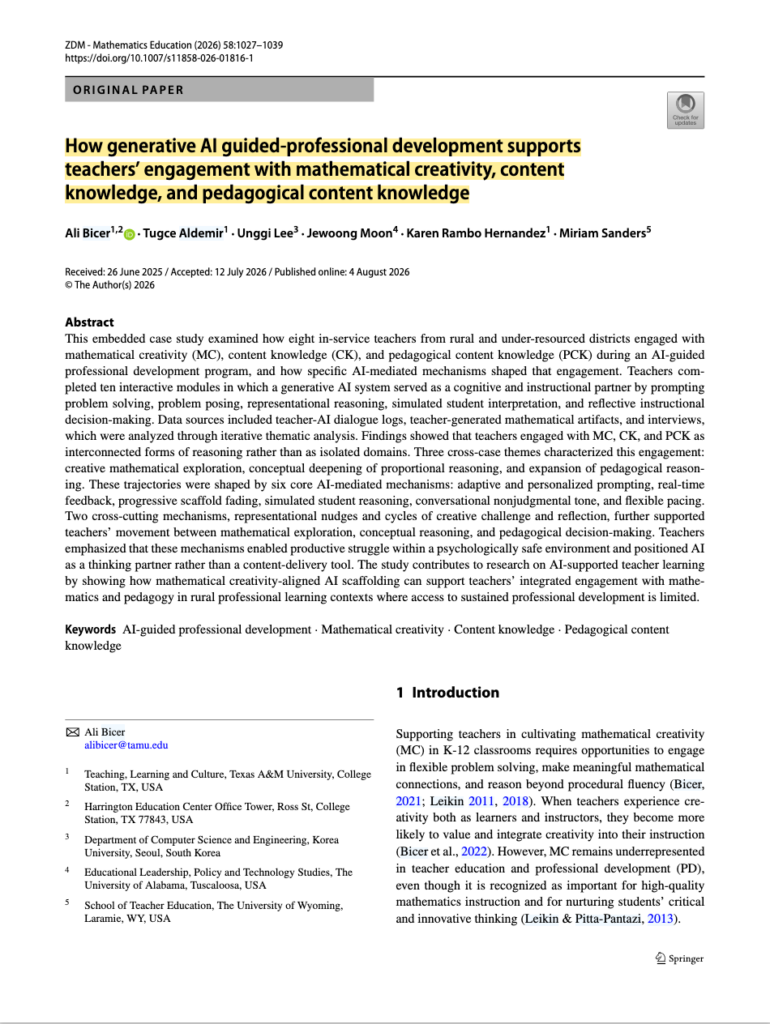
Can AI support teachers’ mathematical thinking during professional development? A study by Bicer and colleagues (2026) suggests that carefully designed AI dialogue can create opportunities to explain ideas, explore different solutions, and rehearse responses to student misconceptions.
Their paper, How generative AI guided-professional development supports teachers’ engagement with mathematical creativity, content knowledge, and pedagogical content knowledge, examines how teachers participated in such a programme.
What interests me here is the attention to the questions AI asked and the reasoning those questions invited. The findings concern engagement during professional learning; they do not establish improvements in classroom teaching or student achievement.
How Did Teachers Learn Mathematics With AI?
The researchers conducted a qualitative case study with Grade 5 and Grade 6 mathematics teachers from rural or under-resourced districts in Wyoming and Texas. Participants completed asynchronous modules on rates and proportional reasoning over an academic semester.
The analysis focused on teachers who completed the programme and follow-up interviews, drawing on their chatbot conversations, mathematical work, and accounts of the experience.
The chatbot was configured with tasks, coaching prompts, examples, and instructions that discouraged direct solution-giving. Teachers solved problems, explained their reasoning, explored alternative representations, extended tasks, and interpreted simulated student responses.
The researchers identified connected patterns of creative exploration, conceptual reasoning, and reflection on teaching. However, the small, selected sample and absence of comparative or pre/post measures limit conclusions about effectiveness.
Teachers also reported repetition, formatting difficulties, limited visualisation, hallucination risk, and missed opportunities to learn with colleagues. How generative AI guided-profes…
What Can Teacher Educators Take From This Study?
For those interested in AI and teaching practice, the paper offers useful design ideas. Its contribution lies in showing what sustained interaction around mathematical reasoning looked like within this particular programme.
Keep Asking for the Reason Behind an Answer
A correct calculation did not automatically end an exchange. The chatbot asked teachers to explain why a procedure worked and what mathematical relationship supported it. When responses relied on rules such as cross-multiplication, follow-up questions invited teachers to examine proportional structure.
I find this especially relevant to professional learning. Teachers need opportunities to revisit familiar content and make their own understanding explicit. A useful question when reviewing an AI-supported activity is whether the interaction asks teachers to explain something they might otherwise take for granted. Producing an answer provides limited insight into that understanding.
Connect Different Representations
Teachers were prompted to move among ratio tables, graphs, double number lines, and other representations. The analysis describes teachers making connections between representations and explaining the relationships they expressed.
This gives mathematical creativity a concrete meaning. It includes finding another way to represent a relationship, extending a problem, and examining how approaches connect.
For teacher educators, the implication is to build these moves into the activity. Asking for several representations is a starting point; asking teachers to explain what connects them creates a further opportunity for reasoning.
Use Simulated Mistakes for Pedagogical Rehearsal
The chatbot also presented hypothetical student errors and asked teachers to interpret them. In one example, a simulated student scaled one quantity in a proportional relationship without scaling the other. Teachers considered the reasoning behind the mistake and how they might respond.
This is one of the paper’s most useful applications. It creates an opportunity to practise interpreting an error before deciding what feedback to give. I would treat these exchanges as rehearsal, with a clear boundary: AI-generated responses are constructed examples. Understanding actual learners still requires attention to their work, explanations, and classroom context.
Reduce Support as the Work Progresses
Early interactions offered more guidance. Later tasks expected teachers to justify, generalise, and design with less assistance. Participants described this progression as a feature of their experience.
That design choice deserves attention when developing AI-supported professional learning. Support needs to leave room for teachers to take increasing responsibility for the reasoning.
The study illustrates how this was attempted within the modules, although it does not establish whether participants could sustain the same reasoning independently afterwards.
Make Space for Uncertainty and Collegial Discussion
Teachers described the chatbot as patient and encouraging, and some felt more comfortable trying incomplete ideas. Flexible pacing also allowed them to revisit tasks around professional and family responsibilities. These accounts suggest that the conditions surrounding an activity can affect teachers’ willingness to persist with difficult mathematics.
Yet participants also missed talking with colleagues. My reading is that AI-guided rehearsal could provide material for subsequent professional discussion: teachers could bring a difficult explanation, a questionable chatbot response, or a revised task to a group.
The authors similarly recommend structured opportunities for collaboration. That would preserve space to question the AI’s mathematical accuracy and discuss how its suggestions fit real classrooms.
References
Bicer, A., Aldemir, T., Lee, U., Moon, J., Rambo Hernandez, K., & Sanders, M. (2026). How generative AI guided-professional development supports teachers’ engagement with mathematical creativity, content knowledge, and pedagogical content knowledge. ZDM – Mathematics Education, 58, 1027–1039. https://doi.org/10.1007/s11858-026-01816-1