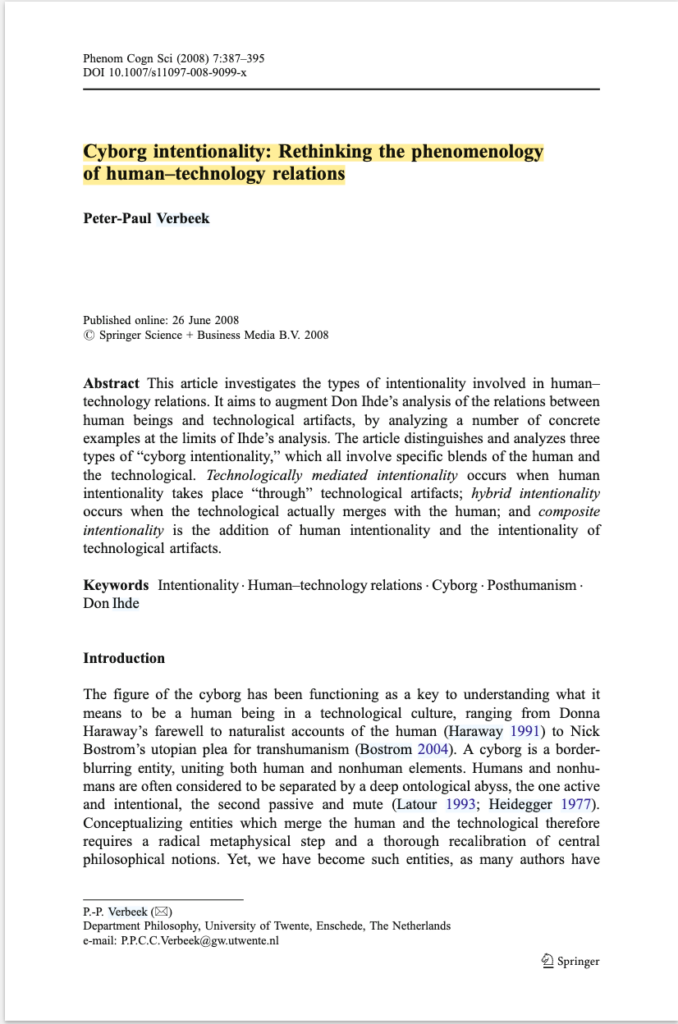
The word “hallucination” might be the most misleading term in the entire AI education conversation, and I’ve been waiting for a framework that explains why. It arrived from an unexpected decade. Peter-Paul Verbeek’s 2008 paper on cyborg intentionality, published in Phenomenology and the Cognitive Sciences, was written to analyze pacemakers, sound recorders, and experimental photography. Read in 2026, it dismantles the way we talk about AI errors. This is the third post in my series on postphenomenology and AI, which began with Verbeek’s mediation theory and the argument that AI is never a neutral tool.
What Cyborg Intentionality Means
Verbeek starts from the phenomenological concept of intentionality, the directedness that defines human experience. We never just think, we think something; we never just see, we see something. His claim is that this supposedly exclusively human capacity has become entangled with our technologies, and he borrows the cyborg figure to work out the forms of that entanglement. Following Stiegler, he even suggests we’ve always been cyborgs in a sense, since technologies like writing helped constitute the interpretive culture that made us who we are.
The first form, mediated intentionality, restates Don Ihde’s four human-technology relations in terms of directedness. When we look through glasses, read a thermometer, or hold a phone conversation, our intentionality passes through the artifact, and the artifact helps shape the experience. Verbeek notes that “human beings simply could not have such experiences without these mediating devices” (p. 390). So far this is the territory my first post in this series covered.
The genuinely original move comes next, and it’s a lovely piece of philosophical method. Ihde drew his relations as little schemas with arrows for intentionality and dashes for unexamined connections. Verbeek interrogates the dashes. The dash between human and technology in the embodiment relation, and the dash between technology and world in the hermeneutic relation, each hide a black box. Opening them produces two new categories.
Hybrid Intentionality, Briefly
The first black box yields hybrid intentionality. A pacemaker, an antidepressant, or a retinal microchip doesn’t get embodied the way eyeglasses do. It merges with the person and produces a new experiencing entity, which Verbeek writes as a fifth relation: (human/technology) → world. His formulation is precise: “[t]echnologies used, like telescopes and hearing aids, help to constitute us as different human beings, whereas technologies incorporated constitute a new, hybrid being” (p. 392). He then maps two routes past the human, a posthumanist one where human and technology co-constitute each other, and a transhumanist one involving literal physical fusion, taking a detour through Sloterdijk’s provocation that we must accept moral responsibility for technologies that alter human biology.
Hybrid intentionality will earn its education debate when neurotechnology reaches classrooms. For the AI questions in front of us now, the second black box is the one that pays off.
Composite Intentionality and the Double Arrow
Opening the hermeneutic relation reveals what Verbeek calls composite intentionality. Technologies have their own directedness at the world. A sound recorder, in Ihde’s example that Verbeek revisits, “hears” background noise a focused human listener filters out. A thermometer attends only to temperature. When human intentionality aims at technological intentionality, a double structure appears, which Verbeek writes as human → (technology → world). His gloss: “humans are directed here at the ways in which a technology is directed at the world” (p. 393).
Verbeek then splits technological directedness into two kinds using Dutch art photography. Wouter Hooijmans exposes landscape photographs for hours by starlight, producing images where only lasting things survive, a view no human eye could assemble. Verbeek calls this augmented intentionality: an expansion of what humans could in principle see. De Realisten build stereographic photographs of impossible object combinations, three-dimensional scenes with no original counterpart in reality. Verbeek names this constructive intentionality, a technological directedness aimed at generating a new reality, not depicting an existing one.
Why AI Hallucinations Are the Wrong Frame
Verbeek never mentions AI in this paper, so the application that follows is mine, but the fit is uncanny.
The term hallucination implies a system that normally represents reality and occasionally slips into fabrication, the way a reliable witness might have a bad day. Composite intentionality suggests a different ontology. A large language model’s directedness at the world is statistical directedness at language. It doesn’t consult reality and report back. It constructs text, every single time, and some of its constructions happen to align with facts. On Verbeek’s terms, generative AI runs on constructive intentionality as its default mode, with representation as a fortunate side effect, never the mechanism.
This reframe changes what we teach. Calling errors hallucinations trains students to treat accurate output as the system working and inaccurate output as the system malfunctioning, which ends up certifying everything that sounds right. If construction is the default, the student’s job shifts from spotting glitches to interrogating the construction itself, including the fluent, confident, correct-sounding parts. It also illuminates a pattern I’ve written about before: when millions of writers read and produce text through the same constructive intentionality, expression converges, which is the homogenization effect Yakura et al. (2025) documented across languages and cultures.
Teaching the Double Arrow
Here’s where the 2008 paper lands in the 2026 classroom. Verbeek’s double arrow, humans directed at how a technology is directed at the world, is close to a working definition of critical AI literacy. A student who asks what this system attends to, what it cannot see, and what kind of reality it constructs is standing exactly where Verbeek’s schema puts them, on the outer arrow looking at the inner one.
That stance is teachable through ordinary prompts. Ask students to identify what a chatbot’s answer emphasizes and omits. Ask them whether a given output represents something checkable or constructs something plausible. Ask who tuned the inner arrow, and toward what end, a question that connects to Dakota Root’s (2025) analysis of companion chatbots whose directedness aims at keeping users engaged. The evaluation competency that AI literacy frameworks from UNESCO to Chiu et al. place at their center is, in phenomenological terms, the ability to perceive both arrows at once.
Fair warning about the source: this is a dense theoretical paper written for philosophers, eighteen years before the tools it now explains. It offers no data and no classroom guidance, and it shouldn’t be read for either. What it offers is lineage and precision, the conceptual groundwork under the frameworks we now use daily.
The technology constructs. The student interrogates the construction. Between those two arrows is where AI literacy lives.
References
- Root, D. (2025). Reconfiguring the alterity relation: The role of communication in interactions with social robots and chatbots. AI & Society, 40(3), 1321-1332. https://doi.org/10.1007/s00146-024-01953-9
- Verbeek, P.-P. (2008). Cyborg intentionality: Rethinking the phenomenology of human-technology relations. Phenomenology and the Cognitive Sciences, 7(3), 387-395. https://doi.org/10.1007/s11097-008-9099-x
- Yakura, H., Lopez-Lopez, E., Brinkmann, L., Serna, I., Gupta, P., Soraperra, I., & Rahwan, I. (2025). Empirical evidence of Large Language Model’s influence on human spoken communication (Version 3) [Preprint]. arXiv. https://doi.org/10.48550/arXiv.2409.01754