
AI in education should begin with a question that is often pushed aside: what kind of education do we want? UNESCO’s 2026 report, The Algorithm in the Room: Seeing and Confronting the Implications of AI for the Future of Education, argues that educators still have choices. Systems built around efficiency, prediction and commercial priorities should not set the terms. Their use must answer to educational purposes.
This is not a report about the latest classroom tools. It asks what happens when algorithms begin to influence how students learn, how teachers assess, which knowledge becomes visible and who gets to make educational decisions.
Why the algorithm is already in the room
The title is a play on “the elephant in the room.” Algorithms are already woven into educational platforms, admissions, assessment, content recommendation and decisions about students. Their presence can be easy to miss because they often arrive through familiar promises: personalised learning, faster feedback, improved efficiency and data-informed decisions.
The report asks us to look behind those promises. Algorithms are built from human choices about data, categories, objectives and acceptable outcomes. They carry assumptions about what counts as learning and which behaviours should be rewarded. When those assumptions remain hidden, educators may find themselves following decisions that do not fit their students or their purposes.
This is where critical AI literacy becomes essential. Knowing how to operate an AI tool is no longer enough. Students and teachers also need to ask who designed it, what it optimises, whose knowledge it represents and what may be lost when its recommendations guide educational practice.
What this UNESCO report brings together
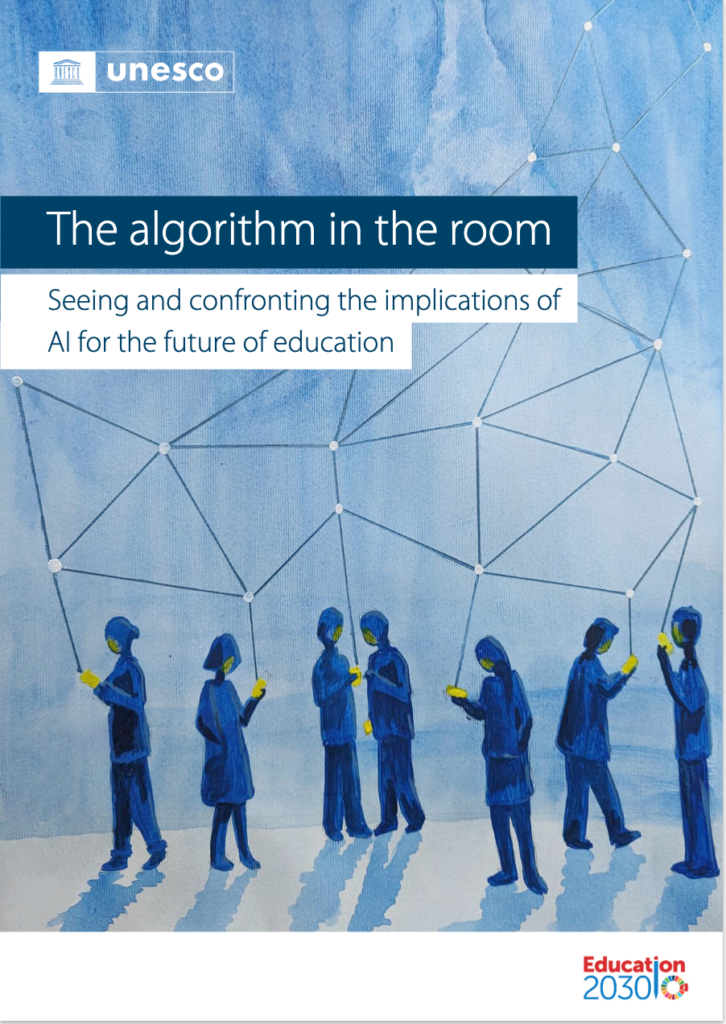
Published by UNESCO in 2026, the report brings together 26 short think pieces written from 2025 into early 2026. It is organised around six questions: agency and oversight; young people’s relational, emotional and cognitive development; pedagogy and assessment; thought, questioning and expression; education as a common good; and our capacity to imagine educational futures beyond those promoted by the technology industry.
This is a conceptual and futures-oriented collection. Its contributors work across different regions and educational contexts, moving between present concerns, emerging experiences and speculative scenarios.
That range is useful because the implications of AI do not stop at classroom practice. The pieces also address privacy, surveillance, data extraction, environmental costs, linguistic flattening, commercial influence and the possible weakening of public education.
The contributions do not speak with one voice or propose a single policy. What holds them together is their refusal to treat AI adoption as inevitable. They ask whether algorithmic systems can be aligned with educational values when education itself serves several purposes at once: knowledge, autonomy, curiosity, social development, justice and preparation for work and public life. I explored related questions in my earlier review of UNESCO’s AI and the Future of Education.
The alignment problem in AI in education
One of the report’s most useful concepts is the educational alignment problem. AI systems need targets they can calculate and optimise. Education, however, depends on qualities that are difficult to reduce to metrics. A system may improve completion rates, test performance or engagement while doing little for curiosity, judgement or meaningful understanding.
This problem becomes particularly visible in assessment. Long before generative AI, grades and completed assignments were imperfect proxies for learning. If an AI system can now produce the assignment, the distance between the observable product and the learner’s competence becomes greater. We may end up optimising the proxy while losing sight of what it was meant to represent.
The same concern appears in personalised learning. An algorithm can create an efficient individual pathway, yet learning is also social, unpredictable and relational. Students develop by encountering disagreement, uncertainty and perspectives that a system designed to predict their preferences may filter out. Personalisation can quietly become prescription when learners cannot see or challenge the logic directing them.
See, steer and rewrite the algorithm
The report closes with three horizons for action. The first is to see the algorithm. Educators and students need to recognise when algorithms are influencing their options and understand that their outputs reflect design choices, data and bias.
In practice, this means making algorithmic influence discussable: what is the system recommending, what appears to guide that recommendation and whose experiences may be missing?
The second is to steer the algorithm. Educators need the authority and knowledge to decide when AI supports a pedagogical purpose, when its use should be limited and when it should be refused. A tool should enter a lesson after the learning outcome and evidence of learning have been established. Its availability is not, by itself, a reason to use it.
The third is to rewrite the algorithm. This is the most ambitious horizon. Students, teachers and communities should participate in determining the aims, assumptions, data and rules of the systems that affect them. The report points to locally developed models, open technologies and community participation as possible routes towards greater ownership.
For me, this framework moves the conversation in the right direction. Education cannot remain a testing ground for systems whose purposes were set elsewhere. We need to see what algorithms are doing, judge where they belong and develop the capacity to shape them around educational values. The future of education is still open. It will narrow quickly, however, if we treat the current direction of AI as the only one available.
Full reference
UNESCO. (2026). The algorithm in the room: Seeing and confronting the implications of AI for the future of education. UNESCO. https://doi.org/10.54675/PMRO5023