
An AI literacy curriculum can give teachers and students a clearer understanding of how AI works, where it is used, and what ethical questions it raises. Fiona Hollands and Cynthia Breazeal reached this conclusion after examining how educators used the Day of AI materials with almost 12,000 students.
Teachers reported gains in knowledge, optimism, and confidence among themselves and their students. These were survey perceptions, however, and the study did not independently test what participants learned.
The paper was published in 2024, when many schools were still responding to the arrival of ChatGPT. Its argument remains relevant: before schools concentrate on adopting AI tools, students and teachers need opportunities to understand the systems entering their lives. Literacy gives them a basis for deciding when AI is useful, how it may cause harm, and what responsible participation should involve.
Moving Beyond Tool Use
School discussions about AI often begin with immediate decisions. Should students use ChatGPT for assignments? Which tools should teachers adopt? What rules are needed? These questions matter, but they can push more basic learning aside. A student may know how to generate text or images without understanding training data, bias, privacy, or why an AI system produces errors.
Hollands and Breazeal define AI literacy as the ability to understand AI’s role in our lives, evaluate its benefits and drawbacks, and use it productively. This is broader than operational skill.
It includes recognizing AI applications, understanding basic mechanisms, examining social consequences, and seeing that people can influence how these technologies are designed and governed.
This broader view also appears in research explaining why AI literacy for teachers goes beyond learning to use ChatGPT. Teachers need enough conceptual and ethical understanding to interpret what a tool does and to guide students through questions that have no simple technical answer.
How Teachers Used the Day of AI Materials
Hollands and Breazeal studied twelve modular curricula created by MIT with the implementation partner i2Learning for learners aged 5 to 18. The materials included educator guides, slides, student resources, and training videos.
Topics ranged from basic AI concepts and machine learning to social media, deepfakes, data, algorithmic bias, privacy, creativity, and ChatGPT. The activities were designed for educators with limited experience teaching AI and required little equipment beyond connected digital devices.
An online questionnaire gathered responses from 265 registered users in 2022 and 2023. Among them, 190 educators had taught at least one curriculum, reaching approximately 12,000 students. Seventeen educators also took part in follow up interviews.
Teachers described adapting the materials for age, time, local culture, student ability, and available resources. Some shortened difficult content, while others added discussions, quizzes, challenges, videos, or interactive tools.
Respondents rated their own AI knowledge higher after using the materials and reported similar improvement among students. They also described greater optimism about AI’s benefits and a stronger belief that they and their students could help shape its future.
The study did not include direct assessments, a comparison group, or independently collected student reports. Its findings tell us how participating educators perceived the curricula and their effects. They cannot establish the size of any learning gain or show that the curriculum caused the reported changes.
Building AI Literacy Before Making Adoption Decisions
The practical strength of the Day of AI approach is its modularity. Teachers did not need to introduce AI through a full computer science course. They could select a short sequence connected to a concern already present in students’ lives, such as recommendation systems, deepfakes, image recognition, or ChatGPT.
For schools beginning this work, the paper suggests a useful sequence. Start with recognition and explanation. Students can examine familiar technologies and decide whether they use AI, what data they require, and what the system appears to do. Activities can then move toward mechanisms by letting students create or inspect a small dataset, train a simple classifier, and observe how data choices affect the result.
Ethical questions belong inside these activities. A lesson on image classification can include bias and representation. Work on social media can address recommendation systems, filter bubbles, and misinformation.
A ChatGPT activity can ask students to develop recommendations for acceptable school use. This places policy discussion after students have learned something about the technology they are being asked to judge.
Teachers in the study often modified the materials substantially. That flexibility is useful, but it also points to a professional learning need. Condensing unfamiliar material may remove the very concepts students need, especially when time is limited.
Schools should give teachers time to work through the activities, clarify the underlying ideas, anticipate misconceptions, and decide which ethical issues fit their students and communities.
The reported increase in optimism also deserves careful handling. AI literacy should help students evaluate benefits without softening attention to risk. The goal is informed agency.
Students should be able to explain what a system can do, question how it works, identify who may benefit or be harmed, and make a reasoned decision about its use. Readers interested in turning broad definitions into learning goals may also find my review of AI literacy competencies for different learner groups useful.
This paper belongs naturally within the wider work on AI literacy. Its evidence is based on participant reports, so stronger evaluations are still needed. Yet it shows what early implementation can look like: short activities, active investigation, ethical discussion, and room for local adaptation. Adoption decisions are more defensible when the people making them understand the technology first.
Reference
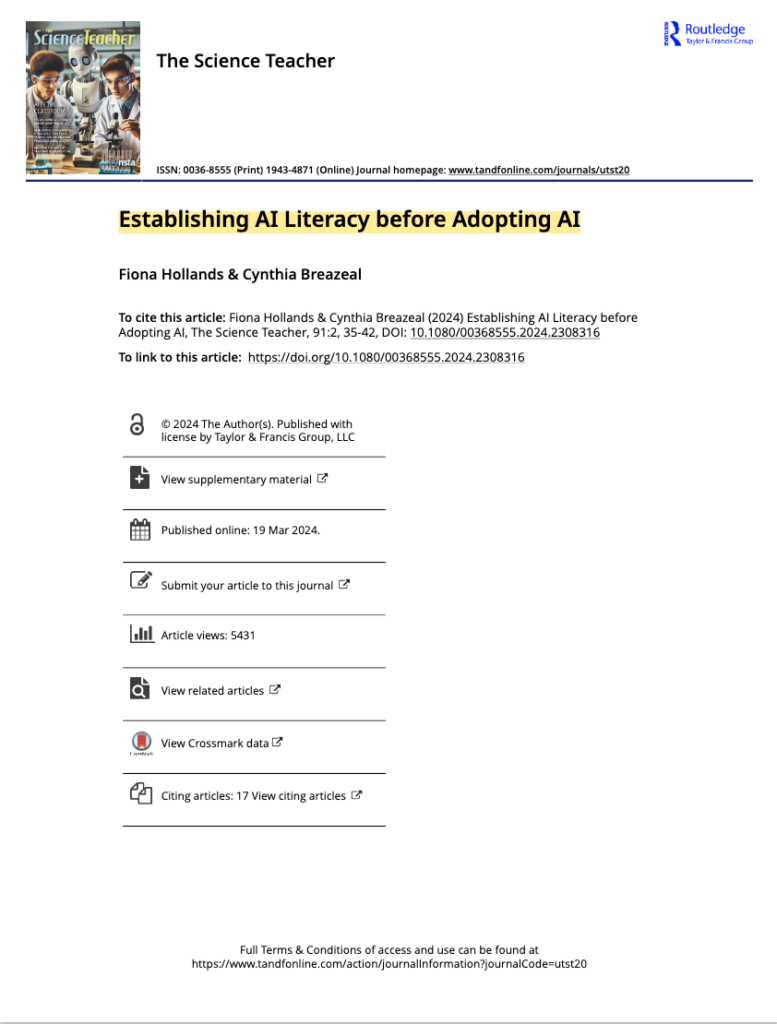
Hollands, F., & Breazeal, C. (2024). Establishing AI literacy before adopting AI. The Science Teacher, 91(2), 35–42. https://doi.org/10.1080/00368555.2024.2308316



