
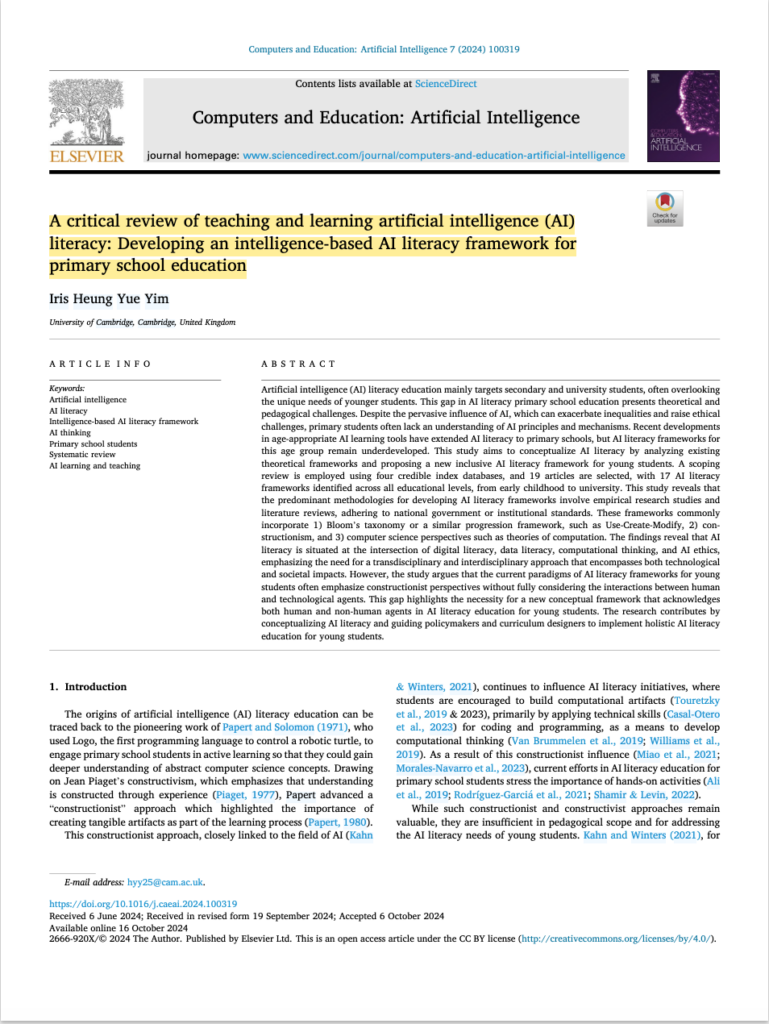
What should young children learn about AI, and what might we leave out when lessons concentrate on using tools or building simple programs? Iris Heung Yue Yim’s (2024) review examines these questions through existing AI literacy frameworks and proposes an intelligence-based framework for primary education.
Its central argument is that technical activities need to sit within a broader account of thinking, ethics, and human–AI interaction. For me, the paper offers a useful way to reconsider the scope of AI literacy in primary schools. It is a conceptual proposal informed by a review, with classroom effectiveness still to be tested.
What did the review examine?
Yim conducted a scoping review using four citation-index databases. Nineteen articles were selected, covering 17 AI literacy frameworks across educational levels from early childhood to university. The analysis examined how these frameworks were developed and the theoretical perspectives behind them.
Common foundations included Bloom’s taxonomy or other progression frameworks, constructionism, and computer science. The review positioned AI literacy at the intersection of digital literacy, data literacy, computational thinking, and AI ethics.
The paper argues that approaches centred on creating computational artefacts can leave insufficient attention to how people interact with AI and how those interactions shape knowledge and decisions.
It proposes an intelligence-based framework incorporating “AI thinking”: cognitive, creative, and analytical engagement with AI that considers social, ethical, and environmental questions. Drawing on sociocultural and posthumanist perspectives, the proposal treats human–technology relationships as part of what children need to understand.
This is not an evaluation of a curriculum or a demonstration of improved learning. The author explicitly calls for empirical research to validate, challenge, or refine the framework.
The review may also have missed relevant work outside its four databases. Interpretation and coding involved judgement, and 60% of the data received independent verification by three coders. These qualifications matter when deciding what the proposal can establish.
What does the framework add to AI literacy?
I find the paper’s attention to relationships particularly useful. Teaching children what a system does is one part of AI literacy. Examining how its suggestions influence what they notice, consider, or decide introduces another set of questions.
The author’s account of AI thinking is a theoretical interpretation of human–AI interaction. It should not be read as evidence that AI has human understanding or that interacting with it necessarily develops children’s thinking. Its educational value lies in directing attention to the interaction itself: what the learner contributes, what the system supplies, and how the response affects the next step.
This broadens the discussion of AI literacy without requiring technical learning to disappear. Understanding data and computational processes can inform an ethical discussion. Ethical questions can, in turn, give children reasons to investigate how a system works. My earlier review of an AI literacy and competency framework explores related questions about the range of knowledge and capabilities involved.
What could this mean for primary teaching?
My reading suggests beginning with a manageable question that connects a system’s operation with its consequences. For example, teachers could discuss why a system might make an incorrect classification and whose examples would need to be included to improve it. Such a discussion can connect data, representation, and fairness within the same learning activity.
Another possibility is to examine an AI suggestion together. What information did the system have? What important classroom context was missing? Which part would the class keep or change, and why? These are possible applications of the paper’s argument, not activities whose effectiveness this review tested.
Teachers can also connect the topic across subjects. Language lessons provide opportunities to examine wording and interpretation; social studies can open questions about representation and consequences. The curricular connection should serve a clear learning purpose. Simply adding an AI tool to an existing activity does not establish that children are developing AI literacy.
How can teachers preserve an active role for learners?
The paper aims to position children as participants who can contribute to AI-related practices, rather than treating them only as consumers. I would interpret that ambition carefully for primary classrooms.
Participation can include questioning a suggestion, identifying missing information, or explaining why an output needs revision. It need not depend on unrestricted access to a chatbot.
Teachers could model these decisions using prepared examples and invite children to explain their reasoning. Where suitable tools are used, their features should be examined against the learning goal, age requirements, and school expectations. My review of AI learning tools in K–12 discusses the wider range of educational tools available.
The next research step is important: the framework needs studies showing how its ideas translate into teaching and what children learn through that teaching. Until then, it gives educators a set of questions for curriculum planning, with its claims about improved or more inclusive learning remaining proposals to investigate.
References
Yim, I. H. Y. (2024). A critical review of teaching and learning artificial intelligence (AI) literacy: Developing an intelligence-based AI literacy framework for primary school education. Computers and Education: Artificial Intelligence, 7, Article 100319. https://doi.org/10.1016/j.caeai.2024.100319



