An assessment can restrict access to AI and still provide weak evidence of learning. What matters is whether the performance supports the claim we want to make about a student’s knowledge or capability.
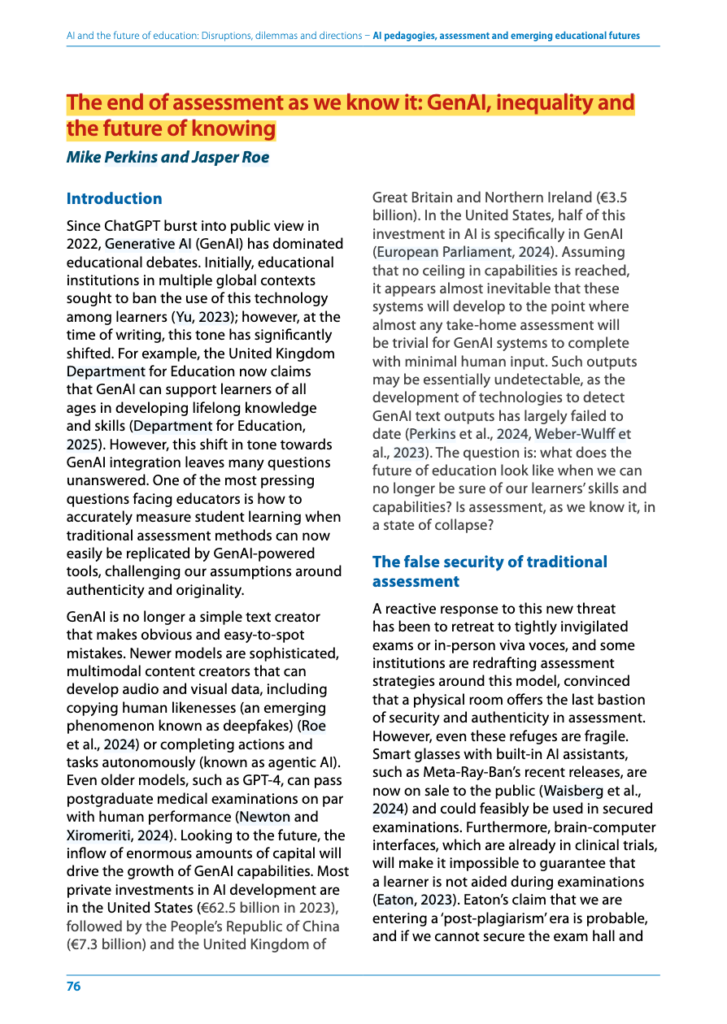
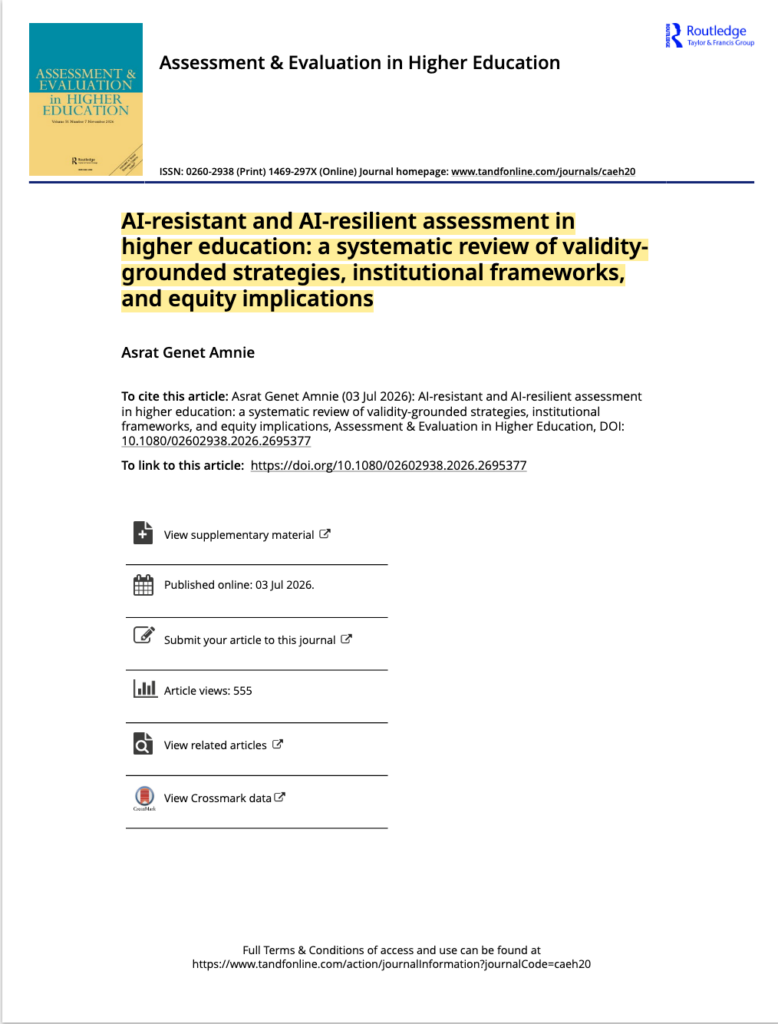
In a systematic review, Asrat Genet Amnie (2026) distinguishes AI-resistant assessment, which seeks to limit AI access or completion, from AI-resilient assessment, which centres educationally valuable human performance.
I find this distinction useful because it directs attention to what our assessments allow us to infer. A polished submission, a supervised examination, and a live explanation each provide evidence, but none interprets itself.
What Does the Review Establish?
Amnie synthesised peer-reviewed research, institutional policies, and sector guidance through a search covering the period from 2022 to 2025, supplemented by citation searching and other sources.
The review examined five databases and used independent screening by two reviewers. Its synthesis identifies six strategy categories: authentic contextualised tasks, oral examinations, assessment across complementary formats, process portfolios, supervised follow-up tasks, and learning analytics.
The author argues that restricting AI access and redesigning assessment can serve complementary purposes. A proposed institutional framework combines contextualised tasks, transparent formative AI use, supervised verification, oral dialogue, process documentation, and analytics. This is a modular proposal developed from the synthesis. It should not be read as an institution-wide system already shown to work across settings.
The evidence requires caution. Most included studies were descriptive or cross-sectional, long-term evidence was scarce, and the literature favoured Anglophone research institutions.
The protocol was not preregistered. The review also identifies limited student-voice and comparative equity evidence. Its claims about lasting resilience therefore remain proposals requiring further testing, even where the underlying educational principles are persuasive.
What Should Assessment Designers Ask First?
The question I would begin with is: what must students demonstrate themselves for this assessment to support the intended learning claim? That decision depends on the outcome. It also determines how we interpret assistance from AI.
The review’s validity framing helps explain why simply making a task more difficult for AI is insufficient. A task may be difficult to outsource while making demands unrelated to the learning we intended to assess.
Conversely, permitted AI assistance may fit an outcome involving informed tool use, provided the assessment captures the student’s relevant decisions and understanding.
Amnie also qualifies the appeal of local or personalised tasks. Supplying an AI system with course materials can weaken the assumption that contextual detail prevents AI completion. Context can make a task educationally meaningful, but its presence alone does not establish student understanding.
How Can Different Forms of Evidence Work Together?
The review recommends combining evidence from formats with different vulnerabilities. Written work might be accompanied by dialogue about reasoning, supervised modification of a solution, or documentation of revisions. The point is to make the learning claim supportable through more than one view of performance.
This connects with my earlier review of assessment twins and assessment validity. In both discussions, the relationship between performances deserves attention. A difference between written and oral performance can prompt a question about understanding. It cannot, on its own, establish misconduct.
Oral assessment also needs design and support. Amnie discusses rubrics, examiner training, calibration, and accommodations. I agree with the underlying caution: introducing a live conversation does not remove the need to establish what is being judged and whether the judgement is dependable.
What Are the Limits of Portfolios and Engagement Data?
Process evidence can make decisions, feedback responses, and developing understanding available for examination. Portfolios are especially useful when teachers discuss that evidence with students throughout the work. An archive of drafts still requires interpretation, including an understanding of what assistance was permitted.
The review also considers learning analytics, while acknowledging that engagement signals can be manipulated and their resistance to manipulation remains untested. Unusual working patterns may have innocent explanations, including connectivity difficulties or disability-related differences.
My reading is that collecting more data cannot substitute for a defensible interpretation. Revision histories and platform activity may inform a conversation. Treating them as automatic evidence of authorship or misconduct would exceed what the review supports.
What Would Fair Implementation Require?
Within the broader debate on AI & Assessment, fairness must be considered when choosing formats. Oral performance may be affected by anxiety, communication differences, or confidence in the language of instruction. Experience-based tasks can depend on unequal access to placements or professional networks.
Institutions also differ in their capacity to fund redesign, examiner training, and individual conversations. Amnie’s review makes those resource demands visible. I would judge a proposed change partly by whether students have a fair opportunity to demonstrate the intended capability, and whether staff have the time and support to interpret that evidence responsibly.
References
Amnie, A. G. (2026). AI-resistant and AI-resilient assessment in higher education: A systematic review of validity-grounded strategies, institutional frameworks, and equity implications. Assessment & Evaluation in Higher Education. Advance online publication. https://doi.org/10.1080/02602938.2026.2695377