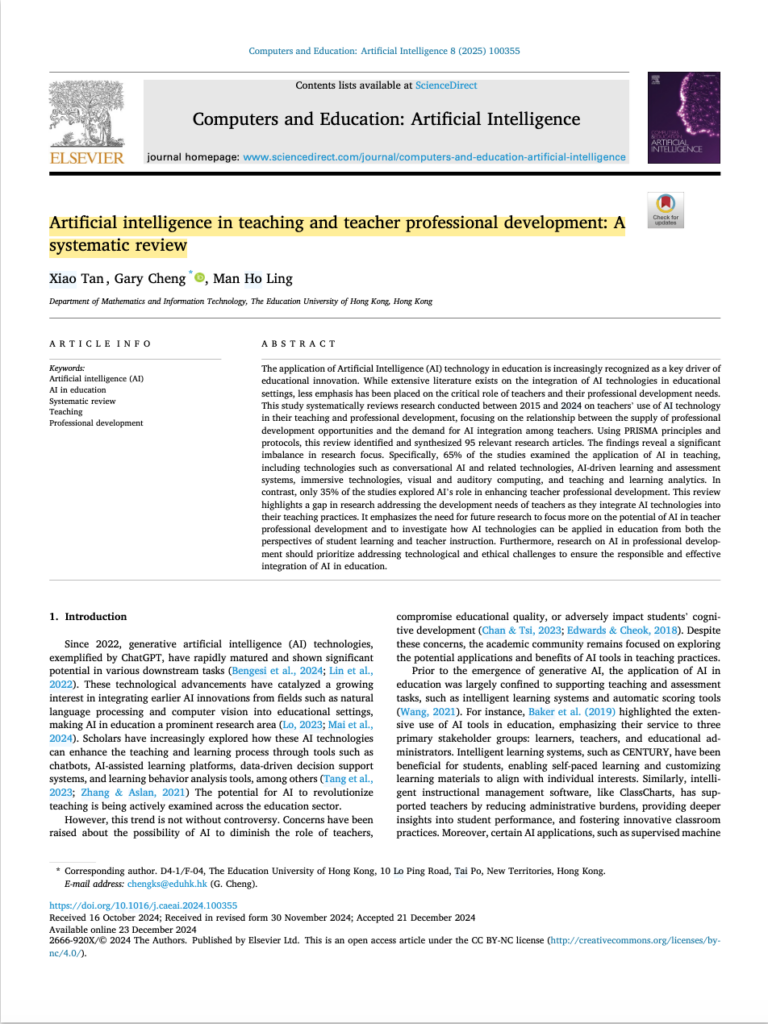
Teachers are increasingly expected to integrate AI into their work, but how much research examines the professional learning needed to support that expectation? Tan, Cheng, and Ling’s (2025) systematic review addresses this question by examining AI in teaching and teacher professional development.
Of the 95 studies reviewed, approximately 65% focused on teaching applications, while 35% addressed professional development. This imbalance describes the research literature, not the proportion of teachers receiving training.
For me, the paper raises a useful concern: exploring what AI can do in classrooms needs to be accompanied by careful investigation of how teachers learn to use it meaningfully.
What did the researchers review?
The authors searched Scopus and Web of Science for research covering 2015–2024 and included 95 empirical, peer-reviewed journal articles. They used PRISMA principles to guide selection and combined deductive and inductive coding to examine publication patterns, teaching applications, and professional development.
Their scope extended beyond generative AI to conversational systems, learning and assessment systems, immersive technologies, visual and auditory computing, and teaching and learning analytics. The review therefore provides a broader picture than a review of ChatGPT training alone.
Sixty-two studies concerned AI in teaching, while 33 addressed professional development. Within the latter group, the authors identified four areas: factors influencing professional development, implementation approaches, AI technologies supporting professional development, and evaluation of its outcomes.
Professional-development research covered a narrower range of subjects than the teaching-application literature. The authors also identified limited attention to targeted AI literacy development and to the integration of technological and pedagogical knowledge.
These findings map research activity and themes; they do not provide a pooled estimate of how effectively AI improves teaching or professional learning. Coverage was restricted to two databases and empirical journal articles, excluding conference papers and other publication types.
The period also combines research on different generations of AI. Consequently, the findings cannot establish the effectiveness of current generative AI tools or a particular training programme.
Why distinguish learning about AI from learning with AI?
One useful feature of this review is its attention to AI’s different roles in professional development. Teachers may learn how to integrate AI into instruction, while AI systems may themselves support professional learning through feedback, reflection, or other activities. These roles raise different questions.
For training about AI, we need to examine what teachers learn and whether they can apply it appropriately. When AI supports the training process, we also need to assess the quality of its guidance and the decisions it leaves with the teacher. A professional-learning tool can generate feedback without that feedback necessarily being accurate or useful.
My reading is that the two roles should be made explicit when schools plan professional development. Otherwise, introducing an AI-supported training platform can be mistaken for addressing teachers’ wider AI literacy needs.
What should professional development help teachers do?
The review argues for greater attention to AI literacy, practical applications, and ethical considerations. It also calls for research that connects technological knowledge with pedagogy. This fits the broader concern of AI and teaching practice: deciding how a tool serves a particular learning purpose.
For me, that means giving teachers opportunities to examine actual teaching decisions. Does an AI-generated activity fit the curriculum outcome? What changes does it need for the learners? Which parts of an output require checking? These are possible ways to apply the review’s recommendations, not activities whose effectiveness the review establishes.
My earlier discussion of Intelligent-TPACK explores a related concern about professional knowledge for ethical AI integration. Technical familiarity is useful, but teachers also need to understand the pedagogical consequences of the choices available to them.
How should schools judge whether the learning helped?
The authors call for evaluation that goes beyond changes in AI literacy or capability measures to examine teaching practices and student learning over time. They recommend research into different formats, durations, and intensities of professional development, alongside teachers’ experiences of that learning.
This is an important qualification. The review supports investigating sustained effects; it does not identify a proven best duration or format. A workshop may increase confidence without showing whether classroom decisions improved. Equally, a useful programme may help a teacher recognise situations where AI adds little educational value.
I would therefore ask schools to connect professional learning with evidence from practice. Teachers could explain a lesson revision, examine a questionable output with colleagues, or discuss what happened when they tried an activity.
These examples make professional judgement available for feedback. My review of AI literacy for teachers addresses why that judgement extends beyond knowing how to operate a tool.
The research gap identified here gives professional development a clear agenda: investigate what teachers need, how different supports affect their practice, and whether those changes benefit learners. Counting tools introduced or training sessions delivered gives only a partial account of that work.
References
Tan, X., Cheng, G., & Ling, M. H. (2025). Artificial intelligence in teaching and teacher professional development: A systematic review. Computers and Education: Artificial Intelligence, 8, Article 100355. https://doi.org/10.1016/j.caeai.2024.100355