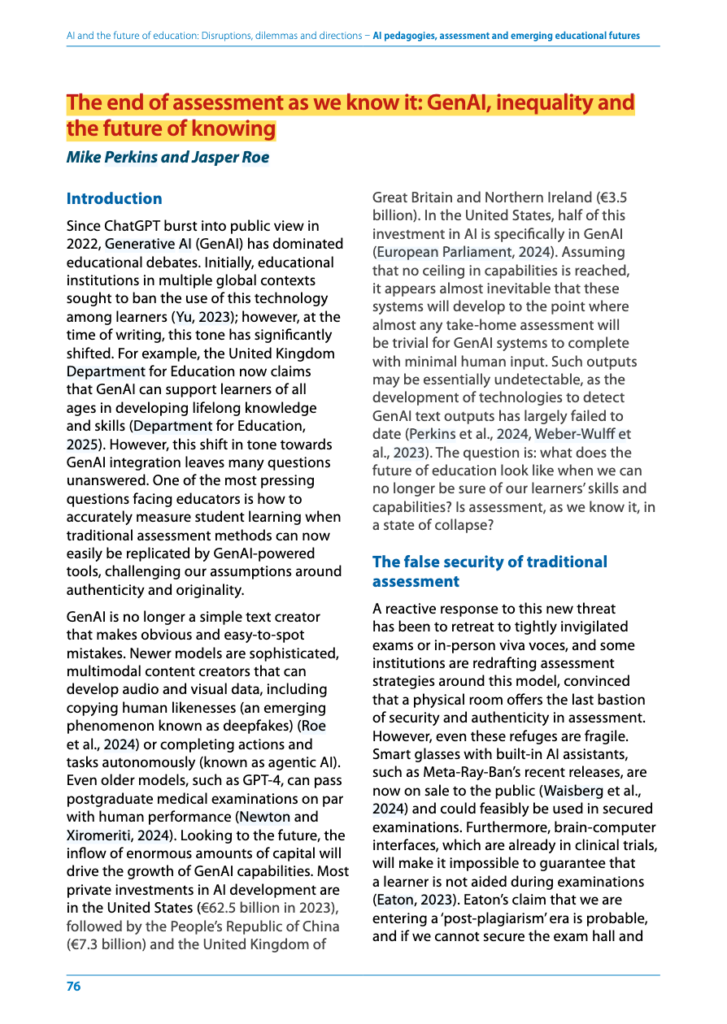
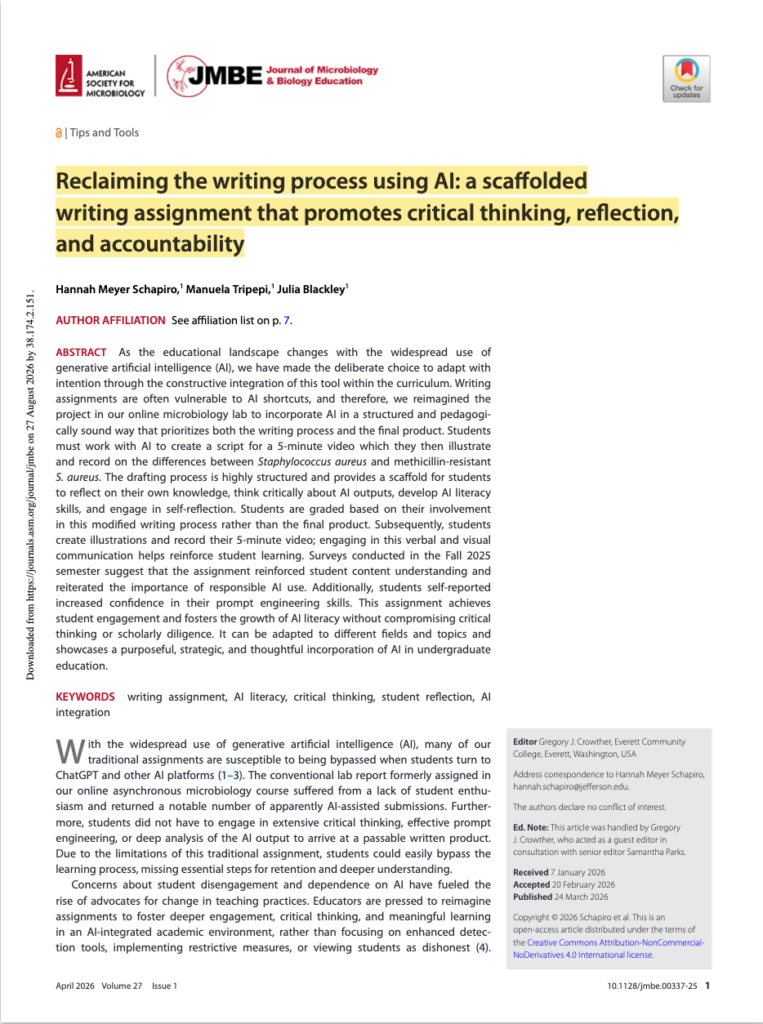
Writing assignments become difficult to assess when AI can produce a polished draft before students have worked through the ideas. Schapiro, Tripepi, and Blackley (2026) address this problem in Reclaiming the writing process using AI, an account of a redesigned undergraduate microbiology assignment.
Students use AI to develop a video script while documenting their planning, evaluation, and revisions. They then create illustrations and record the video without AI assistance. The paper offers a practical approach to making students’ decisions visible throughout an AI-assisted writing task, although its evaluation relies on student perceptions and does not establish gains in critical thinking.
How Was the Microbiology Assignment Redesigned?
The authors replaced a conventional lab report in an online asynchronous microbiology course with a project comparing Staphylococcus aureus and methicillin-resistant S. aureus (MRSA), including their differing susceptibility to penicillin and its derivatives. Students prepare a script for a short explanatory video.
Before requesting an AI draft, they complete a planning framework called CLARITY, identify what they know and where they need help, and write a prompt asking the chatbot to pose clarifying questions. They answer those questions before proceeding to drafting.
Students then use a REACT log to document their evaluation and revision of the AI output, followed by self-reflection. Grading for this writing component rewards completion of the documented process.
In the second component, students create illustrations and record their explanation without AI assistance. Illustrations can be hand-drawn or constructed with icons; they are assessed for scientific clarity and technical content, with artistic skill excluded from the criteria.
Voluntary, anonymous surveys and student reflections suggested perceived benefits for content understanding, communication, and confidence with prompting. Some students found the REACT log excessive.
These findings offer feedback on the assignment’s implementation, but they cannot demonstrate improved learning, retention, or critical thinking. The authors identify future assessment of understanding and stronger guidance on evaluating AI outputs as areas for development.
What Can Teachers Take From This Assignment?
For educators interested in AI and assessment, the most useful contribution is the sequence of decisions built into the task. Students must prepare, examine, revise, and explain, with a record of their involvement available to the instructor.
Give Students Thinking to Do Before the First Prompt
CLARITY asks students to consider context, learning goals, audience, requirements, information checks, tone, and their request. This makes preparation part of the submitted work.
I find the information check particularly useful. Students identify what they already understand and what remains uncertain before receiving an AI-generated explanation. That gives them an initial position from which to evaluate the response. The framework also connects prompting to communication: students need to decide what their audience should understand and what background knowledge they can assume.
Require Reasons for Revision
The REACT log asks students to review what worked, evaluate what was unclear or inaccurate, identify an adjustment, record the follow-up prompt, and judge the new response.
This is where the assignment connects with evaluative judgement in the AI age. Students have to examine the quality of an output and decide what needs attention. My reading is that the educational value depends on the substance of those judgements. A completed log provides material for assessment; instructors still need to examine whether the identified problems and proposed revisions make sense.
Ask Students to Explain the Content in Another Form
The illustration and recording stage requires students to work with the scientific content beyond the script. They must decide how to represent it visually and communicate it orally.
That is a useful design choice for this topic. However, I would be careful about what it establishes. Reading a script aloud provides limited evidence of understanding on its own.
The illustrations, explanation, and documented revisions need to be considered together. Adapting the assignment to another subject would require deciding which form of representation could meaningfully reveal understanding of that content.
Match the Assignment to the Learning Claim
The project combines scientific understanding, communication, and AI literacy. Those purposes matter when deciding whether the design fits another course.
If the intended outcome includes evaluating scientific explanations, this sequence gives students opportunities to practise that work. If the outcome requires students to independently compose an initial explanation, an AI-generated first draft changes the evidence available. This is a question of assessment validity: what can the submitted work support us in concluding about the student?
Keep Documentation Useful
Some students’ concerns about the REACT log deserve attention. Process documentation takes time, and its purpose should be clear.
I would use the paper’s design as a starting point for deciding which decisions are worth documenting. The strongest evidence would show students identifying a substantive problem, explaining a revision, and judging its result.
The authors’ plan to provide more guidance on evaluating AI outputs is especially relevant here. Students need help recognising what counts as an adequate scientific explanation before they can reliably improve one.
References
Schapiro, H. M., Tripepi, M., & Blackley, J. (2026). Reclaiming the writing process using AI: A scaffolded writing assignment that promotes critical thinking, reflection, and accountability. Journal of Microbiology & Biology Education, 27(1), e00337-25. https://doi.org/10.1128/jmbe.00337-25