
AI writing feedback can arrive in seconds, but speed is only useful when students can understand the comments and act on them. With younger writers, this becomes especially important. A detailed response filled with unfamiliar language may look impressive while giving the student more work to decode.
A recent case study takes us inside an eighth-grade classroom in a rural, Indigenous-serving school in Southeast Alaska. It belongs within the wider discussion of AI and teaching practice because it examines the conditions surrounding the tool: the rubric, the interface, the school network, and the support students needed while revising.
Summary of the Study
Tzirides and colleagues studied how four students used AI-generated feedback during a journal-writing activity about belonging. The students wrote in a platform that organized feedback around a teacher-created rubric covering areas such as clarity, evidence, organization, tone, and mechanics.
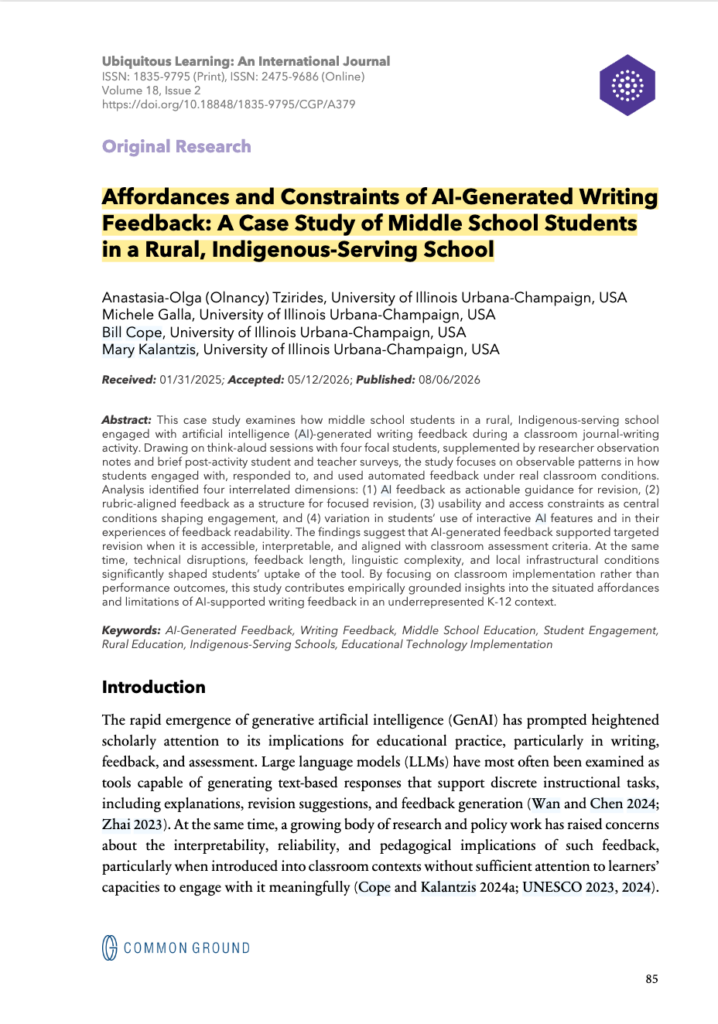
During individual think-aloud sessions, they reviewed the feedback, explained what they were thinking, and revised as they saw fit. The researchers analysed their observation notes and analytic memos, supported by brief student and teacher surveys.
When the system worked and the language made sense, students used its comments to add detail, improve transitions, reconsider wording, and make their writing sound more polished. Organizing the feedback one rubric criterion at a time helped them focus on manageable parts of the draft.
Some students also asked the system follow-up questions, while others accepted or rejected the initial comments without further discussion. This variation is important. Interactive feedback does not automatically create a dialogue; students need the confidence and feedback literacy to question it and decide what belongs in their writing.
The difficulties were part of the learning experience, not minor technical inconveniences. The tool sometimes failed to recognize students’ writing, generated feedback slowly, or required them to log out and begin again. The teacher spent much of the session troubleshooting problems with devices, the network, and Zoom.
Students also differed in how they experienced the comments. Some found them clear, while others struggled with unfamiliar vocabulary or felt overwhelmed by the amount of text. Rubric alignment gave the feedback direction, but it did not guarantee that every student could understand or use it.
The study is intentionally small and does not test whether AI feedback improved writing. Its evidence comes mainly from researchers’ notes about four students selected by their teacher, not full transcripts or systematic comparisons of drafts. The researchers did not analyse the students’ written work or the complete feedback they received, so we cannot judge the accuracy of the comments or the quality of the revisions.
The Indigenous-serving context also deserves closer examination. The paper documents infrastructure and access, but it does not show whether the AI recognized local language, culture, or students’ ways of expressing belonging. Those questions require the voices of students, teachers, families, and community members.
Practical Insights
This study offers a useful reminder for teachers: test AI feedback with the students who will actually receive it. A comment that sounds clear to an adult may be confusing to a thirteen-year-old. Before classroom use, submit several sample drafts and check the vocabulary, length, tone, accuracy, and developmental level of the responses.
- Anchor feedback to the classroom rubric. Give the system the same criteria students already use. This helps connect the comments to instruction and prevents the tool from introducing its own hidden standards.
- Limit the amount of feedback. Ask for one or two priorities at a time. Students can revise those areas before requesting another round. More feedback can easily become less usable feedback.
- Teach students how to respond. Have them label each suggestion: accept, adapt, reject, or ask for clarification. They should also explain one decision. This turns revision into judgment instead of compliance and connects naturally with critical AI literacy.
- Check accessibility in practice. Test the tool on school devices and networks before the lesson. Prepare an offline or teacher-feedback alternative so technical failure does not leave some students without support.
- Protect the student’s language and meaning. Ask whether a suggested change makes the writing clearer or merely makes it sound more like the system. This concern matters when students are writing about identity, culture, community, or personal experience.
For researchers, future studies should examine the original drafts, AI comments, revision decisions, and final texts together. Longer studies could show whether students become better at evaluating feedback or simply more accustomed to accepting it. Research in Indigenous-serving schools should also be designed with communities, giving cultural and linguistic fit the same attention currently given to usability and infrastructure.
AI feedback becomes educational when students can read it, question it, and make deliberate choices about their writing. This case study shows how easily that process can be helped or interrupted by the design of the feedback and the conditions of the classroom.
Reference
Tzirides, A.-O., Galla, M., Cope, B., & Kalantzis, M. (2026). Affordances and constraints of AI-generated writing feedback: A case study of middle school students in a rural, Indigenous-serving school. Ubiquitous Learning: An International Journal, 18(2), 85–112. https://doi.org/10.18848/1835-9795/CGP/A379



