
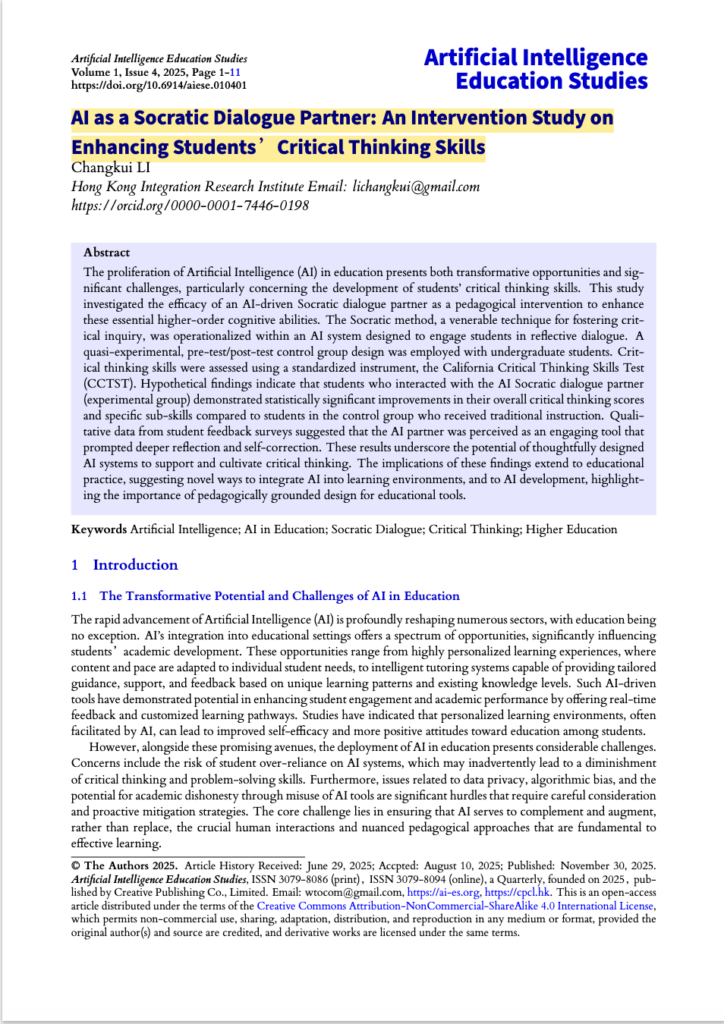
One of the more productive ways to use generative AI in education may be to stop treating it as an answer machine. In a recent paper, Changkui Li examines a different possibility: an AI system that responds to students with questions, asks them to explain their reasoning, and presses them to examine their assumptions.
The paper presents this as an intervention intended to develop critical thinking among university students. The pedagogical idea is worth examining. However, there is an important qualification readers need to know from the outset: the study’s participants, results, themes, and student quotations are presented as hypothetical. The paper therefore gives us a proposed research design and an instructional model, not empirical evidence that the intervention worked.
How Is the AI Supposed to Support Critical Thinking?
The intervention is based on the Socratic method. Instead of supplying conclusions, the AI is designed to ask open-ended and probing questions. It invites students to justify claims, identify assumptions, consider other perspectives, and follow the implications of their reasoning. The intended shift is simple but consequential: students remain responsible for constructing the answer.
Li describes a custom system built on a large language model and fine-tuned with examples of Socratic dialogue and pedagogical principles. Students would use a web-based chat interface to discuss course topics such as ethical dilemmas or literary themes. The AI would adapt its questions to each response while avoiding direct solutions.
This design speaks to a genuine concern about educational AI. When a chatbot completes the intellectual work, students can reach an answer without practising the thinking that the task was meant to develop. A Socratic chatbot changes the role of the system. Its purpose is to sustain inquiry and make the learner’s reasoning visible.
What Does the Proposed Study Involve?
The paper outlines a quasi-experimental study with two intact undergraduate humanities classes. The anticipated sample is 120 students, divided evenly between an experimental group and a control group.
Over eight weeks, students in the experimental group would complete two AI-supported dialogue modules each week, while the control group would study the same topics through lectures, readings, and classroom discussion.
Critical thinking would be measured before and after the intervention with the California Critical Thinking Skills Test. Student surveys and interviews would also be used to explore how participants experienced the dialogue partner. Quantitative results would be analysed through comparisons that account for baseline scores, while the qualitative responses would undergo thematic analysis.
As a research plan, the design is easy to follow. It connects the intervention, the proposed mechanism, and the outcome measure in a reasonably coherent way. The paper also acknowledges familiar limitations associated with a single institution, intact classes, a short intervention, reliance on one standardized measure, and the particular AI system being tested.
Did the AI Improve Students’ Critical Thinking?
The paper presents improvements in overall critical thinking, analysis, inference, and evaluation. It also reports themes such as deeper self-reflection, engagement, comfort with a non-judgmental partner, and occasional frustration with repetitive or circular questions.
These findings cannot be treated as observed outcomes. The tables label the participant information and statistical results as hypothetical, the results section is titled “Results (Hypothetical),” and the sample student quotations are also identified as hypothetical. Even the abstract refers to “hypothetical findings.” No actual intervention results are reported.
This distinction matters. A hypothetical dataset can illustrate how a proposed study might be analysed, but it cannot show that the intervention caused improvement, that students experienced the system in the ways described, or that an AI Socratic partner is effective.
The paper sometimes uses empirical language when discussing these illustrative results, which may lead a hurried reader to draw a stronger conclusion than the document supports.
What Can Teachers Take From the Paper?
The most useful contribution is the instructional design behind the proposed intervention. Teachers do not necessarily need a custom fine-tuned system to experiment with the underlying principle.
A chatbot can be instructed to withhold answers temporarily, ask one question at a time, request evidence, probe assumptions, and invite counterarguments. The learning goal should determine the sequence, and the teacher still needs to decide what counts as sound reasoning in the subject.
This last point is especially important. Generic questioning can create the appearance of intellectual depth while sending students through repetitive loops. Effective Socratic dialogue depends on disciplinary knowledge, careful timing, and questions that respond meaningfully to what a learner has said.
The paper itself anticipates problems such as circular questioning and limited understanding of complex responses, although these observations come from hypothetical feedback.
I would therefore read this paper alongside research showing that the effects of AI depend heavily on how the tool structures students’ activity. Unguarded answer-giving can weaken independent learning, while well-designed questioning may keep students cognitively involved.
My reviews of generative AI without guardrails in mathematics, the cognitive cost of quick AI answers, and the broader evidence on teaching critical thinking provide useful context for this distinction.
For educators, the paper offers a design proposition worth testing: use AI to extend a student’s reasoning instead of replacing it. For researchers, it offers a study blueprint that now needs to be carried out with real participants, transparent intervention materials, and reported data. Until that happens, the paper should inform hypothesis-building and instructional experimentation, not claims about effectiveness.
This post belongs to my broader collection on AI and cognition, where I examine how AI use shapes thinking, attention, memory, and human judgment.
References
Li, C. (2025). AI as a Socratic dialogue partner: An intervention study on enhancing students’ critical thinking skills. Artificial Intelligence Education Studies, 1(4), 1–11. https://doi.org/10.6914/aiese.010401



