
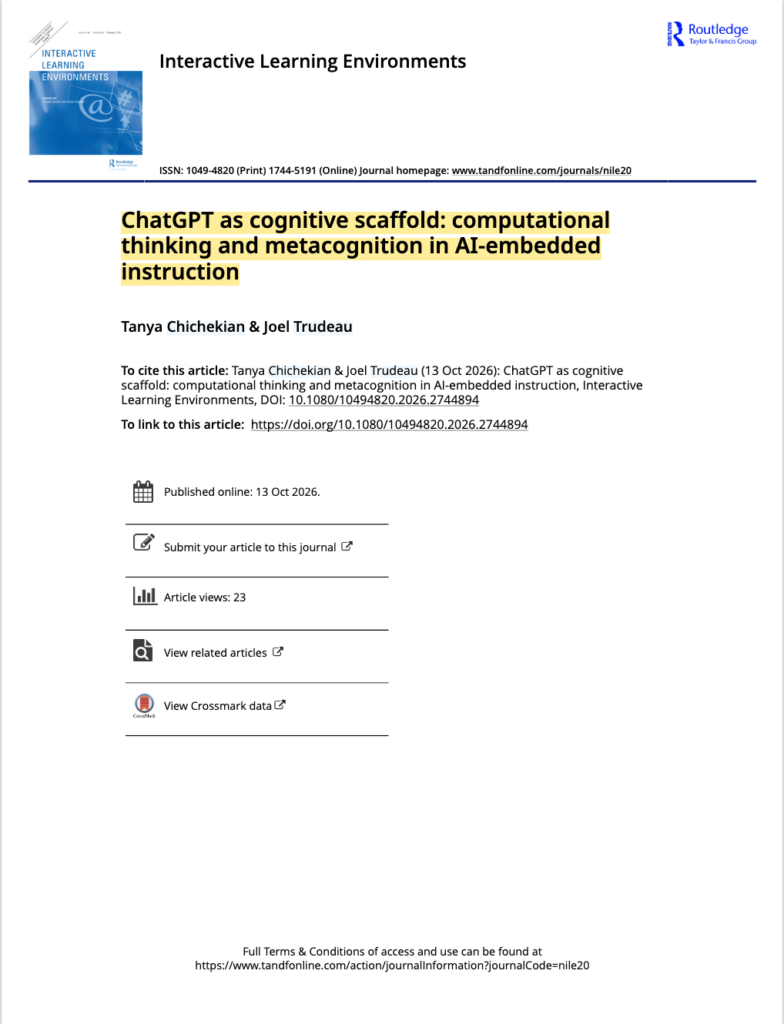
ChatGPT can support students’ thinking, but much depends on when it enters the learning process and what students are asked to do with its responses. In a 2026 study, Tanya Chichekian and Joel Trudeau found that students in a ChatGPT-embedded class reported stronger computational problem-solving skills than students in a comparison class.
The activity did not begin with the chatbot. Students first worked through a cryptography problem independently, then used ChatGPT to test hypotheses, examine discrepancies, and extend their reasoning. That sequence is what makes this study worth examining.
How Was ChatGPT Used as a Cognitive Scaffold?
The study compared two naturally occurring sections of the same liberal arts course, taught by the same instructor in consecutive fall semesters. The sample included 47 second-year pre-university college students between the ages of 17 and 19.
The first class completed the course without a ChatGPT-embedded activity. The second used ChatGPT-3.5 during a cryptography activity involving ciphers, frequency analysis, pattern recognition, and logical deduction.
The timing of the AI support was deliberate. Students completed the initial frequency analysis and developed their own ideas about the encryption key before consulting ChatGPT.
They were then asked to use the system to explore possible solutions, compare its reasoning with their own, identify discrepancies, and refine their hypotheses. They also submitted screenshots of their conversations alongside their lab work.
This design positioned ChatGPT as a second step in the reasoning process. Students had an initial solution to defend, revise, or reject. They could not simply begin with a generated answer and work backwards.
The researchers measured computational-thinking skills and used an adapted questionnaire to examine planning, monitoring, and evaluation when learning with generative AI. Open-ended responses from the ChatGPT class were also analysed.
What Did the Study Find?
Students in the ChatGPT-embedded class reported substantially stronger problem-solving skills. The classes did not differ significantly in digital literacy, although the study may have been too small to detect a modest difference. This pattern fits the activity itself: it concentrated on hypothesis testing and iterative reasoning, not general technological fluency.
Across the full sample, computational-thinking skills were associated with metacognitive strategy use. Problem solving had the strongest simple relationship with metacognition, although it was not a unique predictor once the other variables were considered together.
The students’ written responses add an important layer. They described ChatGPT as a cognitive scaffold that helped them get unstuck, simplify complex material, organize ideas, and test possible solutions. At the same time, many worried that easy access could weaken their thinking. One student compared the mind to a muscle that becomes weaker when it is not exercised.
Students also described setting their own boundaries. Some reserved creative and learning-related decisions for themselves or used AI mainly to confirm ideas. A smaller group resisted using it on pedagogical, ethical, or environmental grounds.
What I find most interesting is that these positions often appeared together. Students could value ChatGPT’s help, recognize the danger of dependence, and still protect parts of the thinking process. Awareness of risk sometimes led to more deliberate use.
What Should Teachers Take From This Study?
The practical lesson is not simply to give students access to ChatGPT during complex work. The surrounding sequence did much of the pedagogical work.
Require an initial attempt before AI consultation. Students need something of their own to bring into the exchange: a hypothesis, interpretation, calculation, draft, or proposed solution. Without that first attempt, the chatbot can become the source of the reasoning instead of a resource for examining it.
Ask students to compare, not merely collect. In this activity, learners had to check the AI response against their own analysis and identify inconsistencies. Similar prompts could ask students what changed, which answer is better supported, where the AI may be wrong, and why they accepted or rejected its suggestion.
Keep a record of the interaction. Requiring the conversation alongside the finished work gives teachers evidence of how the tool was used, especially when students explain which decisions remained theirs.
Make boundaries part of the task. Students can be asked in advance what they will delegate, what they will complete independently, and when they will stop consulting the tool. This turns boundary-setting into a metacognitive practice instead of leaving it to chance.
These ideas connect with earlier research on metacognitive laziness, which warns that learners may offload the monitoring and regulation of their work to AI. They also speak to the wider cognitive risks of AI. Offloading is not automatically harmful. The question is whether the tool frees capacity for deeper reasoning or removes the very reasoning students need to practise.
How Cautiously Should We Read the Findings?
This was an exploratory comparison, not a randomized experiment. The two classes were taught in different semesters, and the study did not measure their skills before the course. The later cohort may have differed in prior ability, motivation, familiarity with AI, or exposure to institutional discussions about it. The groups also differed in gender composition.
The sample came from one institution, the metacognition measure was newly adapted, and the instructor who designed the activity was also a co-author. No independent observation checked whether the classes received fully comparable instruction. The problem-solving advantage should therefore be understood as an association, not proof that the activity caused it.
Even with these limits, the study offers a useful design principle for AI and cognition: let students think first, bring AI into the middle of the process, and require them to evaluate what it contributes. ChatGPT functions as a scaffold when it gives students something to think with while leaving the judging, checking, and deciding in their hands.
References
Chichekian, T., & Trudeau, J. (2026). ChatGPT as cognitive scaffold: Computational thinking and metacognition in AI-embedded instruction. Interactive Learning Environments. Advance online publication. https://doi.org/10.1080/10494820.2026.2744894