
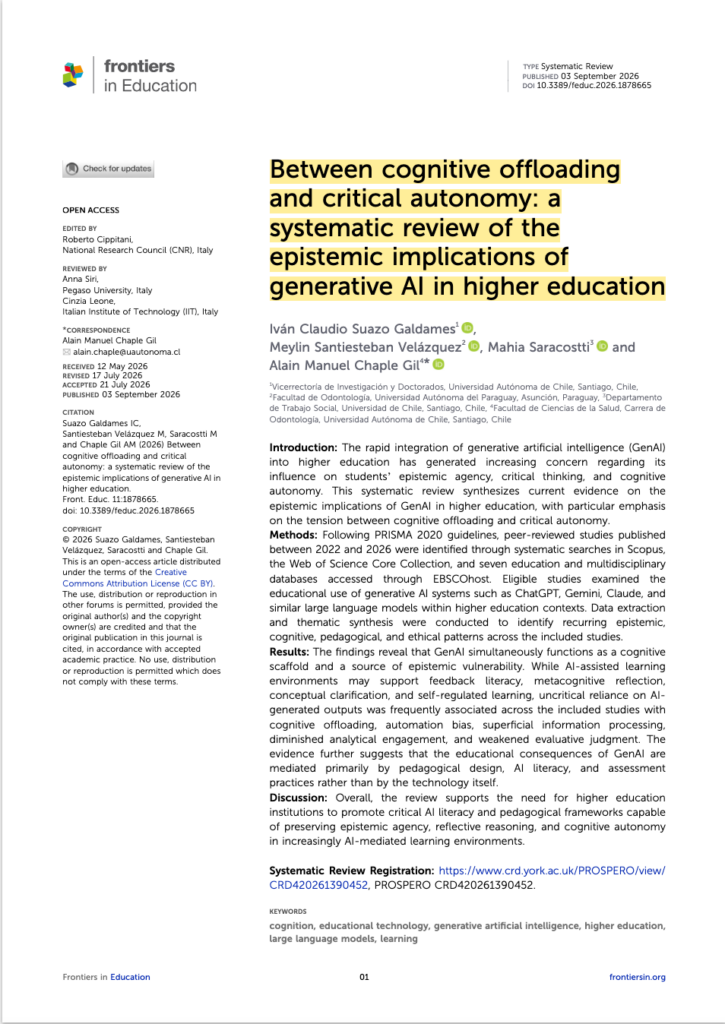
When students ask AI to explain a concept, evaluate an argument, or interpret evidence, what intellectual responsibility do they retain? This question is central to Between Cognitive Offloading and Critical Autonomy, a systematic review by Suazo Galdames and colleagues (2026).
Their synthesis suggests that structured AI use can support reflection and understanding, while uncritical reliance can displace source checking and independent judgement.
The evidence does not establish long-term cognitive decline. What interests me about this review is its attention to how students decide what deserves to be accepted as knowledge when AI becomes part of their learning. Between cognitive offloading an…
What Did the Review Examine?
The authors searched Scopus, the Web of Science Core Collection, and education and multidisciplinary databases accessed through EBSCOhost. They examined peer-reviewed empirical research on generative AI in higher education, focusing on knowledge validation, cognitive delegation, authorship, trust, and learner autonomy. Because the studies differed substantially in their methods and outcomes, the authors used thematic and framework synthesis without pooling statistical effects.
The review identified a recurring tension. AI could provide explanations, feedback, and support for reflective inquiry. It could also encourage overreliance, superficial processing, and reduced evaluation of sources.
However, much of the evidence was exploratory, cross-sectional, or based on participants’ perceptions and self-reports. The authors therefore caution against interpreting these patterns as proof that AI causes lasting changes in students’ thinking.
When Does AI Assistance Become an Educational Concern?
The concern running through this review is the possible transfer of responsibility for judgement. Students may use AI to access an explanation, then gradually begin treating its response as sufficient justification for a claim.
The authors describe this as a change in epistemic authority: who or what learners trust when deciding what is credible. Fluent, confident responses can make AI appear authoritative even when its claims lack reliable evidence. Students consequently need to examine how an answer is supported, where its information comes from, and whether it fits the disciplinary context.
I find this a useful extension of the discussion about AI and cognitive offloading. The educational question concerns which parts of a task students delegate and whether they retain enough understanding to evaluate the result.
What Can University Teachers Take From This Review?
For me, the most useful implications concern how we make students’ judgement visible. The authors explicitly present their teaching recommendations as evidence-informed proposals; these have not all been tested across the reviewed studies.
Build verification into the activity. Asking students to “check the answer” leaves considerable room for interpretation. The review proposes more explicit practices: comparing AI-generated claims with external evidence, verifying citations, identifying uncertainty, and explaining why a response should be accepted or rejected.
My interpretation is that verification needs a clear place in the task itself. If students are assessed on how they evaluate a claim, checking becomes part of the intellectual work they must demonstrate.
Ask students to explain their decisions. A polished submission reveals relatively little about how students used AI or evaluated its suggestions. The authors propose reflective records, successive drafts, source-verification logs, and oral justification as possible ways to make the process visible.
This connects with the concern discussed in my review of metacognitive laziness and AI: educators need to attend to students’ monitoring and evaluation during AI-supported work. A useful question is whether students can explain the reasons behind a revision, including why they rejected an apparently convincing suggestion.
Teach critical AI literacy within disciplinary work. The review uses the term epistemic AI literacy for the capacity to question, verify, contextualise, and responsibly use AI-generated information. Knowing how to prompt a system is only one part of that work.
I would connect this literacy directly to the evidence standards students are learning in their subjects. Evaluating an AI response requires some understanding of what counts as a justified claim in that field. General awareness that AI can make mistakes offers limited guidance about how to investigate a particular answer.
What Does the Proposed HEEP-HE Framework Add?
The authors organise their interpretation into the Hybrid Epistemic Engagement Practices in AI-Mediated Higher Education framework, abbreviated HEEP-HE. It brings together knowledge validation, teaching practices, human–AI interaction, and civic responsibility.
Its value, in my reading, is that it connects classroom decisions with wider institutional responsibilities. Students’ capacity to judge AI-generated information depends partly on teaching, assessment, access, and the guidance universities provide. The framework also links these practices to participation in public information environments where misleading synthetic content circulates.
HEEP-HE remains a provisional conceptual framework. It has not been validated as an intervention or measurement instrument. For educators following research on AI and cognition, it offers a way to organise questions about delegation and responsibility while further evidence develops.
References
Suazo Galdames, I. C., Santiesteban Velázquez, M., Saracostti, M., & Chaple Gil, A. M. (2026). Between cognitive offloading and critical autonomy: A systematic review of the epistemic implications of generative AI in higher education. Frontiers in Education, 11, Article 1878665. https://doi.org/10.3389/feduc.2026.1878665



