
Cognitive offloading in education is often discussed as though it began with generative AI. It did not. We have always used the world around us to make thinking easier: fingers for counting, paper for remembering, diagrams for reasoning, and calculators for computation. AI has expanded the range of work we can hand over, but the underlying human habit is old.
That longer view makes Risko and Gilbert’s review worth revisiting. It gives educators in the AI & Cognition category a better question than “Is using a tool good or bad?” The sharper question is: which mental work is being offloaded, what happens to the capacity we free up, and does the learner still practise the thinking the lesson is meant to develop?
Summary of the Study
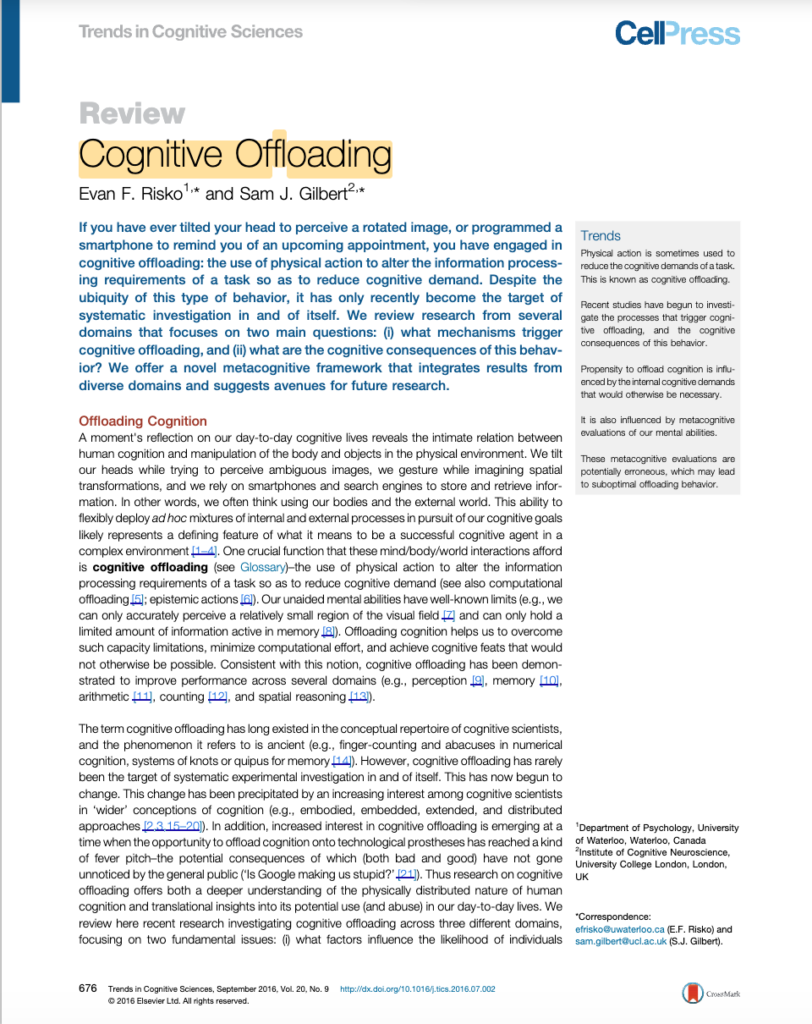
Risko and Gilbert reviewed research across perception, memory, arithmetic, spatial reasoning, gesture, internet search, and navigation. They define cognitive offloading as using physical action to change a task’s information-processing demands. Tilting one’s head to read rotated text, setting a reminder, writing something down, and consulting GPS all fit this definition.
This breadth is useful because it moves the discussion beyond screens. Thinking has never taken place inside the head alone; bodies, other people, and tools often become part of the cognitive system.
The review asks what prompts people to offload cognition and what follows when they do. A recurring pattern is that people rely more on external support as a task becomes mentally demanding. Yet objective difficulty is only part of the story. Decisions also depend on metacognitive judgements: what we believe about our memory, effort, ability, and the reliability of a tool.
Those judgements can be wrong. A learner may reach for assistance because a task feels difficult even when working through that difficulty is both possible and educationally necessary.
The consequences run in more than one direction. Offloading can improve immediate performance, support people whose unaided abilities are limited, and release attention for other work. It can also weaken memory for information stored elsewhere, inflate confidence in what we think we know, and encourage repeated dependence on an external system.
This is where the review speaks directly to current debates about AI cognitive offloading and critical thinking. Faster completion tells us that the combined person-and-tool system worked efficiently. It does not tell us whether the person learned, could perform later without support, or understood enough to judge the tool’s output.
The review’s limits matter. It integrates evidence from varied tasks and research traditions instead of testing one educational intervention, and much of the work concerns short-term behaviour in controlled settings. The authors identify long-term change as an open question, so the paper cannot support sweeping claims that technology permanently damages cognition.
It also predates generative AI, whose ability to produce explanations, arguments, and finished text goes well beyond the reminders and information stores emphasized in the review. Its metacognitive model remains highly relevant, but applying it to AI requires new evidence, especially evidence that separates successful task completion from durable learning.
Practical Insights
Teachers can begin by identifying the cognitive work a lesson is designed to exercise. If the goal is historical argument, students might offload citation formatting while retaining responsibility for selecting evidence and building the claim. If the goal is mental computation, handing the calculation to a tool removes the very practice being taught. The same support can be sensible in one lesson and counterproductive in another.
A simple classroom activity is an offloading audit. Ask students to complete a task and mark each point where they used notes, search, a calculator, AI, a peer, or another external aid. For every use, they record what the tool carried and what they did with the mental space it freed. This makes an often automatic choice visible and gives the class something concrete to discuss.
It is also worth pairing assisted work with a short independent check. Students might explain the reasoning without the tool, reconstruct the main steps from memory, or apply the idea to a new example. This is especially important when fluent AI output creates an impression of mastery.
Research on ChatGPT and knowledge retention similarly suggests that producing a successful answer with assistance should not be confused with retaining the knowledge needed later.
Risko and Gilbert’s model also points to a useful metacognitive prompt: “Why am I reaching for this tool now?” The answer may be genuine overload, low confidence, habit, convenience, or uncertainty about where to begin. Teachers can then help students choose support deliberately instead of treating every moment of difficulty as a signal to outsource the work.
For researchers, the central challenge is to study cognitive offloading in settings where learners can move, choose tools, and interact naturally. Future work should compare different forms of offloading, track what learners can do after assistance is removed, and examine whether repeated use changes confidence as well as capability.
Studies also need to specify what was offloaded. Asking AI to organize notes, generate an argument, and critique a draft are cognitively different acts, even when all three are recorded simply as “AI use.”
Reference
Risko, E. F., & Gilbert, S. J. (2016). Cognitive offloading. Trends in Cognitive Sciences, 20(9), 676–688. https://doi.org/10.1016/j.tics.2016.07.002



