
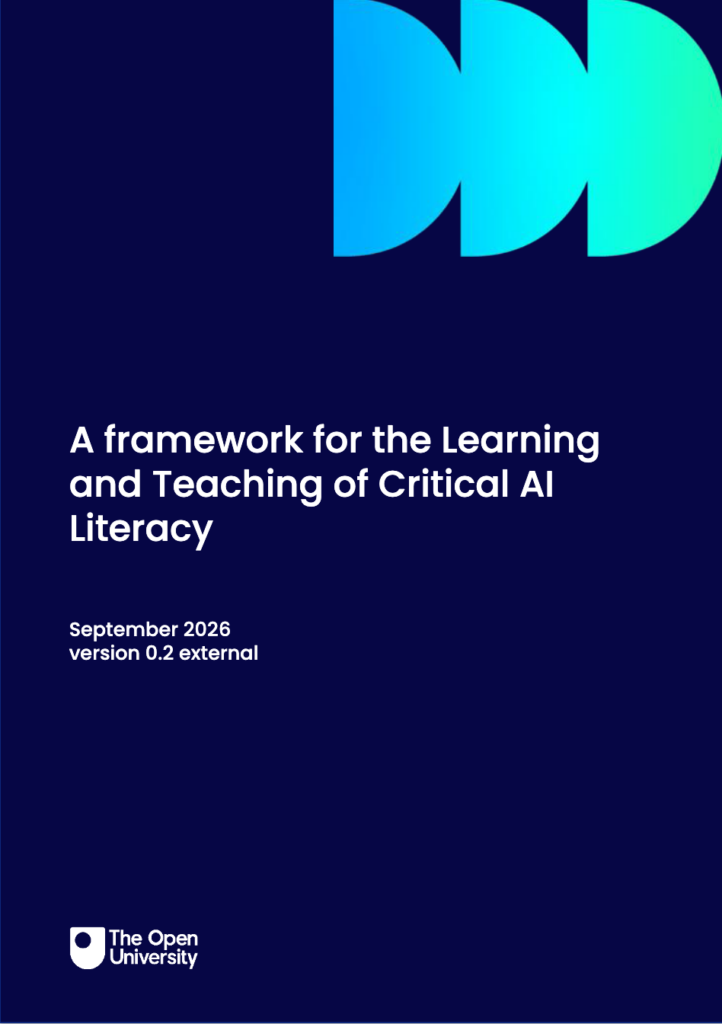
Critical AI literacy asks students to examine how AI shapes knowledge, participation and power. The Open University’s A framework for the Learning and Teaching of Critical AI Literacy skills gives educators a way to bring these questions into curriculum, assessment and staff development. The supplied September 2026 revision, version 0.2, pays particular attention to AI as infrastructure and to the language through which we understand these systems.
What caught my attention is the range of questions it makes available for teaching. Checking an AI response for accuracy is one part of the work. Students are also encouraged to examine whose perspectives appear in that response, who controls the system, and what choices users have about participating.
When AI becomes part of the learning environment
A classroom discussion about AI often begins with a tool: what it does, how to prompt it, and whether its responses are reliable. The framework asks educators to examine the wider environment in which those interactions happen.
Its authors describe AI as an emerging infrastructure, increasingly built into search, office software, learning platforms and other services. Students can encounter AI even when they have not deliberately opened a chatbot or written a prompt. This raises questions about control, visibility and consent: where is AI operating, who put it there, and whose interests guide its use?
The infrastructure framing also brings the material conditions of AI into view. The document discusses energy and water use, the labour behind AI systems, and the uneven distribution of benefits. These issues belong within the educational conversation because they affect how we judge the systems we use.
This connects with the questions running through my Critical AI Literacy collection: how technologies shape what counts as knowledge, whose voices receive recognition, and how learners can exercise judgement within those conditions.
The critical AI literacy framework at a glance
Mirjam Hauck, Eleanor Moore and Carol Wright authored the framework, with Mike Sharples contributing as an advisor. It is a learning and teaching document informed by scholarship on AI literacy, critical digital literacy and the social conditions of technology. The September 2026 version extends an earlier framework; it does not report an empirical evaluation of its effectiveness or measured student learning gains.
The framework has six dimensions: AI concepts and applications, learning and teaching with AI, AI creativity, AI ethics, AI in society, and AI careers. Equality, diversity, inclusion and accessibility, abbreviated as EDIA, inform every dimension. Educators and students are asked to consider representation, access, power, benefits and possible disadvantage throughout their engagement with AI.
The document pairs these dimensions with suggestions for educators and allows different levels of engagement according to discipline, context and purpose. Its account of development is flexible: learners can deepen their understanding over time without following a prescribed linear sequence. Institutions are invited to contribute feedback and examples of practice.
Bringing the framework into teaching
I would begin with a dimension that fits an existing learning outcome. The authors encourage educators to select relevant dimensions and embed activities within their courses. That makes the framework manageable while keeping the educational purpose clear.
One useful starting point is its treatment of AI language. The document asks learners to examine terms such as “intelligence” and “hallucination” and consider how their metaphorical meanings influence understanding.
It suggests comparing a claim when “AI” is replaced with a description such as “statistical prediction system.” My adaptation would be to ask students what each wording encourages them to assume about the system’s capabilities and responsibility. The discussion could reveal assumptions that otherwise pass unnoticed.
Another suggestion is to make human–AI interaction visible in learning and assessment. Students can document, evaluate and reflect on AI’s contribution to their work. I would develop this through a short account of an accepted suggestion, a rejected suggestion, and the reasons behind each decision. Such an activity could give teachers evidence of students’ evaluation, although the framework itself does not establish its effectiveness.
The document also addresses agentic AI. Learners should understand what a system can access and act on before delegating a task, then review the actions it took alongside its outputs. For teaching, this invites a discussion about permissions and responsibility: what should the system be allowed to do, and what would require human checking?
Finally, the framework recognises that students may be unable, or may reasonably choose not, to use a particular AI tool. It asks educators to design learning and assessment so those students are not disadvantaged. This is a practical expression of inclusion that deserves attention when AI activities are planned.
The challenge I see is translating the framework’s broad questions into evidence of learning. A course might assess whether students can explain an omission, justify a decision about delegation, or identify who could be disadvantaged by a proposed use. These are my suggested adaptations. They would need to be evaluated in their own settings, with attention to what students actually learn and whose participation the activity supports.
Reference
Hauck, M., Moore, E., & Wright, C. (2026). A framework for the learning and teaching of critical AI literacy skills (Version 0.2, September 2026). The Open University. https://about.open.ac.uk/sites/about.open.ac.uk/files/files/OU%20Critical-AI-Literacy-framework-2025.pdf



