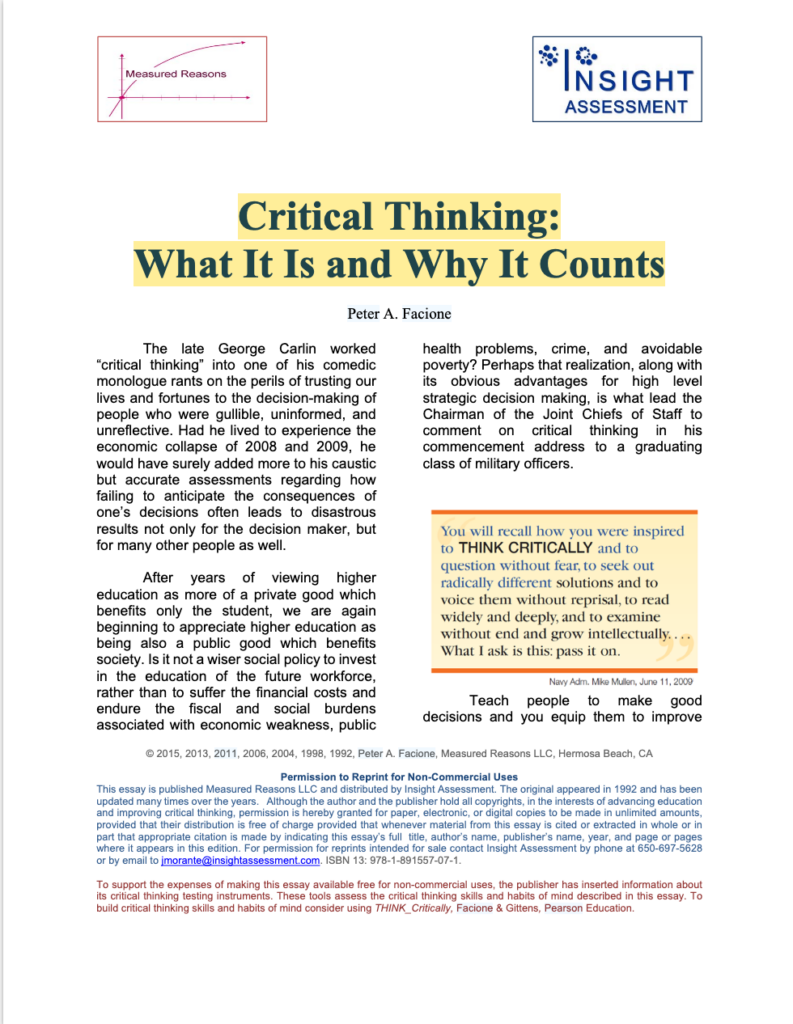
Two scholars whose foundational works I return to whenever I write about critical thinking are Peter Facione and Robert Ennis. Facione’s essay, Critical Thinking: What It Is and Why It Counts, is especially useful because it gives substance to a term we often use loosely in education.
Critical thinking involves interpreting information, examining reasoning, judging evidence, and checking our own conclusions. It also requires a willingness to use these abilities when doing so becomes uncomfortable. Reading the 2015 edition with generative AI in mind, I find this connection between skills and habits of mind particularly relevant to teaching.
What account of critical thinking does Facione present?
Facione’s essay explains an expert consensus developed through a two-year Delphi project involving 46 scholars from the United States and Canada. Conducted on behalf of the American Philosophical Association, the project used successive rounds of responses and feedback to clarify the skills and dispositions associated with critical thinking. The original consensus report appeared in 1990; this essay makes its ideas accessible through explanations, everyday examples, and questions for readers.
The account identifies six core skills: interpretation, analysis, evaluation, inference, explanation, and self-regulation. It also describes dispositions such as inquisitiveness, fair-mindedness, openness to alternative views, and honesty about personal biases.
These are features of an expert account of critical thinking. The essay itself does not test a classroom intervention or investigate generative AI, so the AI applications I discuss below are my interpretation of its educational relevance.
What do the six skills help us see?
Interpretation concerns understanding meaning. Analysis examines how claims, reasons, and assumptions relate. Evaluation considers the credibility of information and the strength of the reasoning supporting a conclusion. Inference involves drawing reasonable conclusions, considering alternatives, and identifying the evidence needed to resolve uncertainty.
Explanation makes our reasoning understandable to others, including the methods and criteria behind a judgement. Self-regulation turns this scrutiny towards our own thinking: examining an interpretation, recognising a bias, checking a calculation, or revising a conclusion when further analysis warrants it.
I find self-regulation particularly important. Students may become skilled at identifying weaknesses in someone else’s argument while giving their own reasoning much less attention.
Facione’s account asks us to consider both. A student who can explain why an answer is flawed also needs opportunities to examine how they reached their initial judgement of it.
Why does willingness to think critically matter?
Facione distinguishes the ability to reason well from the disposition to exercise that ability. Someone may know how to assess a source and still dismiss information that challenges a preferred conclusion.
The dispositions discussed in the essay concern how people approach inquiry: whether they seek relevant information, consider other perspectives fairly, persist with difficult questions, and reconsider their views when there are good reasons to do so.
For teachers, this broadens what we look for in students’ work. Identifying an unsupported claim is useful. So is recognising that one’s own position rests on an assumption that needs checking. I see this as a helpful foundation for discussions of AI literacy, where evaluating a response includes examining our reasons for trusting it.
Critical Thinking in the AI Age: Teaching Ideas for Teachers
My reading of Facione suggests that classroom tasks should make the student’s reasoning available for discussion. The following are possible applications of his account; their effectiveness is not established by this essay.
One task could ask students to select a central claim from an AI response, explain what it means, and identify the reasons offered in support. They could then consult an appropriate source and decide how strongly it supports the claim. This connects interpretation, analysis, and evaluation within a specific subject area.
Another task could ask students to examine a conclusion and identify what additional information they would need before accepting it. This gives inference a clear purpose: students consider what the available evidence permits them to conclude and where uncertainty remains.
Explanation can become part of the response itself. Students might justify one decision to accept, revise, or reject an AI suggestion, identifying the evidence and criteria they used. My earlier discussion of evaluative judgement in the AI age examines a related concern about judging the quality of work.
Finally, teachers could ask students to record an initial judgement and revisit it after checking. What changed? What stayed the same, and why? For me, this is where Facione’s account becomes especially useful.
Revising a view can provide evidence of careful thinking when students explain the reasons for the revision. Keeping a view can also be defensible. The educational value lies in the quality of the examination and the grounds for the decision.
References
Facione, P. A. (2015). Critical thinking: What it is and why it counts (2015 update). Measured Reasons LLC. https://www.researchgate.net/publication/251303244_Critical_Thinking_What_It_Is_and_Why_It_Counts