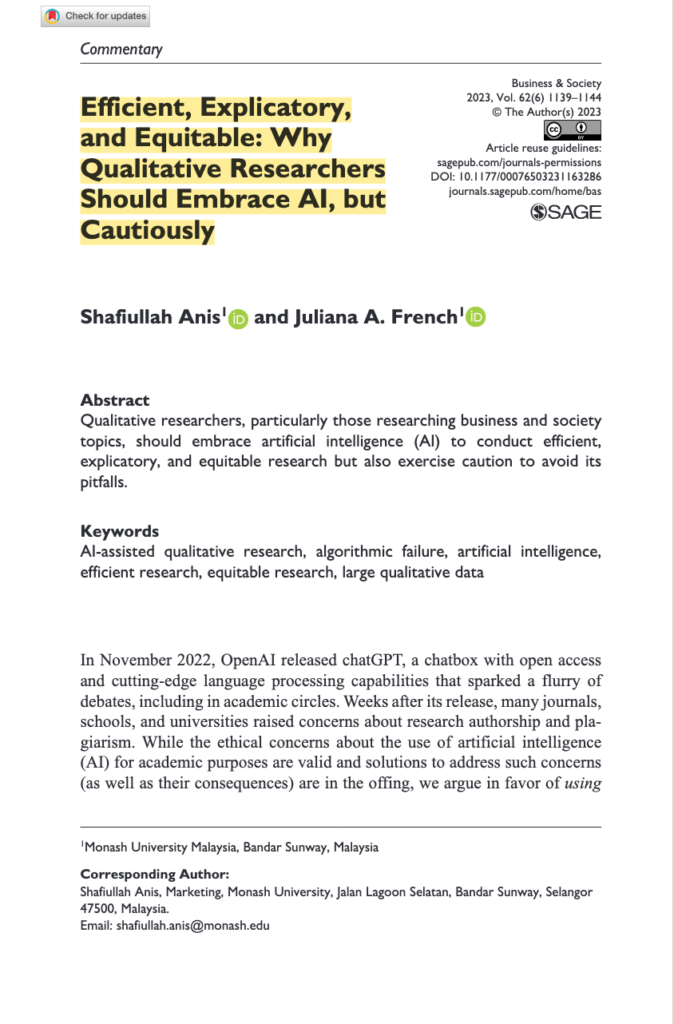
Fabricated AI citations can survive several layers of scholarly review when authors, editors, and reviewers assume that a plausible looking reference must be real. He Liu describes one such case in a 2026 correspondence article in the Journal of Dental Sciences.
A submitted manuscript contained serious methodological problems, but the deeper concern appeared during the editor’s final checks: nearly 80 percent of its references were fabricated or did not exist.
The manuscript had already cleared the journal’s technical screening and passed through three rounds of review involving three reviewers. Nobody had identified the false references.
Liu uses this incident to argue that citation verification can no longer be treated as a minor clerical matter. It is part of research integrity, and responsibility for it is shared across the publication process.

Plausible References Are Easy to Trust
Large language models are good at producing text that resembles academic writing. They can also generate references that look convincing because the author names, journal title, article topic, volume, and DOI follow familiar patterns. A reader moving quickly through a manuscript may recognize the form of a citation and assume the underlying source exists.
This creates a particular problem in peer review. Reviewers are usually asked to assess methods, originality, argument, significance, and ethical compliance. Checking every reference can feel secondary, especially when workloads are heavy.
Yet a fabricated citation can support a claim that has no evidential basis. If several such references appear, the manuscript may create an illusion of an established literature that does not exist.
The problem also complicates discussions of responsible AI use in writing. Language editing, translation, grammar correction, and formatting assistance do not carry the same evidential risk as asking a chatbot to supply sources. As I discussed in my review of ethical recommendations for AI assisted academic writing, researchers remain responsible for the accuracy of every claim and citation in the submitted work.
What Liu’s Editorial Warning Tells Us
Liu’s article is a correspondence piece, not a systematic investigation. Its central case comes from his own experience as an academic editor. The manuscript he examined had major methodological flaws and nearly four out of five cited references were fabricated or nonexistent. The fact that these references went unnoticed during technical screening and three review rounds exposed a weakness in the journal’s checking process.
To place the case in context, Liu cites a 2023 study by Walters and Wilder that examined 732 citations produced across six investigations. Approximately 51 percent were fabricated.
The reported fabrication rate was lower for GPT 4 than for GPT 3.5, but errors remained common even among genuine references. Liu also notes that independent evidence was still insufficient to confirm claims that newer models had solved the problem.
The article does not estimate how often fabricated references enter submitted or published manuscripts. It examines one editorial incident and draws recommendations from it.
We therefore cannot use the 80 percent figure as a prevalence estimate for academic publishing. Its value lies in showing how serious fabrication can remain undetected when each participant assumes someone else has checked the bibliography.
Citation Verification Needs Several Lines of Defence
For authors, the rule is straightforward: never cite a source that has not been located and read. A chatbot can suggest search terms or help clarify a topic, but a generated reference is only a lead. The author must confirm that the publication exists, that the bibliographic details are accurate, and that the source supports the claim attached to it.
A practical author check could proceed claim by claim. Open the source, locate the relevant passage, record the DOI or stable link, and compare the original text with the statement in the manuscript. Reference software can improve consistency, but it cannot decide whether a citation genuinely supports an interpretation. That judgement stays with the researcher.
Reviewers do not have to verify every item with equal intensity. They can begin with references that carry major theoretical, methodological, or factual claims. Warning signs include unfamiliar articles that perfectly match the author’s argument, citations that cannot be found through a DOI or title search, mismatches between journal scope and article topic, and references whose metadata changes across the manuscript.
Editors and journals need checks before a manuscript reaches reviewers. Liu recommends stronger technical screening for fabricated citations, plagiarism, and false content.
DOI validation and bibliographic matching can detect some problems automatically. Human review is still needed because a real reference can be cited inaccurately or used to support a claim it never made.
Transparency matters as well. Liu argues that authors should disclose language model use according to journal policy. Disclosure alone does not verify the work, but it allows editors and reviewers to understand where additional scrutiny may be needed. My earlier discussion of AI disclosure in academic publishing explains why a useful disclosure should identify the tool, purpose, and stage of use.
This issue fits directly within AI and research methodology because citation checking is part of how scholarly claims are constructed and evaluated. Liu’s case is disturbing precisely because the failure was distributed.
The author submitted false references, screening did not catch them, and reviewers passed over them. Preventing a repeat requires each group to perform its own checks instead of relying on the next person in the chain.
Reference
Liu, H. (2026). Fabricated citations in the age of AI: A wake up call for editors, reviewers, and authors. Journal of Dental Sciences, 21(1), 679–680. https://doi.org/10.1016/j.jds.2025.10.024