
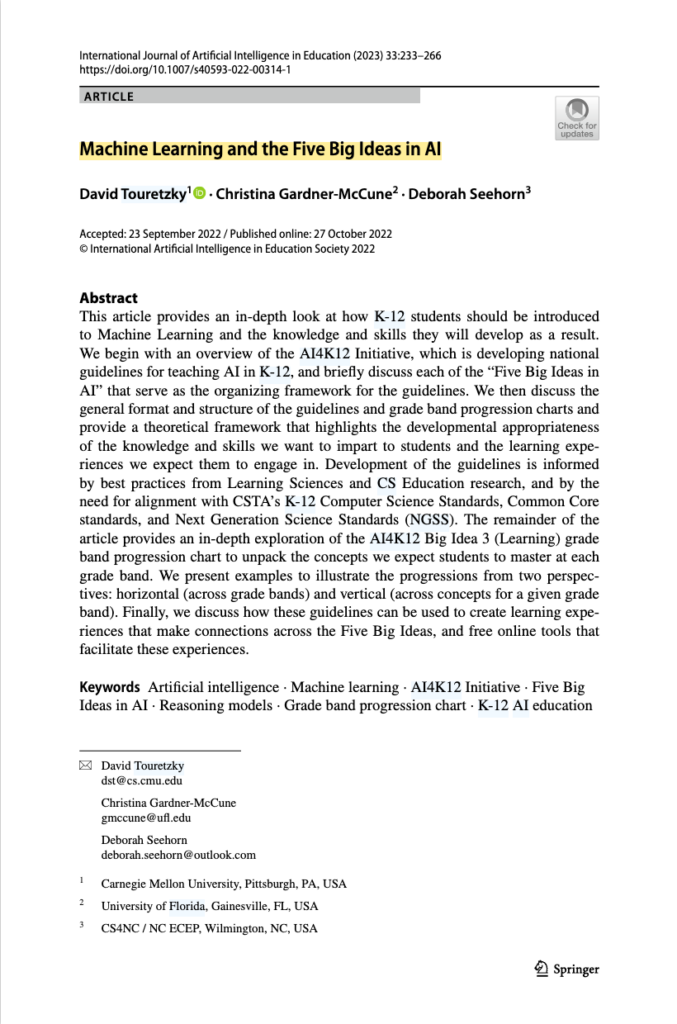
What should students learn about AI when the goal is to understand the technology behind its applications? In Machine Learning and the Five Big Ideas in AI, Touretzky, Gardner-McCune, and Seehorn (2023) present a curriculum framework that gives teachers a substantive answer.
Students should investigate how AI perceives, represents, learns, interacts, and affects society. The paper then explores machine learning in depth, showing how concepts might develop across school grades. I find its emphasis on experimentation especially useful: students are encouraged to train models, examine their mistakes, and explain how data and design choices shape their behaviour.
What Does the Paper Propose?
The article explains the development of AI4K12 education guidelines, drawing on AI expertise, K–12 educators’ input, learning sciences research, and alignment with US curriculum standards. It introduces the Five Big Ideas, then concentrates on Big Idea 3, Learning. This is a curriculum-development paper, rather than an intervention study reporting student learning gains.
The organising framework covers the following areas:
| Big idea | What students investigate |
|---|---|
| Perception | How computers use sensors and knowledge to interpret signals |
| Representation and Reasoning | How representations of the world support reasoning |
| Learning | How algorithms use data to change models’ internal representations |
| Natural Interaction | The knowledge needed for interaction involving language, culture, and people |
| Societal Impact | AI’s benefits and harms, including fairness, bias, transparency, and automation |
The authors propose a content progression across kindergarten through secondary school, supported by examples of learning activities. They explicitly acknowledge that the progression had not yet been tested in classrooms.
Its age-related expectations should therefore be read as proposals requiring investigation and adaptation. The article appeared online in 2022 and in its journal issue in 2023; it reflects the technologies and educational evidence available during its development.
What Should Students Understand About Machine Learning?
A central distinction in the paper is between a learning algorithm and the model it helps construct. During training, an algorithm changes a model’s internal structure or parameters. Once trained, that model can process new inputs and produce classifications or predictions.
This gives teachers something more precise to work with than saying that a computer “learns.” Students can investigate what changes, what data informs those changes, and how the resulting model behaves.
The authors also distinguish training from application. Using a trained model is a different activity from constructing it. I think that distinction helps teachers identify what an activity actually teaches: operating an AI application may reveal little about the process that produced its behaviour.
The proposed progression begins with recognising patterns and explaining simple classification rules. Later work includes decision trees, clustering, neural networks, and evaluation using real-world data. The educational ambition is to revisit ideas with increasing depth as students develop relevant knowledge and skills.
How Can Model Testing Become a Learning Activity?
One example in the paper involves training an image classifier to recognise hand gestures. The important teaching opportunity comes after the initial demonstration. Students test what happens with the other hand, an altered orientation, or different clothing.
A classifier that seemed successful may perform differently under those conditions. That creates questions worth investigating: which features did it rely on, what variation did its training examples contain, and how well does it generalise?
What I like about this approach is that an error becomes material for reasoning. Teachers can ask students to predict a result, test it, and revise their explanation using what happened.
The authors also describe activities in which children infer rules from labelled pictures. Younger learners can explain a rule verbally; older students can represent it more formally. This offers a way to investigate aspects of learning without beginning with programming.
These are proposed learning experiences informed by educational research. The article does not demonstrate that every example produces the intended understanding.
Where Do Data and Fairness Enter the Lesson?
The paper connects machine learning directly to societal impact. Students examine how unrepresentative data can affect predictions and how historical inequalities can enter automated decisions.
I would keep those questions close to the modelling activity. When learners create a dataset, they make choices about examples, labels, and features. Examining those choices gives a concrete basis for discussing what the model might overlook and who could be affected.
This provides a useful connection to my review of UNESCO’s AI competency framework for students, which also considers technical learning alongside ethical responsibility. The AI4K12 paper supplies detailed opportunities to examine that relationship through machine learning. Med Kharbach
For teachers developing an AI literacy curriculum, I would use the framework to plan connected investigations. Begin with a concept students can explore, gather their explanations, and revisit what they understand after testing. The authors’ call for further classroom research matters here: completing an engaging model-building activity is only part of the work. Teachers still need evidence of what students can explain about the system they built.
References
Touretzky, D., Gardner-McCune, C., & Seehorn, D. (2023). Machine learning and the five big ideas in AI. International Journal of Artificial Intelligence in Education, 33, 233–266. https://doi.org/10.1007/s40593-022-00314-1



