
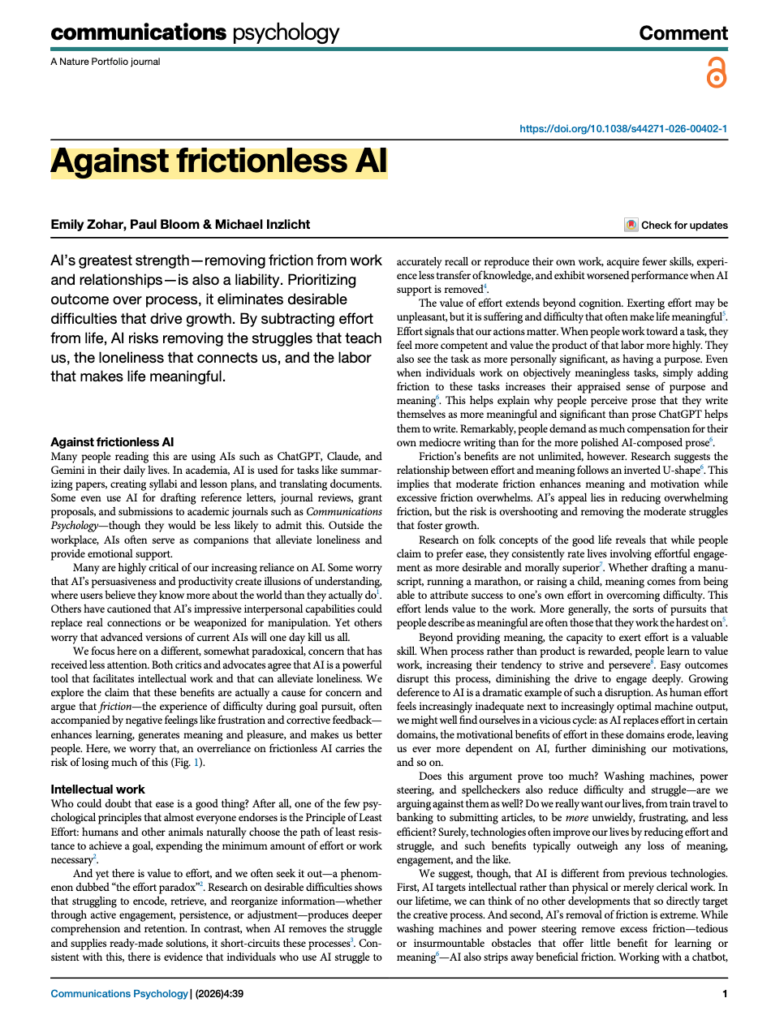
Every AI tool sells the same promise: less effort, fewer steps, faster to done. Most of the time I’m glad for it. But a short, sharp comment just published in Communications Psychology by Emily Zohar, Paul Bloom, and Michael Inzlicht argues that this exact promise is where the trouble starts. Their title says it plainly. They’re against frictionless AI.
The word doing the work is friction. Zohar et al. define it as the difficulty we feel as we pursue a goal, the frustration, the corrective feedback, the sense of pushing uphill. Their claim is that friction isn’t just an obstacle to remove. It’s the thing that teaches us, gives our work meaning, and makes us better at the work itself. Take it away wholesale and we lose plenty we never counted on.
I’ve been circling this idea for a while, and I’m glad someone finally laid it out this cleanly.
Why Effort Isn’t the Enemy
The paper opens with a tension every teacher recognizes. People, and animals, default to the path of least resistance. Psychologists call it the Principle of Least Effort. And yet, Zohar and colleagues point out, we also chase difficulty on purpose, a pattern researchers named the “effort paradox.” We run marathons, tackle the hard crossword, pick the harder recipe when the easy one was right there.
The learning science here isn’t new, and that’s part of why it’s persuasive. The authors lean on research into desirable difficulties, the finding that struggling to encode and retrieve information builds deeper comprehension and stronger memory.
When AI hands a student the finished answer, that struggle never happens. Zohar et al. cite evidence that heavy AI users recall their own work less accurately, build fewer skills, and drop in performance once the AI is pulled away.
A student can produce good work and learn almost nothing in the process. Any teacher who has watched a student breeze through an AI-assisted worksheet and then blank on the same concept a week later has seen this firsthand.
What Frictionless AI Does to Learning
The sharpest part of the argument, for me, is that effort doesn’t only build skill. It builds meaning. The authors report that adding friction even to a pointless task raises how meaningful people find it. That’s why, they note, people value writing they produced themselves over cleaner AI-generated prose. The effort is what makes the work theirs.
Then comes the part that should worry anyone who teaches. Zohar and colleagues describe a vicious cycle. As machine output starts looking flawless, our own effort feels inadequate by comparison, so our motivation to try erodes, so we lean on AI harder, which erodes the motivation further.
A student who outsources the first hard draft has less reason to attempt the next one. This is the same dynamic I flagged when writing about metacognitive laziness, the way learners hand their thinking to the machine and call it efficiency, an idea Dizon and colleagues put front and center.
The authors also head off the obvious rebuttal. Washing machines and spellcheckers removed effort too, so why panic about AI? Their answer is that AI is different in kind. It targets intellectual and creative work directly, which no earlier tool did, and its friction removal is extreme, cutting into the productive struggle, not just the tedious parts.
With a chatbot, Zohar et al. write, a person can go from idea to polished output without questioning it or doing the thinking that produces ownership and critical thought.
The Loneliness Signal AI Quiets
The comment doesn’t stop at cognition. Its second half moves into relationships, and the reframe there is the one I can’t shake. Loneliness, Zohar and colleagues argue, isn’t only a problem to solve.
It’s a biological signal, like hunger or pain, that tells us our social connections need attention. That ache is what pushes us to call an old friend or accept an invitation we’d rather skip. AI companions soothe the ache, and in doing so they silence the alarm.
The authors add that real friends give corrective feedback, telling us when we’re wrong, which sycophantic bots that agree with everything can’t do. It lines up almost exactly with the Stanford companion-chatbot research I covered recently, the study where the people who leaned hardest on bots for connection reported the lowest well-being. Two research groups, working on different questions, arriving at the same warning about ease.
Calibration, Not Maximum Struggle
I agree with most of this. I also think we need to read it carefully. Two things keep me from treating it as gospel.
It’s a Comment, an argument built on existing research, not a new study. The authors are upfront about that, and the reasoning is strong, but it’s synthesis, not fresh evidence. The bigger point for teachers is the shape of the curve.
Zohar et al. describe the friction-benefit relationship as an inverted U, not a straight line. Moderate friction helps. Too much of it overwhelms and teaches nothing but discouragement. That changes the picture for teachers, because it means the goal was never maximum struggle. Pile on too much and you lose the struggling student entirely.
That inverted U is the whole ballgame for pedagogy.
The authors add a caveat teachers should hold onto. The cost of removing friction isn’t the same for everyone. An adult who already built the skills to persevere can treat AI as a supplement, a way to save time on work they could do the hard way if they had to.
A younger learner is a different case. That student hasn’t built the skills yet, so skipping the struggle skips the very thing that would have built them. Zohar et al. reach for an analogy every teacher knows.
We still ask students to show their work even though calculators exist. The calculator is fine once the reasoning is already in place. Handed over too early, it robs the student of the reasoning itself.
So the pedagogy comes down to this. Our job is to find the productive middle, the zone where the task is hard enough to grow the learner without tipping them toward the shortcut. Strip the friction out completely and they learn nothing. Crank it up too high and they give up. Teachers have a name for this already. We’ve been calling it productive struggle for years.
Friction Is a Pedagogical Design Problem
So what do we do with this on Monday morning? We design friction back in on purpose, at the point where it does the most good.
The trick is putting the effort where the learning lives. Let students use AI to brainstorm, then make them defend which ideas they kept and why. Have them draft with a chatbot and mark up what they’d change, justifying each edit. The rule I like best is simple: solve the problem first, check with AI second, never the reverse. The tool can carry the tedious load. The thinking stays with the student.
This runs straight into the critical AI literacy work I’ve been building. Students need to understand not just how to use these tools, but what they cost when used to skip the parts that build a mind.
Zohar, Bloom, and Inzlicht close by saying the concern isn’t AI, it’s our relationship with it. I’d put it in classroom terms. The friction we remove for a student is friction they never learn to handle. Design the struggle back in, and AI becomes what it should be, a tool that carries the load without carrying the learning.
References
Zohar, E., Bloom, P., & Inzlicht, M. (2026). Against frictionless AI. Communications Psychology, 4, 39. https://doi.org/10.1038/s44271-026-00402-1



