
Generative AI and academic skills are often discussed in extremes. Either tools such as ChatGPT are transforming learning, or they are weakening the very abilities universities are meant to develop.
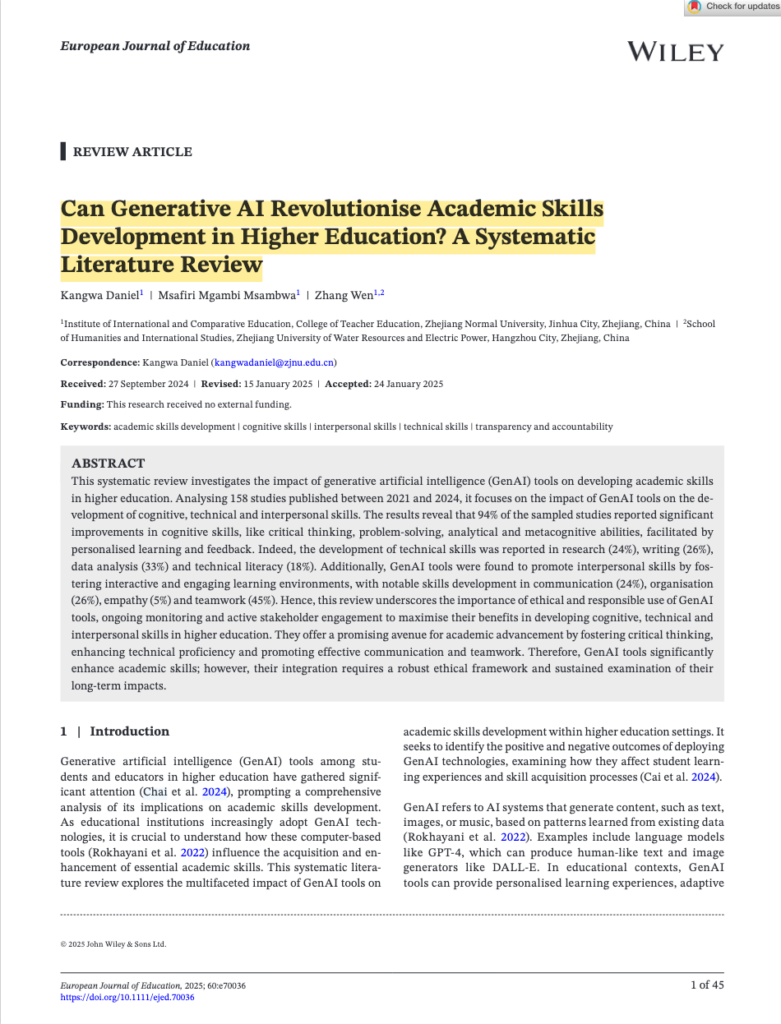
A systematic review by Kangwa Daniel, Msafiri Mgambi Msambwa, and Zhang Wen offers a more useful answer. Across 158 studies, generative AI was associated with gains in cognitive, technical, and interpersonal skills. Yet the review does not establish that AI automatically produces those gains. The educational design around the tool remains decisive.
Why Academic Skills Are Hard to Measure in the AI Era
Academic skill is broader than polished writing or a correct answer. The authors organize it into three domains. Cognitive skills include critical thinking, problem solving, analysis, and metacognition. Technical skills include research, writing, data analysis, and technical literacy. Interpersonal skills include communication, organization, empathy, and teamwork.
Generative AI can contribute to all three. It can offer immediate feedback, adjust explanations, support brainstorming, facilitate group work, and help students enter tasks that previously felt inaccessible. The difficulty is that assistance and development are not the same thing.
When AI supplies the interpretation, argument, code, or plan, improved task performance may conceal limited learning. This is the same concern raised by research on AI cognitive offloading and critical thinking.
For that reason, this paper fits especially well within the blog’s AI and Cognition research. Its central question is not simply whether students can do more with AI. It is whether working with AI leaves them more capable.
What the Review Found About Generative AI and Academic Skills
The researchers followed a PRISMA review process and searched PubMed, Web of Science, Scopus, ERIC, and PsycINFO for English language, peer reviewed studies published from 2021 to September 2024. After screening and quality appraisal, they included 158 studies from higher education contexts and synthesized them thematically and narratively.
The overall picture was positive. The authors report that 94 percent of the sampled studies described improvements in cognitive skills, particularly critical thinking, problem solving, analytical thinking, and metacognition. They also identified benefits for research, writing, data analysis, technical literacy, communication, organization, empathy, and teamwork.
Personalized feedback, interactive learning, collaboration, and support for self regulation were recurring mechanisms. These findings complement research showing that students need feedback literacy when writing with AI, because feedback becomes educational only when learners can interpret and act on it.
The headline figure needs context. This was a thematic and narrative synthesis, not a meta-analysis that pooled comparable effect sizes. The included studies varied in design, discipline, tool, and outcome.
“Reported improvement” can therefore refer to different kinds of evidence and should not be read as a single causal estimate. The review also covered a young evidence base, ending in September 2024, so it cannot answer whether gains persist after AI support is removed. The authors themselves call for longitudinal research, discipline specific studies, and closer examination of academic integrity, bias, and long term effects.
What This Means for Teaching Practice
The most defensible conclusion is that generative AI can support academic skills when the activity still requires students to exercise those skills. Teachers can design for that condition in several practical ways.
First, pair AI supported work with an independent performance. A student might use AI feedback on one argument, then construct a second argument without assistance. Second, ask students to show the decisions behind the product: which suggestions they accepted, what they rejected, and how they verified claims. Third, preserve human interaction. AI can help groups organize ideas, but students still need face to face discussion, disagreement, explanation, and shared responsibility.
Students also need structured preparation. A staged approach to scaffolding AI literacy can move them from basic tool knowledge to critical evaluation and ethical use. Clear policies, equitable access, privacy safeguards, and continuing monitoring belong inside that preparation rather than being added after adoption.
The review’s title asks whether generative AI can revolutionise academic skills development. My reading is more measured. AI expands the kinds of feedback and support universities can offer, often at impressive speed and scale. Whether that support becomes genuine capability depends on what students are still asked to think through, practise, explain, and eventually do for themselves.
Reference
Daniel, K., Msambwa, M. M., & Wen, Z. (2025). Can generative AI revolutionise academic skills development in higher education? A systematic literature review. European Journal of Education, 60, e70036. https://doi.org/10.1111/ejed.70036



