
A student practises asking for directions with an AI chatbot before trying the same task with a classmate. The rehearsal may help the student find the words and feel more comfortable speaking. Whether they can handle an unexpected reply or decide what to practise next are separate questions.
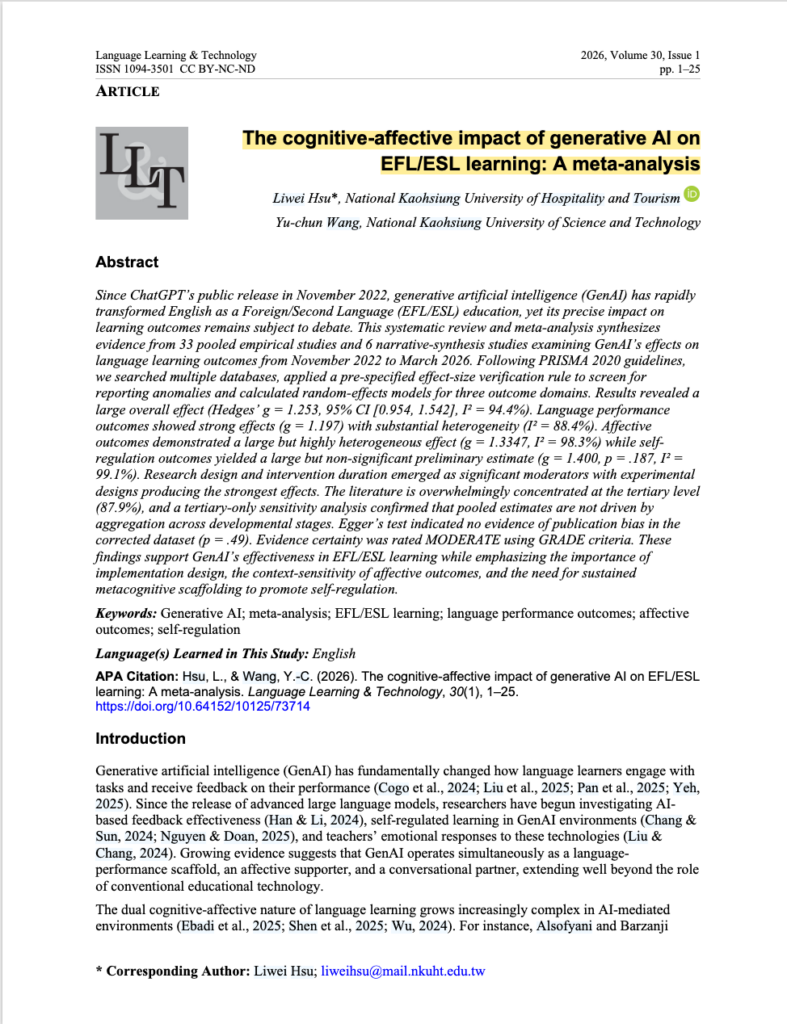
Liwei Hsu and Yu-chun Wang’s meta-analysis makes that distinction worth paying attention to. Across studies of English as a foreign or second language, generative AI interventions showed positive average effects on language performance and on measures related to how learners felt about learning. Evidence that students became better at managing their own learning was much less conclusive.
Where Were the Gains Most Consistent?
Hsu and Wang pooled results from studies of generative AI in English language learning and reviewed additional studies separately. They grouped the evidence into three areas. Language performance included outcomes such as writing and speaking. Affective outcomes covered experiences such as anxiety, motivation, and engagement.
Self-regulation included how learners monitor their progress, manage their learning, and make decisions about revision. These outcomes answer different questions. A writing score tells us something about the work a student produced. An anxiety rating tells us something about how the student experienced the task.
Language performance showed a positive average effect and more consistent gains than the affective measures, though results in both areas varied substantially across studies. The positive average across affective measures leaves open what a particular class might experience.
Students who welcome private rehearsal, for example, may respond differently from students who find a chatbot’s feedback confusing. My earlier review of a study on English for Academic Purposes takes a closer look at how students described their experiences. ChatGPT and the Language Learning Experience
The pooled result for self-regulation did not reach statistical significance, and few studies contributed to that estimate. Most of the research also took place in higher education, and short interventions were common.
The review gives us a better picture of performance during or shortly after AI-supported instruction than of what students carry into later tasks. It also leaves teachers with less evidence to draw on when planning for younger learners.
How Can English Teachers Turn AI Support Into Language Practice?
Ask for feedback students can act on. In an opinion-writing lesson, I’d have students draft a paragraph and ask AI to identify one place where the reason feels disconnected from the claim. The student would then decide what to change. One learner might add a missing explanation.
Another might keep the original wording because the AI misread the point they were making. I’d ask both students to explain their decision. That gives me something to respond to as a teacher, especially when a suggestion improves the flow of a sentence while changing what the student meant. AI in Second-Language Writing
Give rehearsal somewhere to go. If the speaking goal is to ask for clarification, an AI role-play can give students a chance to try a few phrases before speaking with a partner. In the partner task, give each student a slightly different map. One map might show a bus stop beside the library and the other might place it across the street.
Now the learner has a reason to ask, “Do you mean the stop next to the library or the one across from it?” I’d listen for how students handle that mismatch and ask separately whether the rehearsal made it easier to begin speaking. Those two observations can inform different teaching decisions.
Help learners decide when to ask for help. Before opening an AI tool, have students identify one difficulty in their own work. A student who keeps shifting verb tenses might mark the time expressions in a draft and check the verbs around them. After consulting AI, ask the student to record one check they can try on their next piece of writing.
A week later, give them a fresh task and see whether they use it. Given how little evidence the review found on self-regulation, I’d look for these small decisions over time. A student who can identify a problem, choose a strategy, and judge whether it worked is showing something a corrected draft alone can’t capture. AI & Teaching Practice
References
Hsu, L., & Wang, Y.-C. (2026). The cognitive-affective impact of generative AI on EFL/ESL learning: A meta-analysis. Language Learning & Technology, 30(1), 1–25. https://doi.org/10.64152/10125/73714