
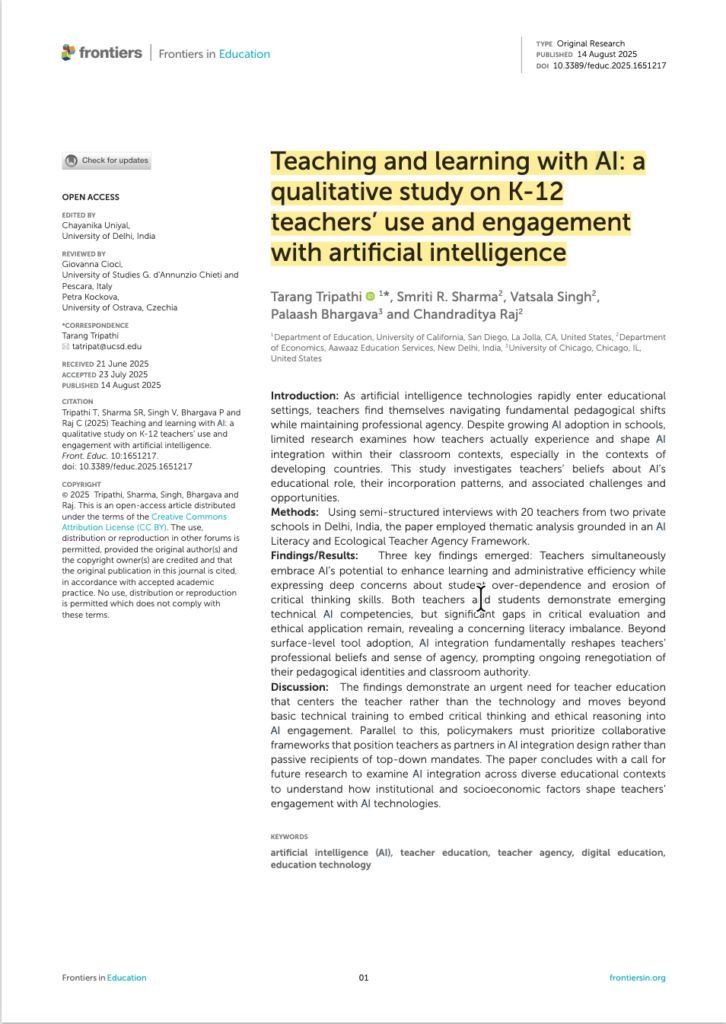
K-12 teachers and AI are often discussed through adoption rates: who is using the technology, which tools they choose, and how often they use them. A qualitative study by Tarang Tripathi and colleagues asks a more revealing question. What happens to teachers’ judgment, classroom authority, and professional identity when AI enters their everyday work?
The researchers interviewed 20 elementary and middle school teachers from two private schools in Delhi’s National Capital Region. The interviews took place between August and December 2024, lasted about 45 minutes, and were analysed thematically through two lenses: AI literacy and ecological teacher agency. That second lens matters because it treats agency as something shaped by teachers’ beliefs, experience, institutional setting, available resources, and relationships with students.
From saving time to reshaping teaching
Teachers were already using AI across administrative and pedagogical work. Reports, student profiles, correspondence, lesson outlines, presentations, worksheets, and routine assessment questions were common applications. Much of this use was basic: a straightforward prompt followed by direct use of the output.
Some teachers went further. They combined tools to create richer visual materials, aligned questions with Bloom’s Taxonomy, supported flipped classrooms, and redesigned activities so that students had to discuss, explain, visit a place, or defend their work orally. These examples are important because they show that classroom value does not come from the tool alone. It comes from the teacher’s capacity to connect the tool to a learning purpose.
This finding fits closely with earlier research I reviewed on Intelligent-TPACK and the knowledge teachers need to integrate AI ethically. Knowing how to generate a worksheet is a technical skill. Deciding whether that worksheet asks students to think, and checking whether its content is sound, requires pedagogical and evaluative judgment.
The study found an uneven pattern of AI literacy. Teachers were becoming more comfortable understanding and using AI, yet their ability to evaluate outputs and handle ethical questions was less developed. That gap also appeared in how they described students.
Many worried about uncritical copying, declining effort, and their growing difficulty in judging what students could actually do. As I argued in my review of AI literacy training for teachers, tool familiarity is only the beginning. Critical evaluation, ethical reasoning, and pedagogical decision-making need equal attention.
AI is also changing classroom authority
What I find especially useful in this paper is its treatment of teachers’ apparently contradictory views. The same teacher could use AI to save time on lesson preparation and object when students used it to complete homework. The authors interpret this as context-sensitive professional reasoning. I think that reading is largely convincing. Teachers were judging different uses according to purpose, responsibility, and their effect on learning.
At the same time, their comments reveal a deeper shift. Some students challenged teacher explanations with AI-generated information, assumed classroom materials had been produced by AI, or moved directly to digital tools during lessons. Teachers were negotiating more than a new workflow; they were renegotiating who counts as a trusted source of knowledge.
One teacher captured the educational issue clearly: “If you don’t know the content, if you don’t know the context, then relying on GenAI Tool (X) is actually cheating” (p. 10). The wording is blunt, but the distinction is useful. Meaningful AI use depends on enough subject knowledge to question, adapt, and sometimes reject what the system produces.
This also connects with research on students adopting AI while teachers are still catching up. The answer cannot be a one-off workshop on prompting. Teachers need sustained opportunities to examine real classroom dilemmas, redesign tasks, evaluate outputs, and discuss how visible AI use affects trust and authority.
There are limits to what we can conclude. These were self-selected teachers in two relatively well-resourced private schools serving middle- and upper-middle-class families. The study reports what teachers said in interviews; it did not observe classroom practice or measure changes in student learning.
Student perspectives were also absent. We should therefore treat the findings as a detailed account of teacher sense-making in a specific setting, not a general picture of K-12 education in India.
For me, the main lesson is that teacher agency must be built into AI implementation from the beginning. Professional development should begin with the decisions teachers actually face: when AI saves useful time, when it removes necessary thinking, how its outputs should be checked, and what evidence of learning an assessment still provides. Teachers are already making these judgments. Schools need to give them the knowledge, time, and institutional voice to make them well.
Reference
Tripathi, T., Sharma, S. R., Singh, V., Bhargava, P., & Raj, C. (2025). Teaching and learning with AI: A qualitative study on K-12 teachers’ use and engagement with artificial intelligence. Frontiers in Education, 10, Article 1651217. https://doi.org/10.3389/feduc.2025.1651217



