
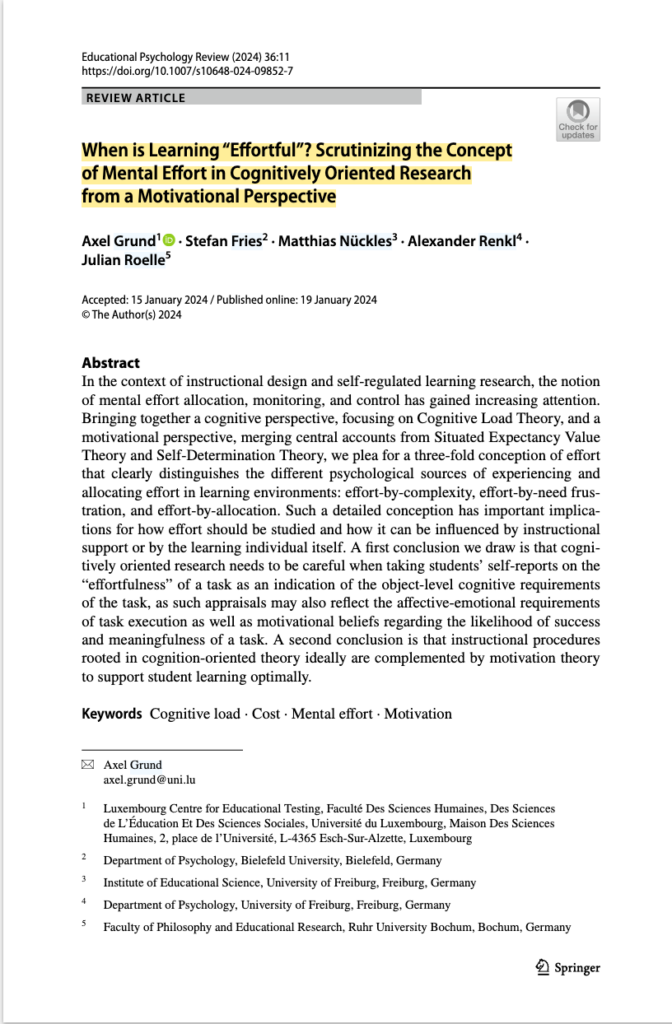
When a student says a task takes too much effort, we need to ask what makes it feel that way. The work may be intellectually demanding, emotionally draining, or difficult to see any value in. In When is Learning “Effortful”?, Axel Grund and colleagues (2024) argue that these experiences deserve closer attention.
Their paper brings cognitive and motivational perspectives together to explain why mental effort is a more complicated concept than it first appears. I find this distinction useful for teachers because our response to a struggling student depends on how we understand the struggle.
What Does the Paper Mean by Mental Effort?
This is a conceptual review, with no new classroom experiment or intervention. The authors bring together Cognitive Load Theory, Self-Determination Theory, and Situated Expectancy Value Theory.
They propose three conceptions of effort: effort-by-complexity, the processing demands of a task; effort-by-need frustration, the unpleasant strain experienced during learning; and effort-by-allocation, the effort a learner initiates and sustains. These can interact, but they have different sources and different implications for instruction.
Complexity concerns the thinking a task requires, including demands created by poorly designed materials. How demanding that work becomes also depends on prior knowledge. Need frustration concerns experiences such as feeling incapable, pressured, or unsupported.
Drawing on Self-Determination Theory, the authors connect these experiences to the needs for competence, autonomy, and relatedness. Effort allocation concerns whether students begin, concentrate, and persist. Their expectations of success and the value they attach to the task help explain this investment.
The central caution concerns interpretation: a student’s report that something feels effortful cannot, by itself, tell us how cognitively demanding the task is. It may also reflect emotional strain or motivational beliefs. This is a theoretical argument supported through existing literature. The proposed distinctions still need further empirical testing, particularly through measures that can separate these experiences in real learning settings.
How Should Teachers Respond When Learning Feels Effortful?
Ask what is making the work difficult. I read this paper as an invitation to slow down before interpreting a student’s frustration. A broad question about effort leaves too much unresolved.
More specific questions might ask which part is difficult to understand, how stressful the work feels, whether success seems possible, and why the task matters. These questions follow the distinctions in the paper; they should be treated as conversation starters, without assuming they constitute a validated classroom assessment.
Match cognitive demands to students’ knowledge. The authors explain that greater reported effort can reflect limited prior knowledge or unnecessary processing demands. A high effort rating therefore gives us little reason, on its own, to celebrate a task’s learning potential.
Clearer materials, appropriate guidance, and attention to prerequisites remain important. Teachers need to examine what students are spending their mental resources on and whether that activity contributes to the intended learning.
Avoid treating distress as evidence of productive learning. The paper challenges the easy association between effort and unpleasantness. Intellectually demanding activity can be absorbing and enjoyable.
Equally, an exhausting experience can arise from pressure or frustrated psychological needs. I think this matters whenever we use phrases such as “productive struggle.” We need evidence that students are making sense of something, alongside attention to how they experience the task. Feeling bad is a poor measure of learning.
Explain the value of a learning strategy. Students may understand that retrieval practice or another strategy supports learning and still choose not to use it. The authors argue that knowing a strategy works does not ensure that its outcome matters to the learner. Instruction therefore needs to address both perceived usefulness and confidence in success. Simply repeating that a method is effective leaves the question of personal meaning unanswered.
Examine the conditions for independent learning. Near the end, the authors raise a question that deserves attention: how much responsibility should students bear for regulating learning when their environment frustrates their needs and offers little reason to engage? Teaching self-regulation strategies remains useful, but teachers and institutions also shape the conditions in which students are expected to use them.
For readers following my Teaching & Pedagogy reviews, this paper offers a useful way to examine classroom difficulty. Before asking students to try harder, we can investigate what the task requires, how they experience it, and what makes the work worth pursuing.
References
Grund, A., Fries, S., Nückles, M., Renkl, A., & Roelle, J. (2024). When is learning “effortful”? Scrutinizing the concept of mental effort in cognitively oriented research from a motivational perspective. Educational Psychology Review, 36, Article 11. https://doi.org/10.1007/s10648-024-09852-7



