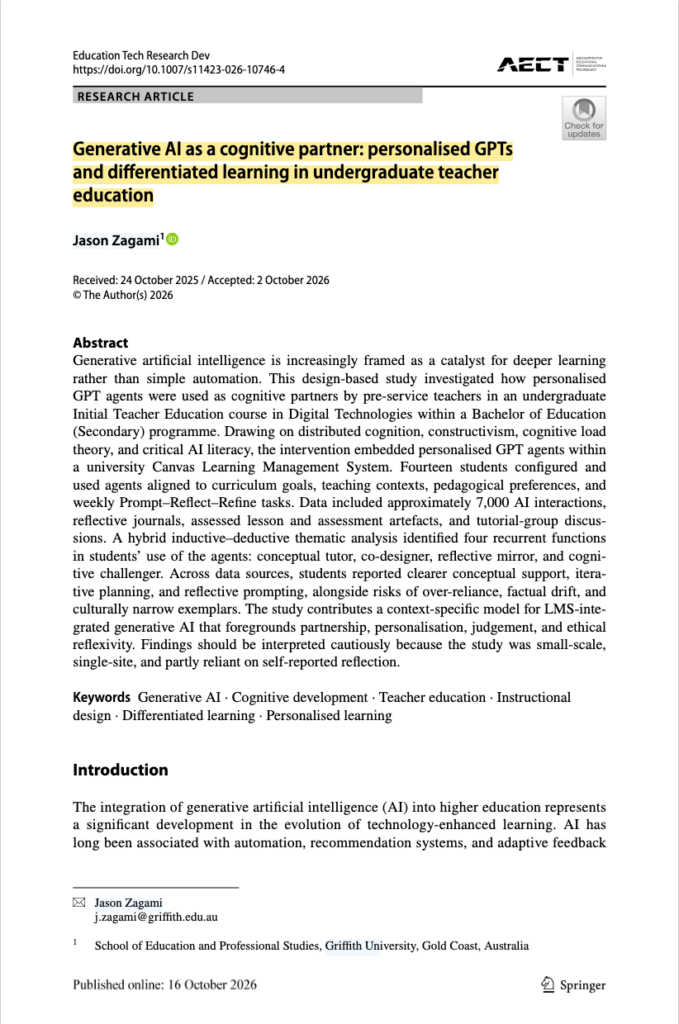
What changes when a generative AI tool is designed to question students, adapt to their needs, and support their reasoning rather than simply produce answers? A recent study by Jason Zagami offers a useful response.
Conducted in an undergraduate teacher education course, the study explored how personalized GPT agents could support differentiated learning through structured, reflective dialogue.
Its most important contribution, in my view, is the shift from treating AI as a convenient content generator to understanding it as a potential cognitive partner, one whose educational value depends heavily on task design, critical evaluation, and the learner’s continued control over judgment.
What Did the Study Examine?
Zagami’s study took place over one semester in an undergraduate Digital Technologies course at an Australian university. Fourteen preservice teachers created and used personalized GPT agents configured around the course curriculum, assessment requirements, teaching contexts, pedagogical preferences, and professional interests.
The agents were embedded within the learning environment and used during weekly activities. Students worked through a recurring Prompt–Reflect–Refine cycle: they asked the agent for help with a question or task, evaluated its response using relevant pedagogical frameworks and professional standards, and then revised either the prompt or the emerging work while documenting their reasoning.
This structure matters. The study was not testing what happens when students are given unrestricted access to a chatbot. It was examining a deliberately designed form of human–AI interaction in which scrutiny, revision, and professional judgment were built into the activity.
How Did the GPTs Support Student Learning?
Across the student interactions, reflections, learning artifacts, and tutorial discussions, four recurring roles emerged.
First, the GPT could act as a conceptual tutor, explaining unfamiliar ideas and adjusting the level or form of an explanation. This offered students a private space to ask follow-up questions without the pressure that sometimes accompanies public classroom discussion.
Second, it worked as a co-designer. Students used the agent to develop lesson plans, assessment ideas, and classroom activities, then revised those suggestions to fit curriculum goals and particular learner needs.
The productive element here was the iterative exchange. Students were not merely collecting ready-made materials; they were testing possibilities and improving designs.
Third, the agent functioned as a reflective mirror. By asking students to explain or defend their choices, it helped make their assumptions more visible. For preservice teachers, this is particularly valuable because professional learning involves more than producing a workable lesson. It requires an ability to articulate why a particular approach is pedagogically appropriate.
Finally, the GPT sometimes became a cognitive challenger, offering counterarguments, questioning a plan, or suggesting alternatives. This role was especially important for students who needed intellectual friction rather than further simplification. It shows that differentiation with AI can concern the kind of thinking a learner is invited to do, not only the difficulty of the content presented.
Why the Prompt–Reflect–Refine Cycle Matters
The Prompt–Reflect–Refine cycle is, for me, the study’s most transferable feature. It gives educators a practical way to organize AI-supported learning while retaining human responsibility for the final decision.
The prompt stage asks students to define the problem clearly. The reflection stage requires them to examine the response for accuracy, relevance, assumptions, cultural fit, and alignment with professional knowledge.
The refinement stage turns that evaluation into action: students revise the output, reformulate the question, consult other sources, or reject the recommendation altogether.
This cycle can help prevent a common problem in educational AI use: accepting fluent language as evidence of sound reasoning. It also connects with concerns about metacognitive laziness and AI. When students must explain what they accepted, changed, and discarded, the chatbot becomes part of a visible reasoning process rather than an invisible shortcut.
The approach also complements the expanded view of TPACK in the age of generative AI. Teachers need more than technical familiarity with AI tools. They need to judge when an AI-supported activity serves the subject matter, the learner, and the pedagogical purpose.
What Can Teacher Educators Take From This Study?
Several practical principles follow from the study.
- Design the role of the chatbot. Ask whether it should explain, question, critique, simulate a learner response, or help compare instructional options. A clearly defined cognitive role is more useful than a general invitation to “use AI.”
- Build evaluation into the task. Require students to verify factual claims, identify weak or culturally narrow examples, and explain how they revised the AI’s contribution.
- Assess the reasoning trail. Prompts, reflections, revisions, and rejected suggestions can provide better evidence of learning than a polished final product alone.
- Vary the support. Novices may need explanations and worked examples, while more confident students may benefit from counterarguments and constraints that challenge their initial thinking.
- Keep professional judgment with the learner. The agent can extend reflection and provide rehearsal, but it cannot assume responsibility for the educational consequences of a decision.
This last principle aligns with research on human-centered AI in education: the quality of the partnership depends on preserving meaningful human agency.
What Are the Limits of the Evidence?
The findings are promising, but they should be interpreted carefully. The study involved a small, voluntary cohort in one course and at one institution. Some of the evidence came from students’ own reflections, and improvements in their work may also have resulted from the structured cycle of reflection and revision rather than from the GPT itself.
The study also documented familiar risks, including factual drift, over-reliance, culturally narrow examples, privacy concerns, and fatigue from repeated prompting. Personalized responses can feel highly relevant yet remain inaccurate or incomplete. Personalization therefore increases the need for critical AI literacy; it does not remove it.
The broader lesson is that a personalized GPT’s educational value lies less in the model’s sophistication than in the pedagogy around its use. When learners are expected to question, verify, justify, and refine, AI can participate in the work of thinking. Without those expectations, the same tool can easily reduce the very cognitive effort that learning requires.
References
Zagami, J. (2026). Generative AI as a cognitive partner: Personalised GPTs and differentiated learning in undergraduate teacher education. Educational Technology Research and Development. Advance online publication. https://doi.org/10.1007/s11423-026-10746-4