
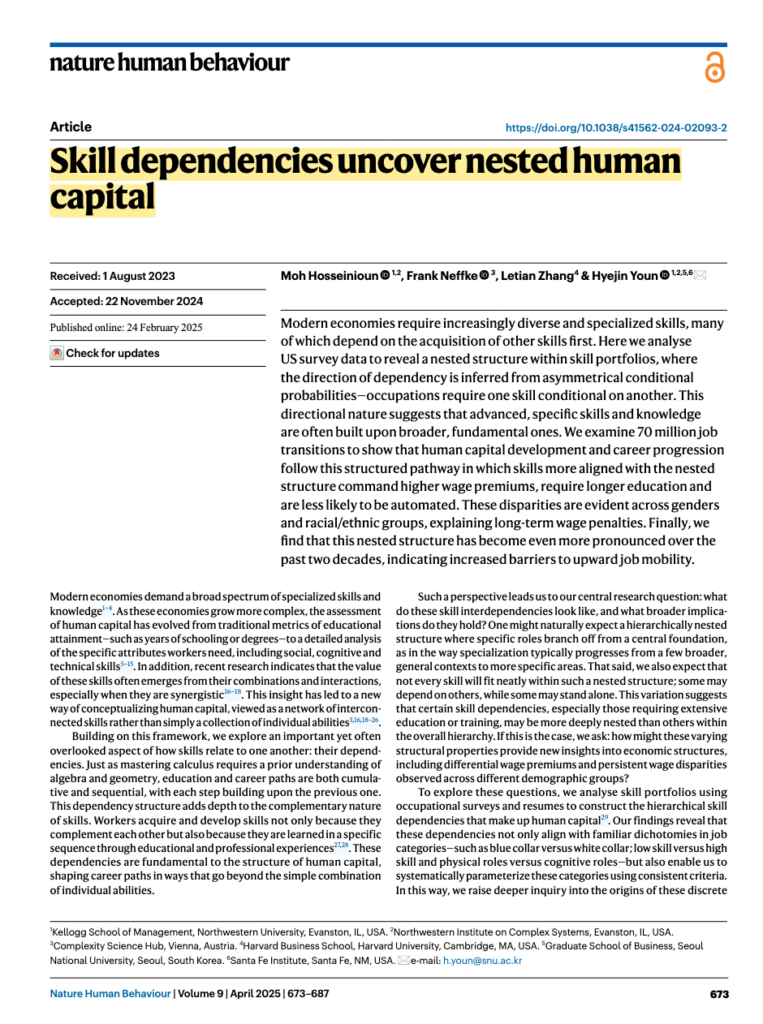
What makes a specialised skill valuable, and what does someone need before they can develop it? Hosseinioun and colleagues (2025) examine these questions in Skill dependencies uncover nested human capital.
Their analysis of US occupational and career data suggests that many specialised skills sit within broader networks of general capabilities. Crucially, those general skills continue to develop alongside specialisation.
For educators, I find this a useful challenge to treating skills as separate items on a checklist. The study invites us to examine how capabilities support one another, while recognising that labour-market patterns cannot establish a universal sequence for teaching them.
How Did the Researchers Map Skill Dependencies?
The researchers combined occupational skill requirements from O*NET with wage, employment, population-survey, and résumé data. They distinguished general skills, needed across many occupations, from more specific skills with narrower occupational demand.
To infer dependency, they examined asymmetries: occupations requiring one skill may also require another, while the reverse relationship is less common. They then examined how the resulting structure related to careers, wages, education, and estimated automation risk.
The analysis revealed a nested structure in which many specialised capabilities were embedded within broader requirements. Specialisations aligned with that structure were associated with stronger wage outcomes, longer education, and lower estimated automation risk.
Career patterns also suggested that general capabilities continued to develop as workers entered and progressed through specialised roles. The authors further identified demographic disparities and evidence that occupational skill requirements had become more nested over time.
These are observational findings. Occupational requirements are not direct measurements of each worker’s competence, and inferred dependencies do not establish causal learning prerequisites.
Résumé records describe career movements rather than everything someone learned between jobs. The US focus also limits generalisation. The paper provides a structural account of skill relationships, not a test of classroom instruction or a guarantee of individual career outcomes.
What Can Educators Take From This Study?
For those interested in teaching and pedagogy, the paper’s most useful contribution is its attention to relationships among skills. It gives educators a reason to ask what a specialised activity draws upon and how those underlying capabilities will continue to develop.
Examine What a Specialised Task Requires
Lists of desirable skills can conceal the relationships that make those skills usable. A learner may need several capabilities together to complete a demanding task.
The authors use calculus and its mathematical foundations to introduce this idea. For curriculum planning, I would extend the question carefully: what knowledge and reasoning does this particular activity require?
Which demands have students already practised, and which are being introduced at the same time? The study cannot supply those answers for a course, but its framework makes the questions harder to overlook.
Keep Developing General Capabilities Within Specialised Work
One of the paper’s most interesting findings challenges a simple progression from general foundations to specialised expertise. The authors describe general skills continuing to develop alongside specific ones. Their example connects critical thinking with entry into negotiation-related work and further progression within it.
My reading is that a foundational capability should not disappear from teaching once a programme becomes more specialised. Students need opportunities to use it under increasingly demanding conditions. The relevant question is how the quality of their reasoning develops within the subject, and what evidence would show that development.
Design Connections Between Learning Experiences
If a programme presents each course or credential as a separate achievement, students may have little help recognising how learning carries forward.
I would use this paper as a prompt for curriculum discussion: which earlier ideas are students expected to draw upon, and where do they practise connecting them to new demands?
This is an educational implication, not an intervention tested by the researchers. It also requires more than adding prerequisite labels. Teachers need to examine whether tasks actually call on the earlier learning and make those connections understandable to students.
Consider Access to Developmental Pathways
The paper relates its skill structure to demographic differences in occupational opportunities and earnings. Those patterns should not be interpreted as evidence of inherent differences in people’s ability.
For educators, the useful issue is access: who has opportunities to develop broad capabilities, enter specialised work, and continue progressing? A programme can ask whether learners receive adequate preparation and support for its next stage.
The study also cautions against assuming that any specialised training will open comparable opportunities. Its labour-market findings concern the relationships among capabilities and the pathways available to develop them.
Be Precise About the Implications for AI
This paper does not test whether generative AI strengthens or weakens skill acquisition. Its automation analysis should not be read as a current forecast of which careers AI will replace.
Still, it raises a question for educators considering AI assistance: if a tool performs a foundational part of a task, where will students develop and demonstrate that capability?
The answer depends on the learning goal. I would examine the relationships within the task before deciding what to delegate. The paper supports taking those relationships seriously; direct evidence about a particular AI-supported learning design must come from elsewhere.
References
Hosseinioun, M., Neffke, F., Zhang, L., & Youn, H. (2025). Skill dependencies uncover nested human capital. Nature Human Behaviour, 9, 673–687. https://doi.org/10.1038/s41562-024-02093-2



