The future of AI in education is regularly presented as though the important decisions have already been made. AI is here, transformation is inevitable, and schools must learn to keep up.
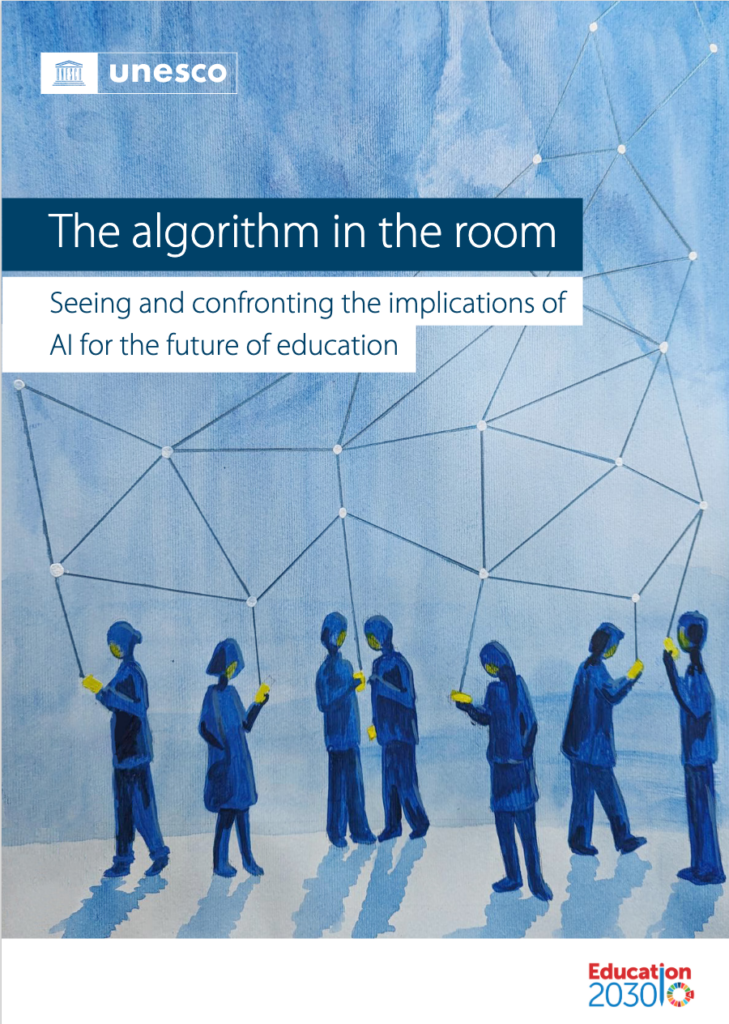
UNESCO’s new volume, The Algorithm in the Room, asks us to resist that storyline. Education still has choices to make about which technologies enter its institutions, whose purposes they serve, and which parts of learning should remain protected from automation.
The report belongs within the wider discussion of AI in practice because it moves attention away from tool demonstrations and toward the conditions under which AI is introduced. The question running through the collection is simple and far-reaching: are educational systems shaping AI, or are commercial systems quietly reshaping education?
Summary of the Study
This publication is a collection of 26 short think pieces written by educators, researchers, policy specialists, and other contributors from different regions. It is organized around six questions concerning agency and oversight, children’s relational and cognitive development, pedagogy and assessment, thinking and expression, education as a common good, and our ability to imagine alternatives.
The pieces combine observation, argument, and speculative scenarios. This is important for reading the report correctly: it is a contribution to public and educational debate, not an empirical study or a systematic synthesis of research.
Several concerns recur across the volume. AI systems carry assumptions about what counts as useful knowledge, successful performance, and efficient learning. When those assumptions enter assessment, personalization, writing, student support, or institutional decision-making, they can redirect educational practice without an open discussion of purpose.
The report also examines children’s relationships with chatbots, cultural and linguistic flattening, environmental costs, accessibility, data extraction, and the growing role of private companies in public education. These arguments extend the point made in an earlier manifesto on generative AI in education: every system brings values, priorities, and interests with it.
The report’s most useful organising idea appears in its conclusion. UNESCO proposes three horizons for action: see the algorithm, steer the algorithm, and rewrite the algorithm. Seeing means learning to recognize where algorithmic systems are already influencing pedagogy, curriculum, assessment, and decisions.
Steering means deciding when these systems serve educational purposes, when they need limits, and when they should be rejected. Rewriting goes further by placing educators, students, and communities in the position of shaping the aims, data, and rules of the technologies that affect them.
This develops the human-centred principles found in UNESCO’s earlier guidance for generative AI and gives them a useful temporal sequence.
The breadth of the collection is also its main limitation. Short essays can open neglected questions and bring different contexts into view, but they do not establish how widespread a problem is or which proposed response will work.
The report does not explain a systematic method for selecting or analysing the contributions, and the strength of evidence varies from one piece to another. Some chapters describe emerging experiences; others offer conceptual arguments or imagined futures.
Readers should treat the volume as a map of risks, choices, and possibilities. Claims about learning outcomes, development, or institutional effects still require direct empirical support.
Practical Insights
The three horizons can be turned into a practical review process for schools, universities, and individual teachers.
- See what the system is doing. Identify where AI selects, ranks, predicts, recommends, generates, or evaluates. Many algorithmic decisions remain hidden inside platforms that appear to be ordinary administrative or learning tools.
- State the educational purpose first. Before adopting a system, write down the educational problem it is expected to address. Then ask whether the tool supports that purpose or quietly replaces it with speed, completion, personalization, or measurable performance.
- Look beyond intended benefits. Consider privacy, bias, accessibility, language, environmental cost, student dependency, intellectual freedom, and the possibility that a decision will be difficult to challenge. Different groups of learners may experience the same system very differently.
- Preserve meaningful human authority. Teachers and students need clear ways to question, override, or refuse algorithmic recommendations. Human oversight has little value when people cannot understand the basis of a decision or reverse it.
- Include the people affected. Students, educators, families, and communities should participate before procurement and policy decisions are finalized. Consultation after a platform has been purchased leaves the central choices untouched.
- Create alternatives. Rewriting does not always mean building a new language model. It can include supporting open-source tools, developing local datasets, retaining analogue options, strengthening libraries and the arts, or designing institutional rules that keep public educational aims in control.
For researchers, the report supplies a substantial agenda. Its concerns could be tested through longitudinal studies of children’s chatbot use, audits of algorithmic decisions, comparisons of commercial and public infrastructures, classroom studies of expression and cognitive development, and research led with communities whose languages and knowledge remain poorly represented in current systems. UNESCO’s AI competency framework for students may also help translate awareness of these issues into capabilities that can be taught and assessed.
Reference
UNESCO. (2026). The algorithm in the room: Seeing and confronting the implications of AI for the future of education. UNESCO. https://doi.org/10.54675/PMRO5023