
Trust in AI answers is often built from the language we see on the screen. A detailed explanation feels more informed. A confident tone feels like evidence that the system knows what it is talking about. Yet neither of these signals necessarily tells us whether the answer is correct.
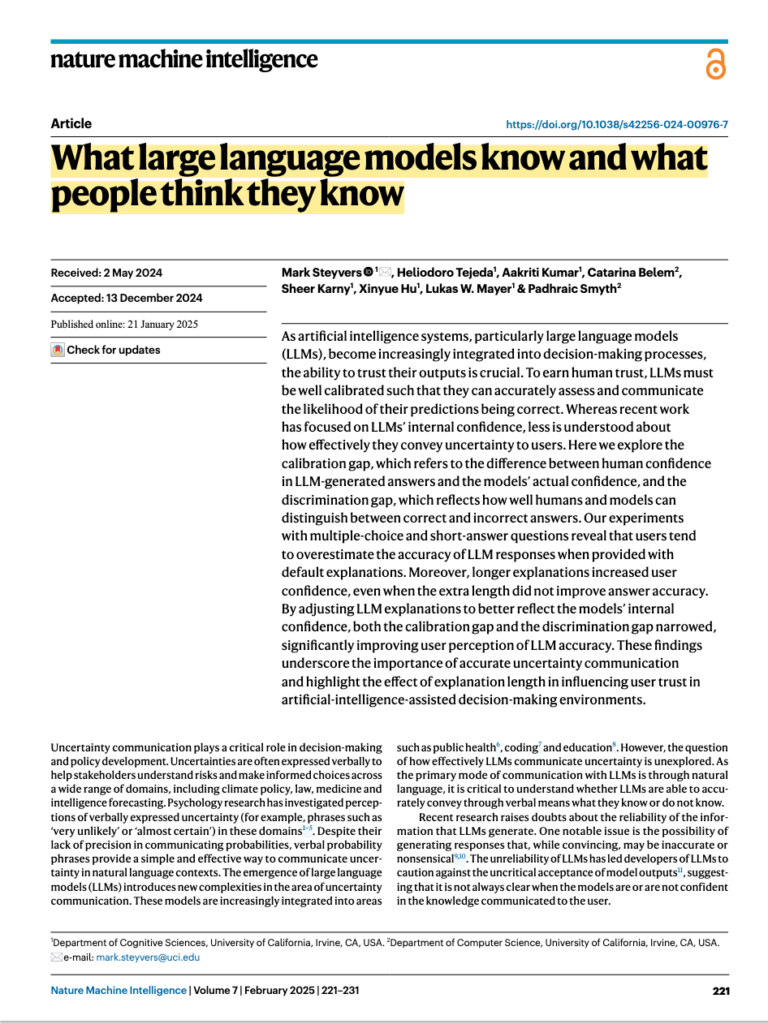
This is the problem Mark Steyvers and his colleagues examine in their study of what large language models know and what people think they know. Their findings add an important dimension to discussions of AI and cognition: the model may contain useful signals about its uncertainty, but those signals can be lost when it turns an answer into fluent prose.
Summary of the Study
The researchers studied what they call the calibration gap between a model’s internal confidence and a person’s estimate of how likely its answer is to be correct. They also examined a discrimination gap: whether people could tell which AI answers were more likely to be correct and which were more likely to be wrong.
Across six experiments, 301 adults in the United States evaluated answers and explanations produced by GPT-3.5, PaLM 2, and GPT-4o mini for multiple-choice and short-answer questions drawn from MMLU and TriviaQA.
With the models’ default explanations, participants generally overestimated answer accuracy. The models’ internal confidence was better at distinguishing likely correct answers from likely incorrect ones than people were after reading the explanations. “Internal confidence” needs careful interpretation here.
It refers to probabilities derived from the models’ token likelihoods, not to human-like self-awareness or understanding. The study therefore examines whether useful statistical information inside a model reaches the user through its language.
The experiments uncovered a clear length bias. Longer explanations increased people’s confidence, even though the added length did not help them judge which answers were correct. Participants responded more appropriately when explanations used verbal cues such as “I am not sure,” “I am somewhat sure,” or “I am sure.”
When these cues were tied to the model’s internal confidence, the gap between perceived reliability and actual accuracy became smaller. This complements earlier research I reviewed on how anthropomorphic AI cues influence trust. In both cases, features of the presentation shape trust independently of factual accuracy.
Better uncertainty communication did not improve participants’ final answers in the multiple-choice tasks. They usually followed the model and appeared to lack enough independent subject knowledge to correct it when it was wrong.
The authors also caution that their tasks involved multiple-choice questions and brief factual answers, so the results may not extend to longer, open-ended exchanges. Their intervention required one step to obtain model confidence and another to generate a matching explanation. Whether the same result can be achieved reliably in a single response remains unresolved.
Practical Insights
For teachers, this paper gives us a concrete AI literacy lesson: explanation length is not evidence quality. Students can test this directly. Give them short and long AI explanations for the same claims, remove any indication of which answers are correct, and ask them to rate their confidence in each one. After checking the claims against reliable sources, discuss which features influenced their initial judgments. Did detail, technical vocabulary, fluency, or confidence make an answer feel safer than it was?
We can also teach students to separate three questions that are easily collapsed:
- What answer did the AI provide?
- How certain does the AI sound?
- What evidence supports the answer?
The third question has to carry the most weight. A phrase such as “I am not sure” can be informative when it accurately reflects uncertainty, but it cannot replace verification. The study shows why this matters: clearer uncertainty helped participants judge the model more accurately, yet they still struggled to improve the answer without knowledge of their own.
This has implications for the design of AI-supported assignments. If students are working outside their area of expertise, asking them simply to “check the AI” may give them a responsibility they are not equipped to carry.
Verification should involve access to original sources, comparison with course materials, or review by someone with relevant knowledge. Otherwise, the student may be left judging credibility through the very surface cues this study found misleading.
For researchers and developers, explanation quality should be evaluated alongside calibration. A system can produce a persuasive rationale while concealing uncertainty.
Studies of educational AI should therefore measure whether users can distinguish accurate from inaccurate advice, whether confidence matches actual performance, and whether uncertainty cues change decisions. More information on the screen may increase trust while adding very little to judgment.
The study leaves me with a simple warning for AI use in education: when an answer becomes longer, it may feel more knowledgeable before it becomes any more reliable.
Reference
Steyvers, M., Tejeda, H., Kumar, A., Belem, C., Karny, S., Hu, X., Mayer, L. W., & Smyth, P. (2025). What large language models know and what people think they know. Nature Machine Intelligence, 7, 221–231. https://doi.org/10.1038/s42256-024-00976-7



