
What is AI literacy? The question sounds simple until we try to decide what an AI-literate person should actually know and be able to do. Is it enough to write effective prompts? Should learners understand machine learning? Do they need to recognize bias, question the data, or know when human judgment should take over?
Long and Magerko were asking these questions in 2020, before ChatGPT made AI an everyday tool for millions of people. Their paper has since become one of the foundational references in AI literacy. Reading it now is interesting because the technologies have changed quickly, while many of the competencies they identified remain relevant.
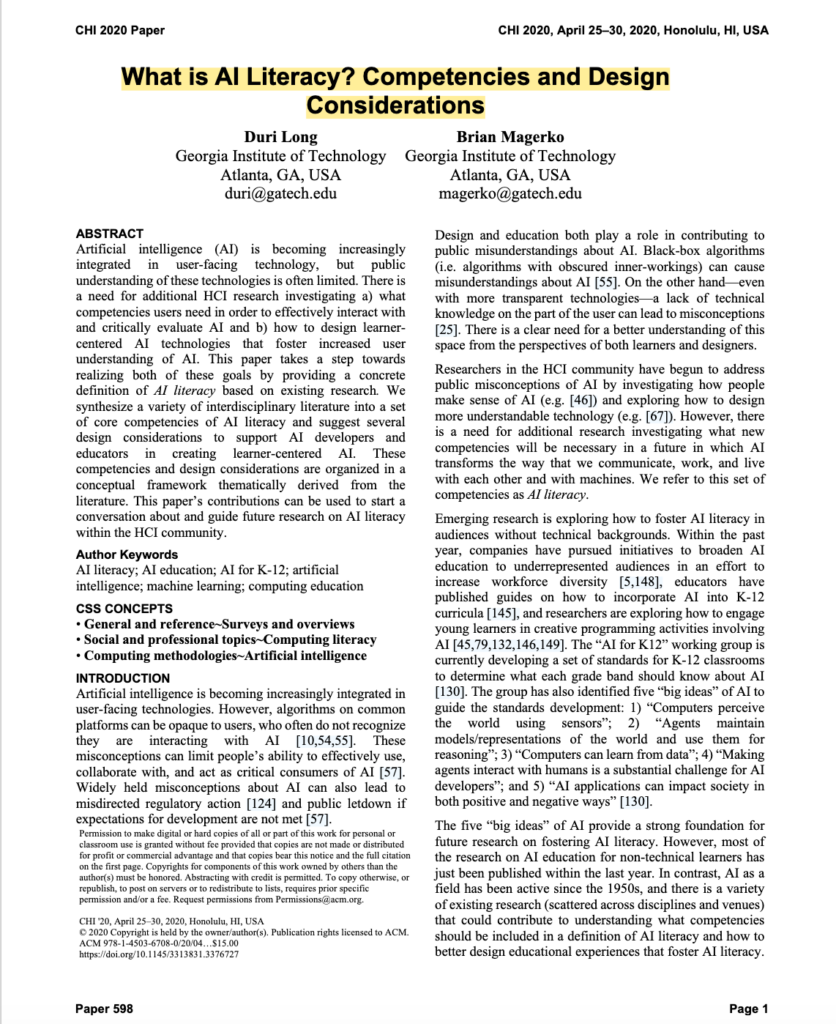
Summary of the Study
The authors define AI literacy as a set of competencies that enables people to critically evaluate AI, communicate and collaborate effectively with it, and use it in daily life and work. They reached this definition through an exploratory review of 150 documents drawn from AI education, human-computer interaction, ethics, public perceptions of AI, university syllabi, textbooks, and related forms of literacy.
This was closer to a scoping study than a systematic review: the search was iterative, the sources included grey literature, and the first author conducted the review with feedback from the second.
From this material, they developed 17 competencies organized around five questions: What is AI? What can AI do? How does AI work? How should AI be used? How do people perceive AI?
The competencies move from recognizing AI and distinguishing narrow from general intelligence to understanding representations, machine-learning processes, human involvement, data, sensors, ethics, and programmability. I appreciate the breadth here. Their account of AI literacy extends well beyond technical proficiency and includes the capacity to understand and judge AI systems.
The framework also includes 15 design considerations for AI learning experiences. These include making systems explainable and transparent, introducing complexity gradually, contextualizing datasets, using embodied and social learning, drawing on learners’ interests and identities, addressing prior beliefs shaped by popular media, and keeping barriers to entry low.
This attention to design matters. Listing competencies tells us what learners may need; the design considerations ask how people with different backgrounds might realistically develop them. The same concern with knowledge, judgment, and context continues in more recent AI literacy frameworks, even as the language and emphasis have evolved.
The paper should be read as an early conceptual map, which is how the authors present it. It does not validate the competencies through classroom trials, establish developmental progressions, or offer an assessment instrument. Its source selection was broad but not systematic, and some of the evidence came from grey literature.
The timing creates another limitation: the framework predates the widespread use of generative AI, so it does not directly address hallucinations, prompt-based interaction, synthetic media, or the forms of cognitive offloading now entering education. The authors anticipated that the framework would need to grow as technologies and social norms changed.
Practical Insights
For teachers, the 17 competencies are more useful as a curriculum-planning lens than as a checklist to cover in one unit. A lesson can begin with a familiar AI system and ask a small set of questions: Where is the AI in this tool? What data might it use? What decisions were made by people? What can the system do well? Where might it fail? Who could be affected by those failures? These questions bring technical understanding, critical judgment, and ethics into the same activity.
The authors’ design considerations can also improve how AI is introduced. Learners do not need to begin with code or mathematical detail. They can compare examples, inspect a small dataset, act out how a classification system makes decisions, test an interactive model, or write a “data biography” explaining who collected a dataset and what may be missing from it. Complexity can then be added gradually. This is especially important for learners who assume AI belongs only to people with strong backgrounds in mathematics or computer science.
Another useful classroom move is to surface students’ existing images of AI. Ask them to draw or describe what comes to mind when they hear the term, then compare those images with the AI systems already embedded in search, recommendation, translation, and other familiar tools. This can expose the tendency to equate AI with robots or human-like intelligence. It also opens a conversation about how films, news, and product marketing shape expectations.
For researchers, the paper provides a historical baseline. New competency models should make clear which elements extend Long and Magerko’s framework, which have become more urgent, and which are genuinely new in the generative AI era.
They should also test whether proposed competencies can be taught, observed, and assessed across different ages and contexts. My review of the UNESCO AI competency framework for students shows how later frameworks have moved toward developmental levels and a stronger human-centred orientation.
The paper’s strongest idea may be the one that now sounds almost obvious: people need ways to understand AI without first becoming programmers. Six years later, that need has only become harder to ignore.
Reference
Long, D., & Magerko, B. (2020). What is AI literacy? Competencies and design considerations. Proceedings of the 2020 CHI Conference on Human Factors in Computing Systems, 1–16. https://doi.org/10.1145/3313831.3376727



