Telling students to question a claim, consider another perspective, or look for evidence gives them useful guidance. Following that guidance requires knowledge of the topic and practice using it.
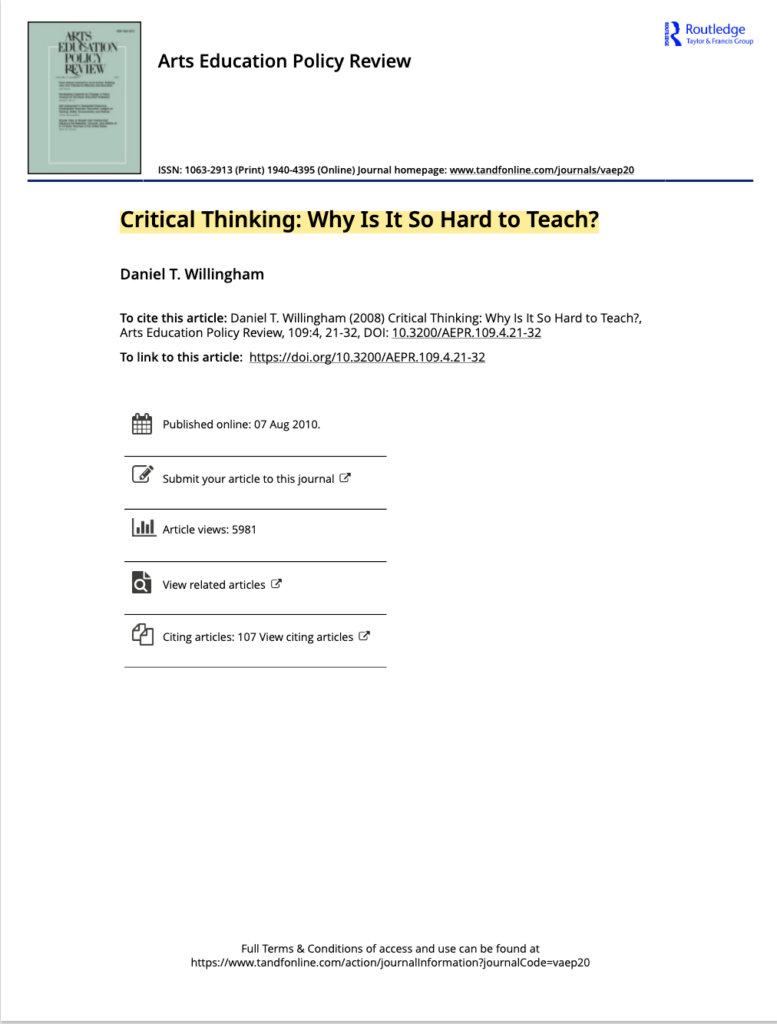
In “Critical Thinking: Why Is It So Hard to Teach?”, Daniel Willingham (2008) explains why students can reason carefully in one situation and struggle in another that calls for similar thinking.
I find this paper useful because it examines a familiar classroom frustration: students seem to understand a strategy during a lesson, yet fail to recognise when they need it elsewhere. His argument helps explain that gap and what teachers can do about it.
Why Does Critical Thinking Depend on the Topic?
Willingham’s article is a research-informed discussion drawing on cognitive psychology, including studies of problem-solving, scientific reasoning, and instructional programmes.
It reports no new classroom experiment. Its central argument is that thinking depends heavily on what a person knows about the subject. Knowing that evidence matters does not supply the knowledge needed to judge whether particular evidence is relevant, credible, or sufficient.
He distinguishes between a problem’s surface features and its underlying structure. Students may encounter two problems that require the same reasoning yet focus on their different scenarios.
Familiarity with the underlying structure, developed through repeated experience, can help them recognise the connection. General reminders can also help, although a reminder cannot supply missing subject knowledge.
Willingham also discusses research showing that children can reason successfully in some situations while trained adults struggle in others. His point is that performance depends on knowledge, context, and recognising when a reasoning strategy applies.
Because this is an older research synthesis, its conclusions should be understood in relation to the literature it discusses. It does not establish that critical thinking instruction is futile or that transfer never occurs.
How Can Teachers Make Critical Thinking Strategies Usable?
Teach the strategy within meaningful subject content. Asking students to examine a historical source involves knowing who produced it, when, for whom, and under what circumstances. Willingham explains that identifying a document’s author does little to support interpretation if students lack the historical knowledge that makes the information meaningful.
For me, this raises a useful planning question: what must students know to make the judgement I am asking of them? A task may appear to assess reasoning while also making substantial demands on background knowledge. Teachers need to consider both when interpreting students’ difficulties.
Make the reasoning explicit. Willingham recommends naming strategies and explaining how they apply. Students benefit from seeing what it means to consider an alternative explanation or examine a source in the material they are studying. These expectations need modelling and guided practice.
Use different examples that share a reasoning demand. Changing a problem’s setting can make a familiar strategy difficult to recognise. Willingham recommends introducing strategies through multiple examples and returning to them within course content. Teachers can initially name the relevant strategy, then give students opportunities to recognise its relevance with less prompting.
This is where I would distinguish successful prompted performance from independent use. Both matter, but a student who can apply a strategy after a reminder is demonstrating something different from a student who recognises the need for it without assistance.
What Does This Mean for Classroom Practice?
One of the paper’s most useful cautions concerns students who struggle academically. Willingham rejects the idea that critical thinking should be reserved for advanced learners while others concentrate exclusively on basic material. Students’ everyday knowledge can provide an entry point into demanding reasoning.
His example involves asking children whether a letter criticising the removal of recess would be interpreted differently depending on whether a principal or a child wrote it. The situation gives students familiar material through which to consider authorship and perspective. The teacher can then connect that reasoning to less familiar subject content.
Practice also needs sufficient depth. Briefly encountering many different thinking activities may give students little opportunity to become familiar with any particular reasoning demand. Teacher feedback matters because students need help examining how they used evidence, where their reasoning became uncertain, and what they should reconsider.
This paper complements my earlier review of research on teaching critical thinking. Here, the focus is the difficulty of recognising and applying a strategy across situations. For readers exploring teaching and pedagogy, it offers a practical reason to examine the knowledge, examples, prompts, and feedback built into a lesson.
References
Willingham, D. T. (2008). Critical thinking: Why is it so hard to teach? Arts Education Policy Review, 109(4), 21–32. https://doi.org/10.3200/AEPR.109.4.21-32